Prepare a Plain Baked Cheesecake in Small Ramekins
Individual baked cheesecakes set in small ceramic ramekins offer a tidy, portion-controlled alternative to a full springform cake. Because each ramekin holds its own filling, there is no need for gelatin to hold a shape after slicing. The batter is poured directly into lightly greased ramekins, baked in a water bath, and chilled before serving. This article outlines one illustrative home-cafe plan using halal-compatible dairy, alcohol-free vanilla flavoring, and standard baking steps. It is a planning guide, not a kitchen-tested result, so treat temperatures and timings as starting points to adjust according to your own oven and ramekin size.
Read the note ↓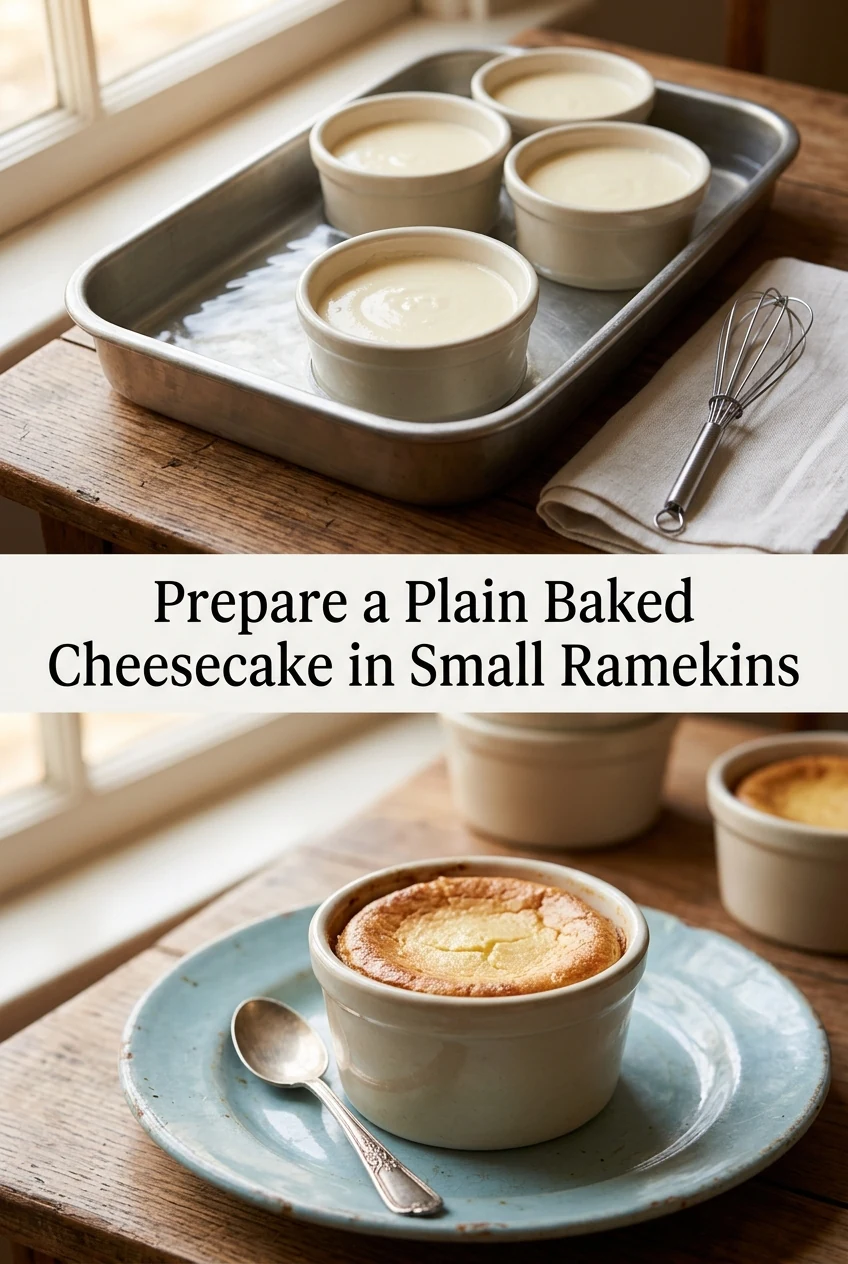
AI-generated editorial concept created for this article. The image is not a technical diagram or a tested result.
Equipment and Ramekin Sizing
Gather six ceramic ramekins that each hold approximately 150 millilitres. A deep roasting pan large enough to hold all six ramekins side by side without touching serves as the water bath vessel. You will also need a hand mixer or stand mixer, a fine sieve, a digital kitchen scale, and a kettle for hot water. Measure each ramekin's internal diameter before you begin, because a shallower or wider ramekin will change the baking time noticeably. Lightly grease the inside of every ramekin with a neutral oil or softened butter, then press a small circle of baking paper onto the base of each one to help with release.
Ingredients for Six Ramekins
For this illustrative plan, the quantities below are intended for six 150-millilitre ramekins. Use 450 grams of full-fat cream cheese at room temperature, 120 grams of caster sugar, 3 medium eggs also at room temperature, 120 millilitres of full-fat sour cream, 1 teaspoon of alcohol-free vanilla flavoring, and a small pinch of fine salt. All dairy should carry halal-compatible labeling appropriate to your region. Bring the cream cheese and eggs to room temperature before mixing, as cold ingredients can create lumps that are difficult to smooth out. Sift the sugar if it has clumped. These quantities are a planning estimate; actual yield may vary with ingredient brand and ramekin depth.
Mixing and Filling
Beat the cream cheese on a low speed until it is smooth and free of lumps, scraping the bowl sides regularly. Add the caster sugar and continue beating on low until fully combined. Add the eggs one at a time, mixing briefly after each addition and keeping the speed low to avoid incorporating excess air, which can cause the surface to crack during baking. Fold in the sour cream, alcohol-free vanilla flavoring, and salt with a spatula until the batter is uniform. Pass the finished batter through a fine sieve into a jug for easier pouring. Divide the batter evenly among the six prepared ramekins, filling each to roughly five millimetres below the rim to allow for slight expansion.
Water Bath Baking
Place the filled ramekins in the roasting pan. Boil a kettle and carefully pour hot water into the roasting pan until it reaches halfway up the outside of the ramekins. Transfer the pan to an oven preheated according to your oven's own calibration, using a moderate setting typically in the range of 155 to 165 degrees Celsius as a starting reference, though your specific oven may require adjustment. Bake until the edges appear set and the centres still carry a gentle wobble when the pan is nudged. As a rough planning guide for 150-millilitre ramekins this may take between 28 and 38 minutes, but check your own oven early. Remove the ramekins from the water bath using tongs or a folded cloth, and allow them to cool on a wire rack at room temperature for around one hour before moving them.
Chilling and Serving
Once the ramekins have cooled to near room temperature, cover each one loosely with cling film and refrigerate promptly. Chilling for a minimum of four hours allows the texture to firm and the flavour to settle, though overnight chilling is often preferred for a cleaner set. Because this is a dairy-based perishable dessert, keep the ramekins refrigerated until the moment of serving and do not leave them at room temperature for extended periods. Serve directly in the ramekin or run a thin knife around the edge and invert onto a small plate. A spoonful of fresh fruit compote or a dusting of matcha powder makes a simple topping that complements the plain filling without overpowering it.
A little more
to know.
Can I use low-fat cream cheese instead of full-fat?
Low-fat cream cheese contains more water and less fat than full-fat varieties, which affects how the batter sets during baking. The texture of the finished cheesecake is likely to be softer and may not hold its shape as cleanly when turned out. If you prefer to use a reduced-fat product, plan to serve directly in the ramekin rather than attempting to unmould it, and be aware that baking time may differ from the full-fat version.
What should I do if the surface cracks during baking?
Surface cracking is common in baked cheesecakes and is usually linked to overmixing, oven temperature running higher than expected, or the water bath running dry before baking is complete. Check that the water level in the roasting pan remains at the halfway mark during baking and top it up with hot water if needed. Cracks do not affect the flavour and can be covered easily with a fruit topping or a light dusting of matcha before serving.
Original editorial guidance and recipe formulations, not independently kitchen-tested. Times are estimates and depend on equipment and product directions. Cooked bases need additional cooling and refrigeration before cold serving. Images are AI-generated illustrations; appearance and yield may vary. Check actual ingredient labels, allergens, and any certification you require. We do not certify products. Read our approach.
Save to Pinterest ↗ANOTHER IDEA FOR THE COUNTER