Matcha and Pineapple Iced Cup With Two Separate Pours
Pineapple juice carries enough natural acidity to cause matcha powder to clump and shift toward a dull, brownish-green when the two meet carelessly. A simple two-pour approach sidesteps that problem by settling cold strained pineapple juice over ice first, then adding a separately whisked matcha concentrate as a second layer. The result is a visually distinct layered cup where each component stays true to its own colour until the drinker stirs. This article walks through every step of that process as an illustrative plan rather than a claim of tested or guaranteed outcomes.
Read the note ↓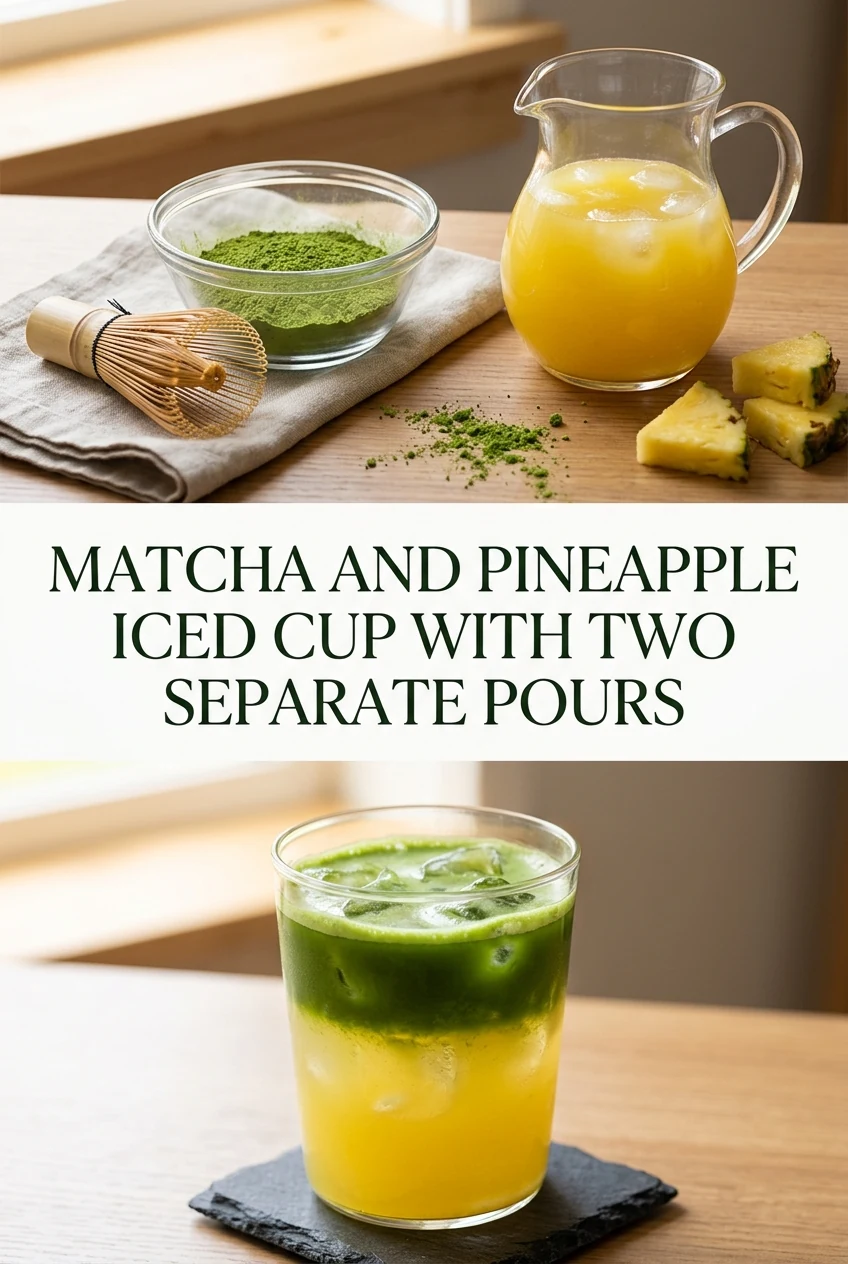
AI-generated editorial concept created for this article. The image is not a technical diagram or a tested result.
Why Acidity and Matcha Powder Conflict
Matcha powder consists of very fine particles that rely on an even suspension in liquid to stay smooth and bright green. When those particles meet an acidic liquid such as pineapple juice before they are fully dispersed, the acid can cause them to aggregate into small clumps that settle unevenly and take on a muted colour. Preparing the matcha separately in plain cold water first creates a stable concentrate where the particles are already distributed. Pouring that concentrate gently over the juice layer, rather than mixing them at the powder stage, reduces the chance of direct contact between dry matcha and undiluted acid.
Choosing and Straining the Pineapple Juice
Use a pineapple juice that lists only pineapple as its ingredient, with no added sweeteners or artificial flavours, so the flavour is clean and the acidity is predictable. Fresh-pressed juice benefits from straining through a fine-mesh sieve into a jug to remove any pulp that could cloud the lower layer. Bottled juice can be used directly but may also benefit from a quick strain if it contains visible sediment. For one serving, measure approximately 120 millilitres of strained juice. Chill the juice in the refrigerator before building the cup so it is already cold when it meets the ice, which helps the layers settle more distinctly.
Sieving and Whisking the Matcha Concentrate
Place a small fine-mesh sieve over a bowl and spoon one level teaspoon of matcha powder through it, pressing lightly with the back of the spoon to break up any pre-existing clumps. Sieving is a straightforward step that removes the small lumps that would otherwise persist even after whisking. Add approximately 60 millilitres of cold water to the bowl. Using a small balloon whisk or a traditional bamboo chasen, whisk in a brisk zigzag motion until no visible powder remains and the concentrate looks uniformly green. Cold water takes a little more effort than warm water, so allow an extra minute of whisking. The finished concentrate should be fluid and free of floating specks.
Building the Two-Layer Cup
Fill a tall clear glass with ice cubes, using enough to reach roughly three-quarters of the way up. Pour the 120 millilitres of chilled strained pineapple juice directly over the ice and allow it to settle for a few seconds. Next, hold a spoon face-down just above the surface of the juice and pour the 60 millilitres of matcha concentrate slowly over the back of the spoon. The spoon disperses the flow so the concentrate lands gently rather than plunging through the juice layer. In this illustrative plan, the matcha layer should sit visibly above the pineapple juice, giving the cup two distinct bands of colour. Total liquid volume in this example is 180 millilitres before accounting for ice melt, which fits comfortably in a 350-millilitre glass.
Serving and Adjusting the Cup
Serve the cup immediately while the layers are still separate, alongside a wide straw or a long spoon so the drinker can stir the two layers together at the table. Once stirred, the drink becomes a single blended flavour rather than a layered visual. If the matcha layer sinks or prematurely mixes, the pour was likely too forceful rather than too thin; pouring more slowly across the ice cubes or over the back of a spoon preserves the separation above the denser juice layer. If the pineapple juice flavour is too sharp, a small amount of plain sugar syrup stirred into the juice before pouring can soften the edge without introducing any flavouring agents. Adjust quantities to personal preference, keeping in mind that these are starting points rather than fixed formulas.
A little more
to know.
Can I use a milk frother instead of a whisk to mix the matcha concentrate?
A handheld milk frother can disperse matcha powder in cold water, though results vary by frother model and powder grade. Run it for at least 30 seconds and check for any unincorporated powder at the bottom of the bowl before pouring. Sieving the powder first still applies regardless of which mixing tool you use.
Will the layers stay separate for long once the cup is built?
The layers will gradually begin to blend on their own as the ice melts and the liquids shift in density. Serving immediately after building the cup gives the clearest visual separation. This is an illustrative observation about the general behaviour of layered drinks rather than a timed or tested guarantee.
Original editorial guidance and recipe formulations, not independently kitchen-tested. Times are estimates and depend on equipment and product directions. Cooked bases need additional cooling and refrigeration before cold serving. Images are AI-generated illustrations; appearance and yield may vary. Check actual ingredient labels, allergens, and any certification you require. We do not certify products. Read our approach.
Save to Pinterest ↗ANOTHER IDEA FOR THE COUNTER