Weigh Milk for a Single Warm Café Cup Before Heating It
Pouring milk by eye into a saucepan almost always produces a different result each time. A 240 ml cup needs roughly 180 to 200 grams of cold whole milk to leave room for your coffee or tea concentrate and any foam that forms during heating. Placing the saucepan on a kitchen scale before you pour takes about three extra seconds and removes the guesswork entirely, giving you a consistent starting point every single morning without memorising volume markings on different pans.
Read the note ↓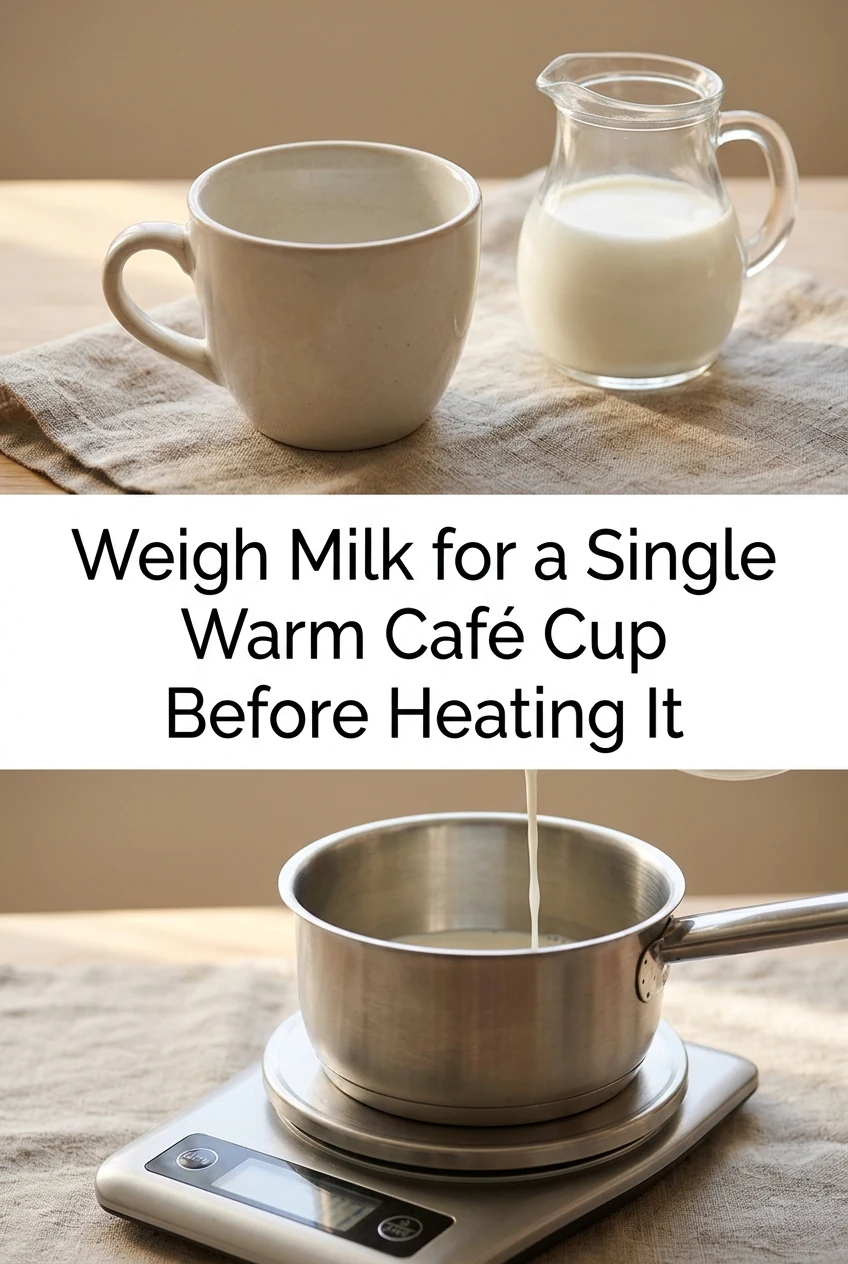
AI-generated editorial concept created for this article. The image is not a technical diagram or a tested result.
Set the Scale Before Anything Touches the Pan
Place your small saucepan on the scale and press tare so the display reads zero. This step must happen before the milk goes in, not after. If you tare with milk already poured, you lose the reference point for that portion. A lightweight 14 cm saucepan works well for single servings because the base sits flat on most household scales without tipping. Confirm the scale is on a level surface before you begin.
Choose a Target Weight That Matches Your Cup Size
For a standard 240 ml mug with a double shot of espresso or 60 grams of brewed concentrate already in it, aim for 160 to 180 grams of cold milk. For a larger 350 ml mug used without a concentrate, 250 to 270 grams gives a full cup with a small buffer for evaporation during heating. Write your chosen target on a sticky note near the stove until the number becomes automatic. These are illustrative starting points, not universal targets.
Pour Slowly and Stop Before the Target
Milk pours faster than most people expect. Stop pouring when the scale reads about 10 grams below your target, then tilt the carton gently to let the last stream settle. The display often catches up a second after the pour stops, so pausing early prevents overshooting. Once you hit your target weight, remove the carton and set the saucepan directly on the burner. There is no need to re-tare at this stage.
Heat Gently and Watch for the First Wisps of Steam
Use low to medium-low heat and stir occasionally with a small silicone spatula. Milk for a warm café drink is ready when small wisps of steam rise steadily and the surface just begins to shimmer, typically around 65 to 70 degrees Celsius if you use a thermometer. Avoid a rolling boil, which changes the texture and can cause the milk to overflow the pan. Remove from heat promptly and pour into your waiting cup.
Record What Worked and Adjust the Next Day
After drinking the finished cup, note whether it felt too milky, too strong, or balanced. If it was too milky, reduce your target by 15 grams tomorrow. If the drink tasted thin, increase by 15 grams. Two or three days of small adjustments usually lands you on a personal target that stays consistent. Keeping a brief note on your phone or a paper pad near the scale makes this iteration fast and removes the need to rely on memory.
A little more
to know.
Does the type of milk affect how much I should weigh out?
Yes. Oat and soy drinks are often thinner in body than whole dairy milk, so some people prefer to reduce the portion by 10 to 20 grams to avoid a watery result. Adjust based on your own taste after the first attempt.
Can I weigh directly into a heatproof jug instead of a saucepan?
You can, but transfer the milk to a saucepan before heating on the stove. Most heatproof jugs are not rated for direct burner use. A microwave-safe jug can be used in the microwave according to the jug manufacturer's instructions.
Original editorial guidance and recipe formulations, not independently kitchen-tested. Times are estimates and depend on equipment and product directions. Cooked bases need additional cooling and refrigeration before cold serving. Images are AI-generated illustrations; appearance and yield may vary. Check actual ingredient labels, allergens, and any certification you require. We do not certify products. Read our approach.
Save to Pinterest ↗ANOTHER IDEA FOR THE COUNTER