Track Sparkling Water Portions with a Closed-Bottle Weight Note
Keeping rough track of how much sparkling water remains in a large bottle is straightforward when you use a kitchen scale and a simple closed-bottle weight note. By recording the capped bottle's mass before and after each pour, you build an approximate running log without opening the bottle unnecessarily or guessing by sight. This approach suits anyone managing a shared fridge bottle or planning how many servings a new bottle might cover across a day.
Read the note ↓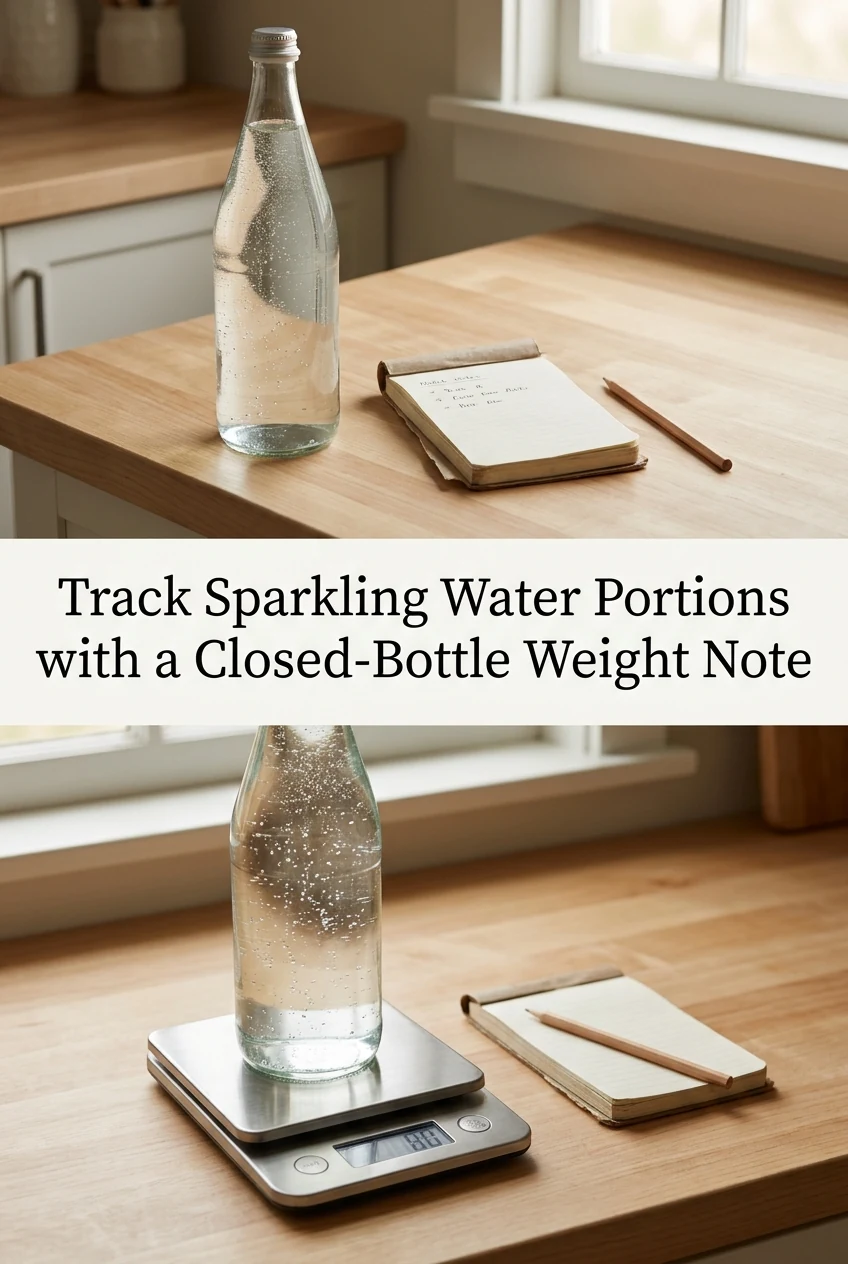
AI-generated editorial concept created for this article. The image is not a technical diagram or a tested result.
What You Need Before You Start
Gather a kitchen scale whose maximum rated capacity comfortably exceeds the full gross weight of your bottle. A standard 1.5-litre sparkling water bottle filled and capped typically sits around 1.55 kg including packaging, so a scale rated to at least 3 kg with a resolution of 1 gram works well for this purpose. You also need a small notebook or a notes app, a dry cloth to wipe the bottle exterior before placing it on the platform, and the bottle itself with its cap firmly closed. Check that your scale sits on a flat, stable surface and that it reads zero before you begin.
Recording the Starting Closed-Bottle Mass
Dry the outside of the capped bottle thoroughly so no surface moisture adds false weight. Place the closed bottle on the scale platform and allow the reading to settle. Write down this figure as your starting mass alongside the date and time. This is your reference point. The label on the bottle states the manufacturer's net volume, which is the declared liquid content. Keep that figure in mind as context, but your weight log tracks approximate remaining content by mass difference, not by converting mass to an exact liquid volume. Those two things are related but not identical, and this method makes no claim to precision beyond a rough guide.
Pouring a Serving and Recapping
When you want a serving, open the cap, pour directly into your serving glass, then recap the bottle firmly before returning it to the scale. Do not decant the whole bottle into a jug or secondary container first. Once you have recapped the bottle, place it back on the scale, let the reading settle, and note the new closed-bottle mass. The difference between your previous note and this new reading gives you an approximate mass of liquid poured. Because some dissolved gas escapes each time the bottle is opened, the mass difference will reflect both liquid poured and any gas released, so treat every figure as an approximation rather than an exact measurement.
A Worked Example to Illustrate the Method
Suppose you start with a capped 1.5-litre bottle that reads 1,562 g on your scale. You note this as your starting mass. You open the bottle and pour what looks like roughly 250 ml into a glass, then recap firmly. Back on the scale, the bottle reads 1,308 g. The difference is 254 g, which you record as the approximate mass removed in that pour. Later in the day you pour again; the bottle now reads 1,058 g after recapping, a further difference of 250 g. Your notebook shows two pours totalling roughly 504 g removed from an original starting mass of 1,562 g, leaving approximately 1,058 g in the bottle. This is an illustrative plan showing how the arithmetic works, not a tested or guaranteed result. Actual figures will vary with your specific bottle, scale, and conditions.
Keeping the Log Useful Over Multiple Sessions
Each time you use the bottle, record the closed-bottle mass immediately after recapping. Use the label's stated net volume as a sanity check on your overall log rather than as a calculation input. If your running total of removed mass approaches the label's stated net volume, the bottle is likely nearly empty. Avoid leaving the log entry until later, since forgetting to note a pour breaks the running record. A simple table with columns for date, time, closed-bottle mass, and approximate mass removed per pour keeps the information clear and easy to review at a glance.
A little more
to know.
Can I use this method with any size of sparkling water bottle?
You can use the same approach with different bottle sizes as long as your scale's rated maximum capacity is greater than the full gross weight of the capped bottle you are weighing. Check the scale's specification label for its maximum load before placing a heavy bottle on the platform. A scale used beyond its rated capacity may give unreliable readings or be damaged.
Does recapping the bottle keep the remaining water fizzy?
This method makes no promise about fizz retention. How well carbonation is preserved after opening depends on the bottle design, how firmly the cap is replaced, how much headspace remains, and how the bottle is stored. The weight log tracks approximate remaining mass only. For guidance on storing an open sparkling water bottle, follow any recommendations printed on the label or provided by the manufacturer.
Original editorial guidance and recipe formulations, not independently kitchen-tested. Times are estimates and depend on equipment and product directions. Cooked bases need additional cooling and refrigeration before cold serving. Images are AI-generated illustrations; appearance and yield may vary. Check actual ingredient labels, allergens, and any certification you require. We do not certify products. Read our approach.
Save to Pinterest ↗ANOTHER IDEA FOR THE COUNTER