Spoon Loose Leaf Tea Into a Warmed Pot Without Losing Leaves Over the Rim
Spooning loose leaf tea into a teapot with a narrow opening scatters leaves across the lid, the counter, and occasionally into the spout rather than the chamber. The problem is worse with lightweight leaves like silver needle or large rolled oolongs that catch air and deflect off the rim. A simple guide placed at the opening redirects every spoonful cleanly inside the pot. This takes one extra second to set up and eliminates the cleanup step that follows a scattered pour.
Read the note ↓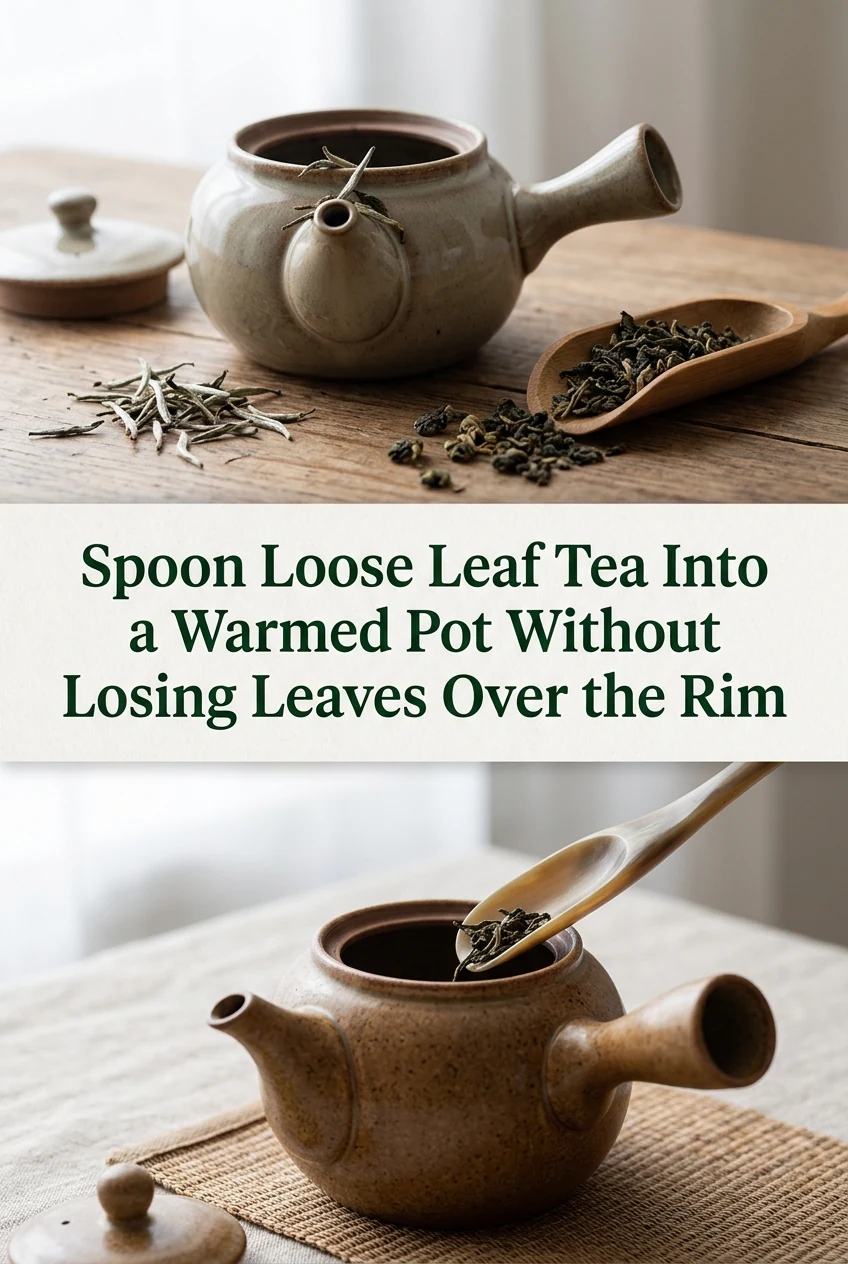
AI-generated editorial concept created for this article. The image is not a technical diagram or a tested result.
Why Narrow Pot Openings Cause the Scattering Problem
A standard ceramic teapot opening is often 4 to 6 cm in diameter, which is narrower than the arc of a heaped teaspoon. When you tip the spoon over that opening, leaves on the outer edge of the heap miss the hole entirely. Lightweight whole leaves are especially prone to catching a slight air current and drifting sideways. The problem compounds when the pot has been warmed with hot water, because the rising steam creates a small upward draft that deflects dry leaves before they fall.
Using a Small Funnel as a Permanent Solution
A small kitchen funnel with an opening of 3 to 4 cm at the narrow end fits inside most standard teapot openings and rests there without being held. Spoon the measured leaf portion into the wide end of the funnel and the leaves fall through into the pot chamber. After use, tap the funnel over the pot to dislodge any leaves caught in the neck, then rinse it. A metal funnel is easier to rinse clean than plastic when working with teas that stain, such as Assam or pu-erh.
Making a Folded Card Guide When No Funnel Is Available
Take a small piece of card stock or a folded index card and bend it into a shallow cone shape, leaving an opening at the narrow end of about 2 cm. Rest this cone in the pot opening so the narrow end points down into the chamber. Spoon the tea into the wide end of the card cone. This is an illustrative example of a workable improvised guide, not a tested precision tool; the card may shift if the pot opening is not level, so hold it lightly with one finger while spooning.
Measuring the Leaf Portion Before Approaching the Pot
Measure your leaf portion into a small bowl or onto a flat spoon before you move toward the pot. A common starting point for many loose leaf teas is 2 to 3 g per 200 ml of water, though the appropriate amount varies by tea type and personal preference. Having the portion already measured means you make one deliberate transfer into the funnel rather than multiple dips from a tin held over the pot. Each additional dip increases the chance of a stray leaf catching the rim.
Warming the Pot First and Timing the Leaf Addition
Warming a ceramic pot with hot water before brewing is a common practice that reduces the temperature drop when brewing water is added. Empty the warming water completely and allow the steam to settle for about 10 seconds before adding dry leaves. Adding leaves while steam is still rising from the interior accelerates the drift problem described earlier. Once the visible steam clears, place your funnel or card guide and spoon in the leaves. The pot interior will still be warm enough to benefit the brew.
A little more
to know.
Does the funnel method work for very fine teas like matcha or finely broken CTC grades?
A funnel works for CTC grades but the fine particles can clog a narrow funnel neck. Tap the funnel base gently to keep the flow moving. Matcha is typically whisked in a bowl rather than brewed in a pot, so the funnel method does not apply to that preparation.
What should I do if leaves have already fallen into the spout opening?
Rinse the spout by pouring a small amount of hot water through the pot with the lid on, directing the flow out through the spout into the sink. This dislodges loose leaves before they dry and partially block the spout during the next brew.
Original editorial guidance and recipe formulations, not independently kitchen-tested. Times are estimates and depend on equipment and product directions. Cooked bases need additional cooling and refrigeration before cold serving. Images are AI-generated illustrations; appearance and yield may vary. Check actual ingredient labels, allergens, and any certification you require. We do not certify products. Read our approach.
Save to Pinterest ↗ANOTHER IDEA FOR THE COUNTER