Sparkling Lychee and Basil Cooler With a Measured Base
Canned lychee syrup varies noticeably from brand to brand and even between cans of the same brand. One can may taste intensely floral while another reads flat and sugary. Fresh lychees add their own inconsistency, since ripeness and variety shift sweetness and acidity. Building a sparkling lychee drink without accounting for that variability often produces something either cloying or thin. This article walks through straining canned lychee syrup, muddling fresh basil briefly, measuring both components, and adding chilled sparkling water in the correct pouring order so carbonation is preserved. The steps below describe an illustrative plan rather than a claim of tested or guaranteed results.
Read the note ↓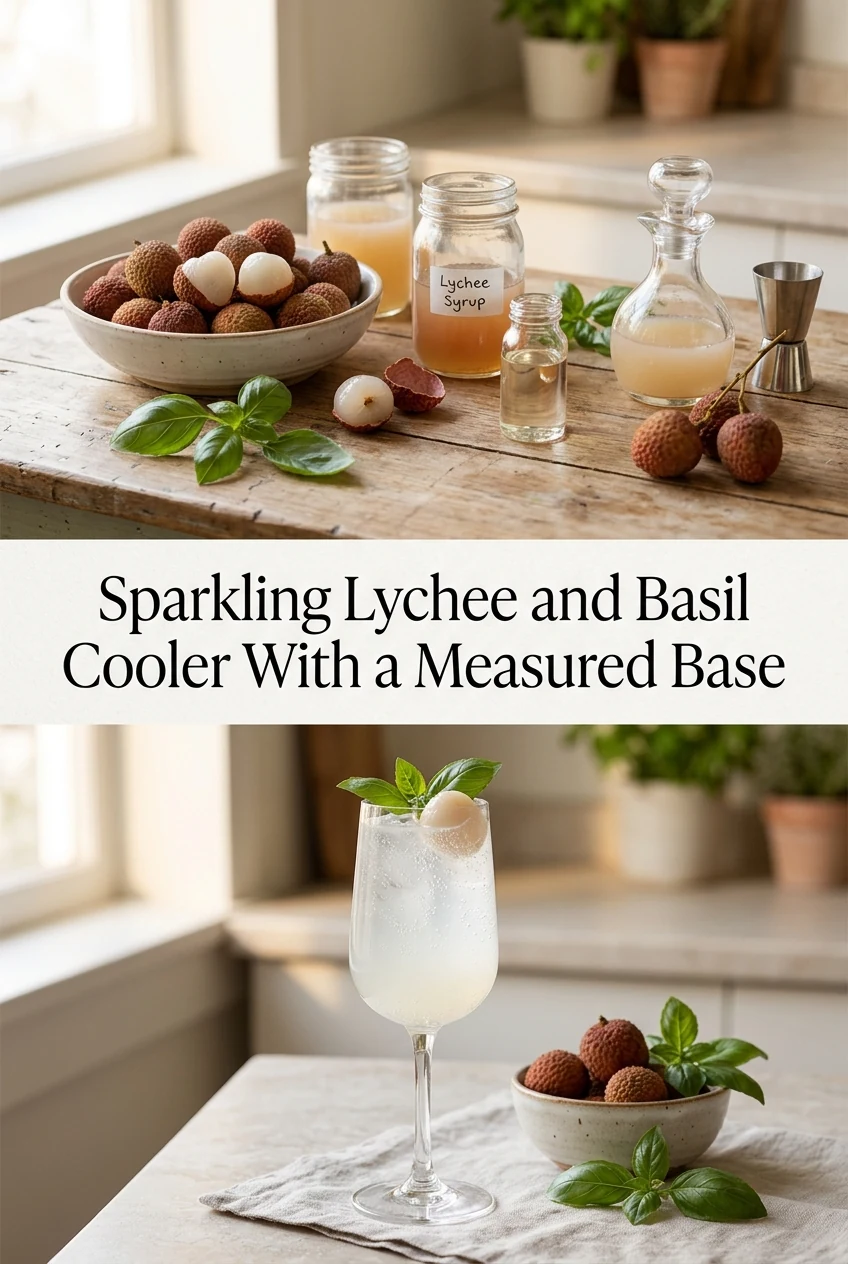
AI-generated editorial concept created for this article. The image is not a technical diagram or a tested result.
Understanding Lychee Syrup Density Before You Measure
Open a standard 565-gram can of lychee in syrup and you will find the syrup ranges from moderately thin to noticeably viscous depending on the producer. Before measuring, pour the entire contents through a fine-mesh strainer set over a bowl. Let it drain for two full minutes without pressing the fruit. This passive drain separates free-running syrup from the pulp clinging to each lychee. The drained syrup is your base liquid. Reserve the fruit for another use or drop one or two pieces into the finished glass as a garnish. Tasting a small spoonful of the strained syrup at this stage tells you whether it reads very sweet or only mildly so, which informs how much you will use. A working starting point for one tall glass is 45 millilitres of strained syrup, but that figure is a starting suggestion, not a fixed rule.
Muddling Basil Without Releasing Bitterness
Fresh basil bruises quickly and releases bitter compounds if it is worked too hard. For one glass, pick four medium leaves, rinse them under cold water, and pat them dry. Place the leaves in the bottom of a sturdy mixing glass or the serving glass itself. Press down firmly with a muddler or the back of a spoon twice, turning the leaves a quarter turn between presses. You are aiming to bruise the leaf surface and release the aromatic oils rather than shred the leaves into fragments. Stop as soon as you can smell the herbal note rising. Over-muddling for more than four or five firm presses tends to push the drink toward a grassy bitterness that competes with the lychee rather than complementing it.
Building the Measured Base in the Glass
With the basil already muddled in the serving glass, add ice first. A 500-millilitre tall glass filled about halfway with ice cubes keeps the drink cold without causing the liquid to overflow once the water is added. Pour your 45 millilitres of strained lychee syrup directly over the ice. If your syrup tasted very sweet during the tasting step, consider reducing to 35 millilitres. If it tasted mild, 50 millilitres is a reasonable upper bound. Add 15 millilitres of fresh lime juice at this stage. The lime juice is not decorative; it provides acidity that balances the residual sugar in the syrup and brightens the basil note. Stir the syrup and lime juice together with a long spoon for about ten seconds so they combine before the sparkling water arrives.
Adding Sparkling Water in the Correct Pouring Order
Pouring order matters for carbonation. If you stir aggressively after adding sparkling water, you release much of the dissolved carbon dioxide before the drink reaches the person drinking it. Pour approximately 250 millilitres of chilled sparkling water slowly down the inside wall of the tilted glass rather than directly onto the ice. This angled pour reduces the surface disturbance. Once the water is in, use the long spoon to lift the syrup mixture from the bottom with one or two gentle passes rather than a circular stir. The goal is to fold the denser base upward into the sparkling water without churning. The finished glass should sit at roughly 310 to 315 millilitres of total liquid, leaving a small gap at the top to prevent overflow when the garnish is added.
Adjusting the Ratio for a Second Glass or a Small Batch
Scaling this drink for two glasses means doubling each measured component: 90 millilitres of strained lychee syrup, 30 millilitres of lime juice, and 500 millilitres of sparkling water across both glasses. Mix the syrup and lime juice together in a small pitcher before pouring, since pre-combining them means each glass receives a consistent ratio. Do not add the sparkling water to the pitcher. Pour the syrup and lime mixture over ice in each individual glass, then add sparkling water to each glass separately using the same angled wall pour. Preparing more than two glasses in advance is not practical with this method because the sparkling water will lose carbonation as it sits. Treat each glass as an individual pour for the best result.
A little more
to know.
Can I use fresh lychees instead of canned syrup?
Yes, but fresh lychees require a different approach. Peel and pit roughly eight to ten fresh lychees, then blend or press them through a fine-mesh strainer to extract juice. Fresh lychee juice contains no added sugar, so you may need to stir in a small amount of plain sugar syrup to reach a sweetness level that works with the lime juice. Taste as you go and adjust in small increments. The quantity of fresh juice you extract will vary with ripeness, so treat any starting measurement as a rough guide rather than a fixed amount.
What sparkling water works best for this drink?
A plain, unflavoured sparkling water with moderate carbonation is the most straightforward choice because it does not introduce competing flavours. Heavily flavoured sparkling waters, such as those with citrus or berry additions, can clash with the basil or make the lychee note harder to taste clearly. Check that the sparkling water you choose contains no added sweeteners, since the lychee syrup already provides sugar and a sweetened sparkling water may push the finished drink past a comfortable balance.
Original editorial guidance and recipe formulations, not independently kitchen-tested. Times are estimates and depend on equipment and product directions. Cooked bases need additional cooling and refrigeration before cold serving. Images are AI-generated illustrations; appearance and yield may vary. Check actual ingredient labels, allergens, and any certification you require. We do not certify products. Read our approach.
Save to Pinterest ↗ANOTHER IDEA FOR THE COUNTER