Scoop Cocoa Into a Small Bowl First Instead of Directly Into a Warm Milk Jug
Adding dry cocoa powder directly to warm milk creates an immediate problem: the powder hits the liquid surface and forms dry clumps that resist mixing even with vigorous stirring. Pre-measuring cocoa into a small bowl and working it into a paste with a small amount of liquid before combining it with the rest of the milk is a straightforward technique that helps produce a smooth, evenly blended drink.
Read the note ↓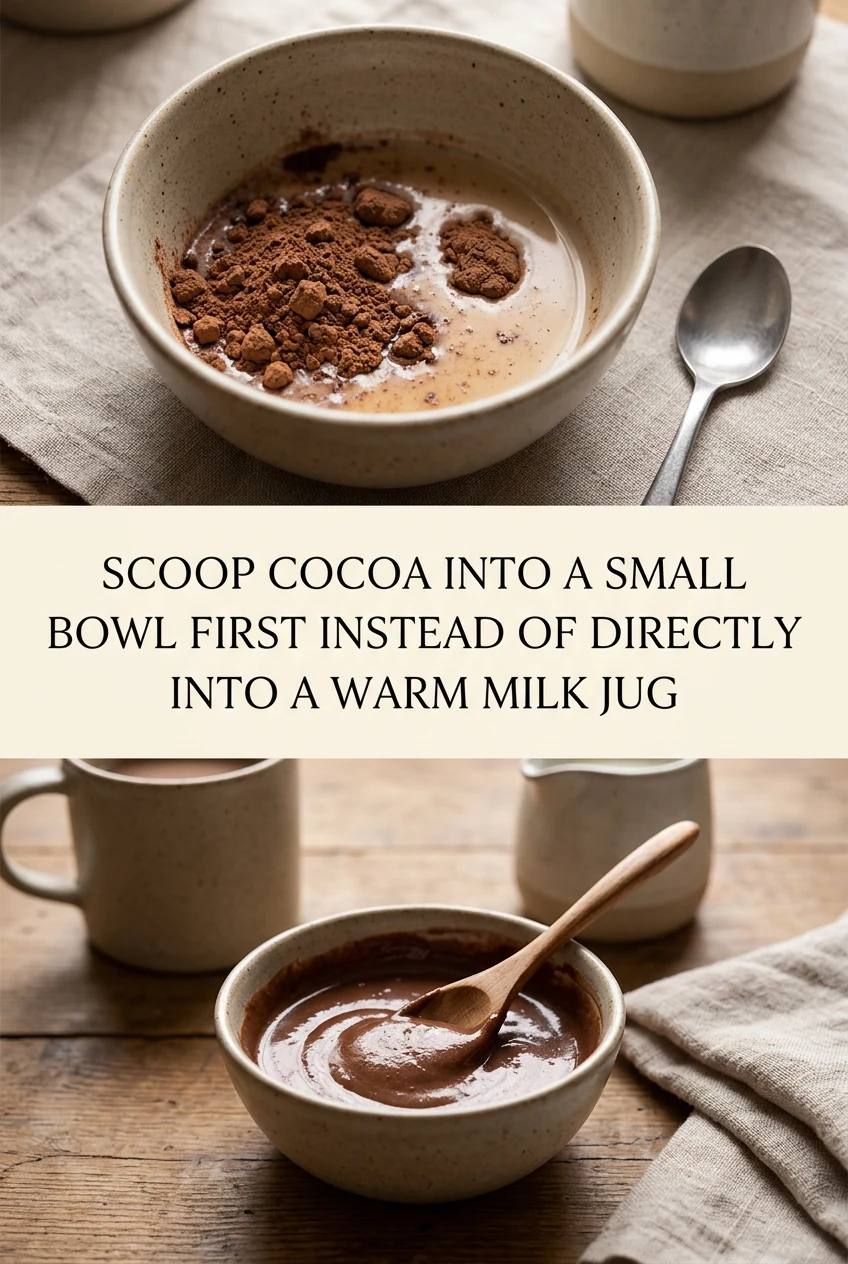
AI-generated editorial concept created for this article. The image is not a technical diagram or a tested result.
Why Cocoa Powder Resists Direct Mixing
Cocoa powder is hydrophobic, meaning its fat-coated particles repel water initially. When you drop cocoa into warm milk, the particles clump together and trap air, forming a layer that floats rather than disperses. Stirring from below pushes the clumps around without breaking them. Making a paste first wets every particle individually before the bulk of the milk is added, eliminating the floating layer before it can form.
Set Up Your Small Bowl and Measure Accurately
Use a small bowl with a flat base, roughly 150 to 200 ml capacity. Measure your cocoa with a proper measuring spoon rather than a kitchen spoon, which varies widely. A common starting point is one to two level teaspoons of unsweetened cocoa per 200 ml of milk, though your preferred intensity will differ. Add your sugar or sweetener to the bowl at the same stage so the sugar dissolves and the granules help break up cocoa clusters as you stir.
Build the Paste With a Small Amount of Liquid
Add one to two tablespoons of your warm milk to the bowl. Use the back of a spoon to press and stir the cocoa and sugar together against the bowl base until you have a smooth, glossy paste with no visible dry powder. This takes about 20 to 30 seconds of deliberate pressing. The paste should hold together without crumbling. If it looks powdery and dry, add a few more drops of milk and continue pressing.
Combine the Paste With the Remaining Milk
Pour a small amount of the remaining warm milk into the bowl first, stir to loosen the paste into a liquid, then pour the whole mixture into your jug or mug. Alternatively, pour the paste directly into the jug and stir immediately as you add the milk in a slow stream. Either method works; the key is that the paste is fully fluid before the full volume of milk surrounds it, preventing any dry pockets from surviving.
Check for Smoothness Before Serving
After combining, hold the mug up briefly and look at the surface. A smooth, evenly coloured drink with no dark specks or floating patches indicates thorough dispersion and that any sugar has dissolved. If you see specks, stir for another 15 seconds using a small whisk or a milk frother held just below the surface. Serve promptly while the drink is still at your intended temperature. Do not leave warm milk drinks at room temperature; refrigerate any remainder promptly.
A little more
to know.
Does this paste method work with Dutch-process cocoa as well as natural cocoa?
Yes. Both types benefit from pre-wetting because both are hydrophobic. Dutch-process cocoa tends to disperse in liquid slightly more readily, but the paste step still produces a noticeably smoother result than adding either type directly to milk.
Can I make the paste ahead of time and store it?
A cocoa and sugar paste mixed with milk is perishable and is best made fresh just before serving. If you prepare it slightly in advance, cover and refrigerate it promptly instead of leaving it at room temperature, and never treat it as shelf-stable.
Original editorial guidance and recipe formulations, not independently kitchen-tested. Times are estimates and depend on equipment and product directions. Cooked bases need additional cooling and refrigeration before cold serving. Images are AI-generated illustrations; appearance and yield may vary. Check actual ingredient labels, allergens, and any certification you require. We do not certify products. Read our approach.
Save to Pinterest ↗ANOTHER IDEA FOR THE COUNTER