Portion Frozen Banana Slices Into a Blender Jar Without Exceeding the Fill Line
Frozen banana slices behave differently from fresh fruit in a blender jar. Their irregular shapes create air pockets that inflate the apparent volume before blending begins, and liquid added on top can push the total load past the marked fill line. Weighing banana pieces directly into the jar before any liquid goes in gives you a reliable starting point and prevents overflow during the first blending pulse.
Read the note ↓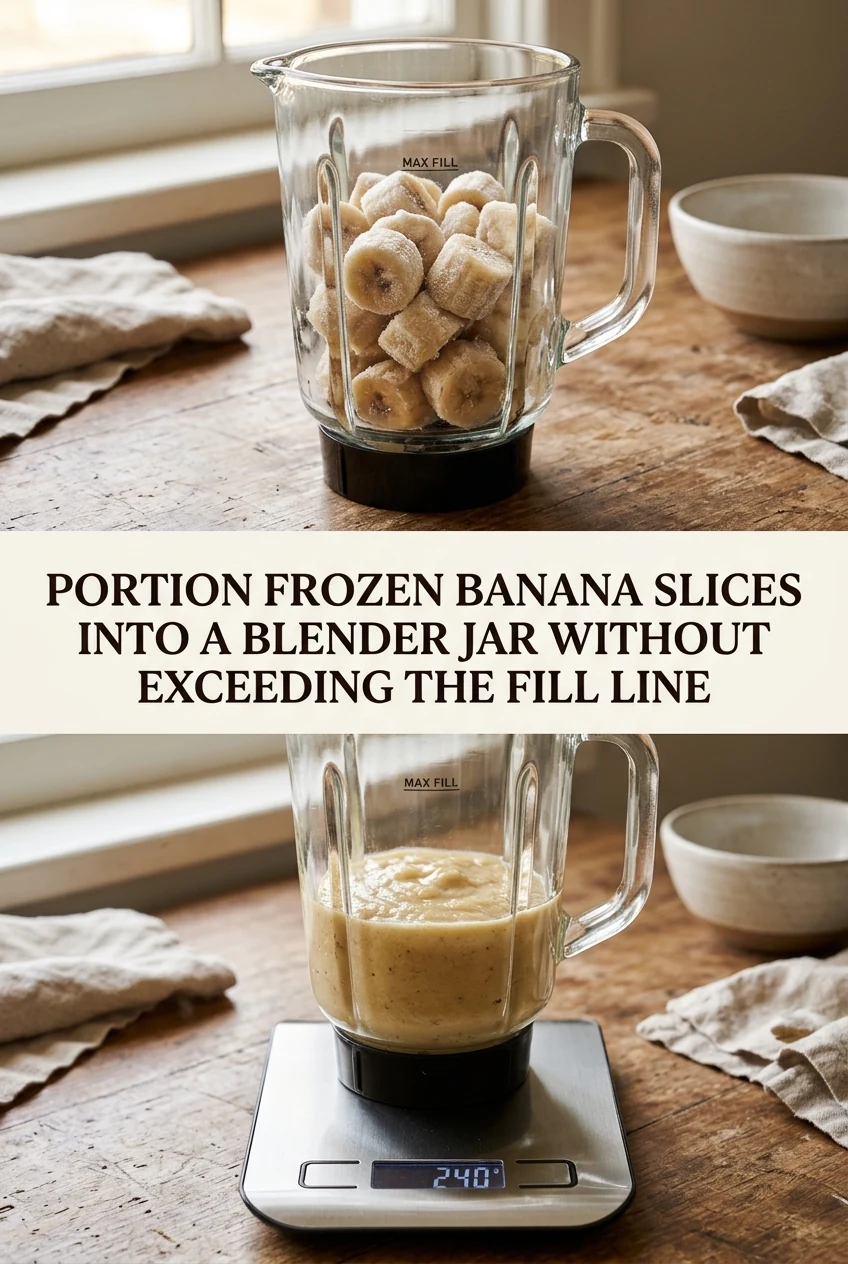
AI-generated editorial concept created for this article. The image is not a technical diagram or a tested result.
Understand Why Frozen Banana Volume Is Deceptive
A medium banana yields roughly 100 to 120 grams of sliced fruit, but those slices stacked loosely in a jar can occupy 300 millilitres or more of apparent space due to gaps between pieces. Adding liquid over unblended slices can cause fruit to float, and rapid vortexing and aeration during blending quickly push the expanding mixture upward toward the lid. Treating the pre-blend reading as a rough guide rather than a final measurement prevents misjudging how much room remains for liquid.
Place the Jar on a Kitchen Scale Before Loading Fruit
Set the empty blender jar on a kitchen scale and tare it to zero. Add frozen banana slices until the scale reads your target weight, typically 120 to 150 grams for a single-serve drink. This approach bypasses the misleading visual volume entirely. Once the fruit weight is confirmed, note the apparent volume mark reached by the fruit so you have a baseline for how much container headroom remains before reaching the maximum fill line.
Calculate the Remaining Liquid Allowance
Most standard blender jars mark a maximum fill line between 1.2 and 1.5 litres, though your specific jar may differ. As an illustrative example only: if frozen banana slices sit at the 400 ml mark visually, and your jar's fill line is 1.2 litres, you have roughly 800 ml of apparent space. In practice, allow at least 150 ml of clearance below the fill line to account for foam and expansion during blending.
Add Liquid in Two Stages Rather Than All at Once
Pour half your intended liquid, such as cold milk or a non-dairy alternative, directly over the banana slices. Transfer the jar from the scale to the blender motor base, secure the lid, and pulse twice at low speed to begin breaking down the fruit. Open the lid carefully, check the level, then add the remaining liquid if the contents are well below the fill line. This staged approach lets the banana compact before you commit to the full liquid volume.
Adjust for Multiple Servings Without Overloading
For two servings, doubling the banana weight does not simply double the safe liquid allowance because the jar capacity is fixed. If 150 grams of banana plus 250 ml of liquid fills the jar adequately for one serving, blending two servings separately is often more reliable than attempting a single large batch. Check your jar's rated capacity in the manufacturer documentation before scaling up, as jar sizes vary considerably between models.
A little more
to know.
Can I pre-portion banana slices into the jar and freeze them there overnight?
Most blender jars are not designed for freezer storage, and thermal stress can affect seals or the jar material. Portion and freeze banana slices on a lined tray first, then transfer the frozen pieces to the jar at blending time.
Does the order of ingredients affect blending efficiency beyond overflow risk?
Yes. Adding liquid before frozen fruit places liquid closest to the blade, which helps the motor engage more smoothly. However, this makes visual volume assessment harder, which is why weighing fruit first and adding liquid second is a practical compromise.
Original editorial guidance and recipe formulations, not independently kitchen-tested. Times are estimates and depend on equipment and product directions. Cooked bases need additional cooling and refrigeration before cold serving. Images are AI-generated illustrations; appearance and yield may vary. Check actual ingredient labels, allergens, and any certification you require. We do not certify products. Read our approach.
Save to Pinterest ↗ANOTHER IDEA FOR THE COUNTER