Portion and Chill Banana Slices for a Week of Smoothies
Freezing whole bananas and breaking off pieces each morning creates uneven portions and leaves the rest of the fruit exposed to freezer air. Pre-slicing and individually freezing portions on a lined tray before bagging solves both problems. Each slice freezes separately so you can shake out exactly what you need without thawing a clump, and the process takes about ten minutes once a week rather than daily effort. The result is consistent smoothie texture and no wasted fruit.
Read the note ↓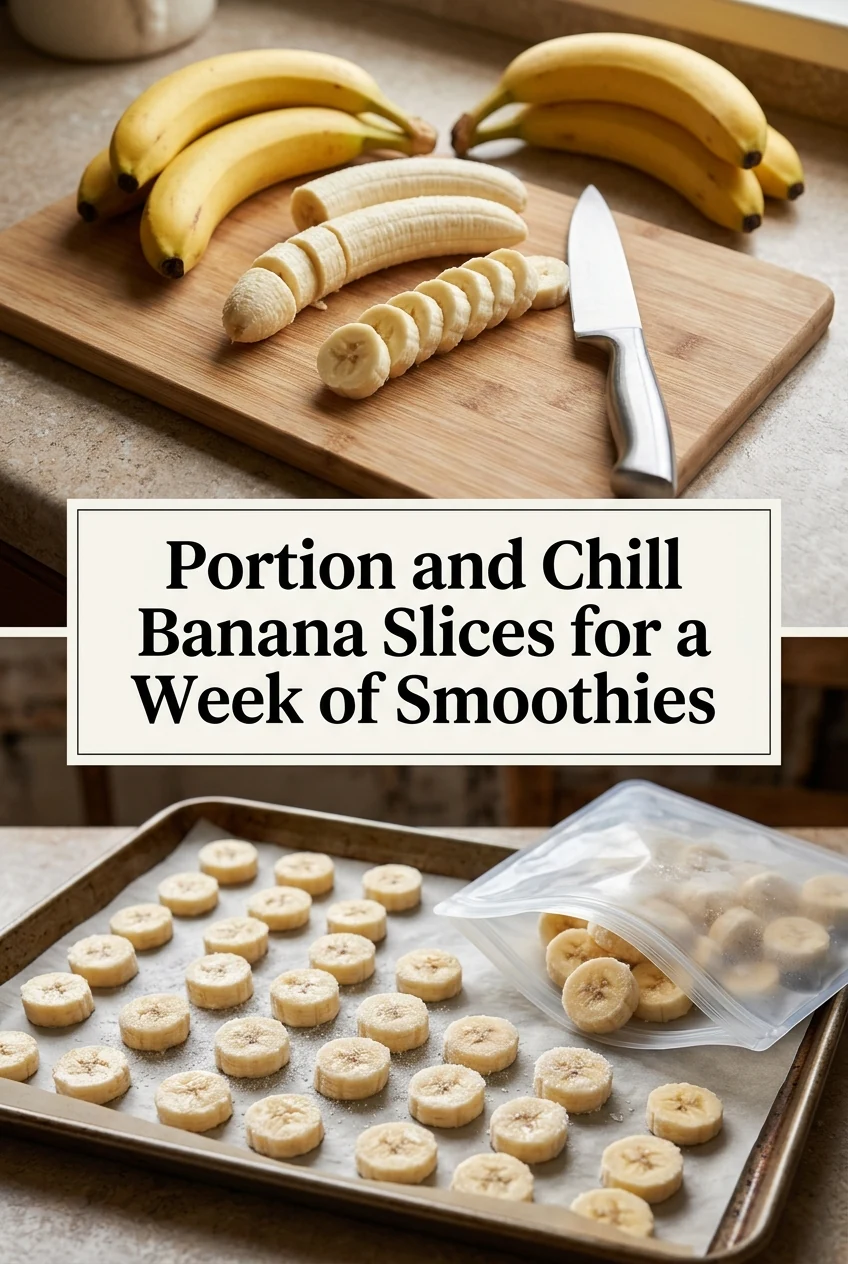
AI-generated editorial concept created for this article. The image is not a technical diagram or a tested result.
Choosing Bananas at the Right Ripeness
Bananas intended for freezing should be ripe enough to have developed sweetness, indicated by a fully yellow peel with some brown spotting. Underripe bananas freeze well structurally but contribute a starchy, less sweet flavour to smoothies. Overripe bananas with heavily blackened peels are still usable and will be very sweet, but their texture becomes extremely soft after freezing and thawing, which may make the smoothie thicker than intended. Aim for bananas that are yellow with light spotting for a balanced result.
Slicing and Tray Setup
Peel each banana and slice into rounds approximately 1.5 to 2 centimetres thick. Thinner slices freeze faster but can stick together at the edges if they touch on the tray. Line a flat baking tray or plate that fits in your freezer with baking paper or a silicone mat. Arrange slices in a single layer with a small gap between each piece. A standard 30-by-40-centimetre tray holds roughly five to six medium bananas sliced at this thickness without crowding.
The Tray-Freeze Step and Why It Matters
Place the lined tray flat in the freezer for a minimum of two hours, or until each slice is frozen solid to the touch. This individual pre-freeze is the step that prevents clumping in the storage bag. Skipping it and bagging fresh slices directly results in a solid frozen block within hours, making it impossible to remove a single portion without thawing the whole bag. Once slices are individually frozen, they release cleanly from the baking paper without tearing.
Portioning Into Bags for the Week
Transfer the frozen slices into a resealable freezer bag. For a single-serve smoothie using roughly 240 to 300 millilitres of liquid, 80 to 100 grams of frozen banana, which is approximately five to six standard slices, produces a thick, creamy texture. Divide the total batch into individual portions by counting slices into smaller bags or marking a single large bag with a line at each portion level. Press out as much air as possible before sealing to reduce freezer burn over the week.
Using Frozen Portions and Storage Limits
Add frozen banana slices directly to the blender from the freezer without thawing. They blend smoothly when combined with liquid and do not require pre-softening if your blender handles frozen fruit. Use portions within four weeks for best flavour and texture; beyond that, freezer burn can affect taste even in well-sealed bags. Frozen bananas are a perishable food product; once thawed, do not refreeze. Any unused thawed banana should be used immediately or refrigerated and consumed within one day.
A little more
to know.
Do I need to add lemon juice to the banana slices before freezing to prevent browning?
Browning during freezing is minimal compared to fresh cut banana left at room temperature. The colour change that does occur inside a frozen banana does not affect smoothie flavour or safety. Lemon juice is not necessary for this application.
Can I freeze bananas that have already been refrigerated for a few days?
Yes. Refrigerating bananas causes the peel to darken but does not harm the fruit inside. If the flesh is still firm and free of mould or off-odour, it freezes and performs in smoothies the same way as a freshly peeled banana at equivalent ripeness.
Original editorial guidance and recipe formulations, not independently kitchen-tested. Times are estimates and depend on equipment and product directions. Cooked bases need additional cooling and refrigeration before cold serving. Images are AI-generated illustrations; appearance and yield may vary. Check actual ingredient labels, allergens, and any certification you require. We do not certify products. Read our approach.
Save to Pinterest ↗ANOTHER IDEA FOR THE COUNTER