Make a Small Batch of Plain Granola Clusters
A small batch of plain granola clusters starts with rolled oats pressed firmly into a thin, even layer before baking. The pressing step is what separates this approach from loose granola or portioned biscuit dough: you are compacting a spread mixture so that it bakes as one connected sheet, then cools undisturbed until it sets, and finally breaks into irregular pieces by hand. This article walks through one illustrative home-cafe plan using a quarter-sheet pan. Because this is a worked example rather than a laboratory-tested result, your own oven, pan and ingredient brands will influence the outcome, so treat the details as a starting framework to adjust as you go.
Read the note ↓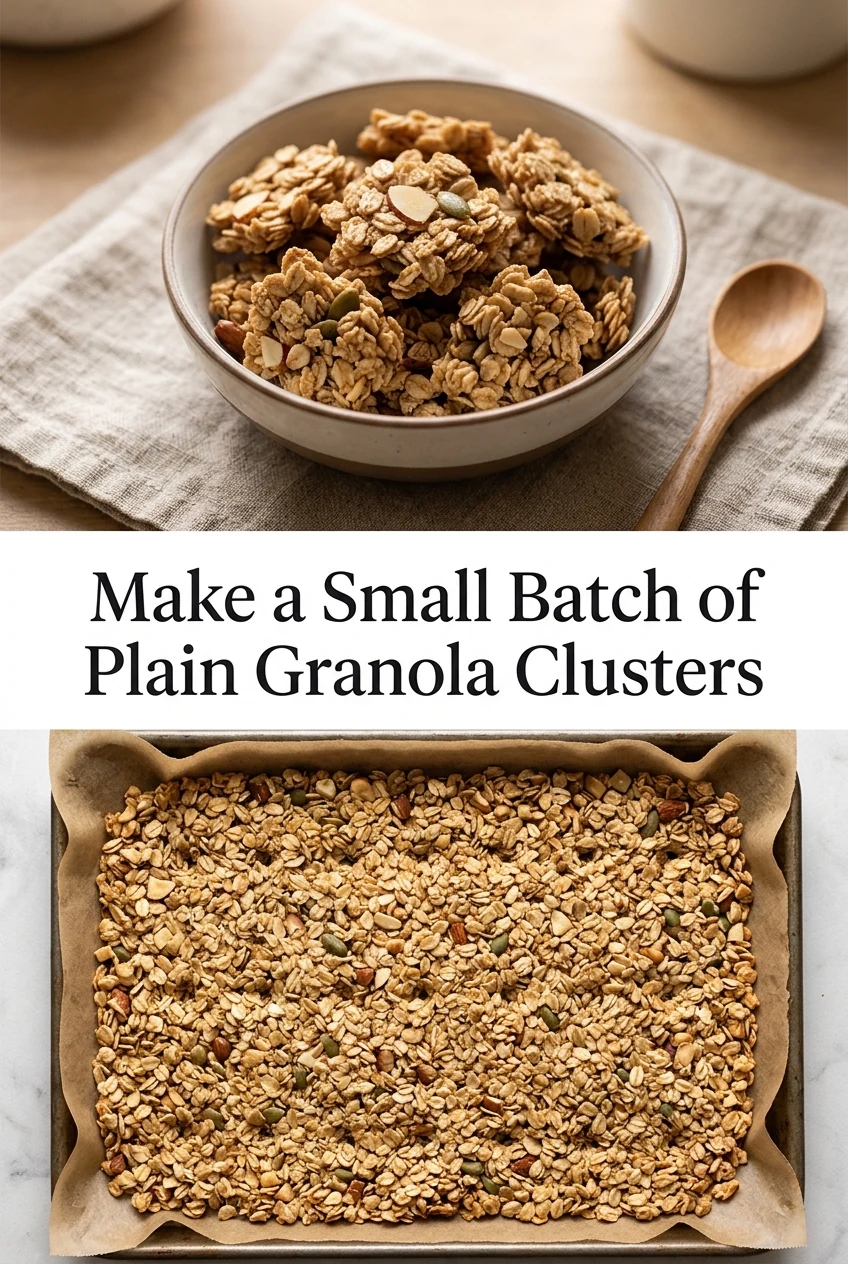
AI-generated editorial concept created for this article. The image is not a technical diagram or a tested result.
Gather Your Ingredients and Equipment
For this illustrative plan you will need 200 g old-fashioned rolled oats, 60 ml neutral oil such as sunflower or light olive oil, 60 ml honey or pure maple syrup, a small pinch of fine salt, and a few drops of alcohol-free vanilla flavoring if you choose to use one. Check that any vanilla product you buy is explicitly labeled alcohol-free before adding it. You will also need a quarter-sheet pan measuring roughly 23 cm by 33 cm, a sheet of parchment paper cut to fit the base, a mixing bowl, a spatula, and a flat-bottomed cup or the back of a spoon for pressing. No additional binding agents such as egg white are included in this plain version, which means the cluster bond will be lighter and more dependent on the pressing and cooling steps.
Mix and Press the Oat Layer
Preheat your oven according to its own dial markings and your knowledge of how it runs; a moderate baking temperature in the range commonly used for granola is a reasonable starting point, but your specific oven may run hotter or cooler than its dial suggests, so observe the color carefully rather than relying on a single universal setting. Combine the oats, oil, sweetener and salt in the bowl and stir until every oat is coated. Pour the mixture onto the parchment-lined pan and use your spatula to spread it into a rectangle that fills most of the pan surface. Then take your flat-bottomed cup and press firmly and evenly across the entire surface, working from the center outward. The goal is a compact layer roughly 6 to 8 mm thick with no loose gaps. This pressing step is the defining action that distinguishes cluster-style granola from a crumble or from portioned biscuit dough: you are creating one unified sheet, not individual portions.
Bake and Watch for Color
Slide the pan into the center rack of your preheated oven. Because ovens vary, check the surface at around the 15-minute mark. You are looking for an even golden color across the top without dark edges. If the edges are browning faster than the center, you can rotate the pan once, following your oven's actual behavior. The mixture is ready to come out when the surface looks set and uniformly golden. Avoid pressing or disturbing the sheet while it is still in the oven, as movement at this stage breaks the forming bond before it has a chance to develop.
Cool Without Touching, Then Break
Remove the pan from the oven and place it on a heatproof surface. Now do nothing. Leave the sheet completely undisturbed until it has cooled to room temperature; this resting period is when the sweetener firms up and holds the oats together. Cutting, pressing or moving the sheet while it is still warm will cause it to crumble into loose oats rather than clusters. Once the sheet feels firm and cool to the touch, lift the parchment and sheet together and flex it gently over the bowl. The sheet will crack into irregular pieces. You can guide larger breaks with your hands. The resulting clusters will vary in size, which is a natural outcome of hand-breaking rather than a cutting error.
Store Promptly and Serve
Transfer the finished clusters to a clean, dry airtight container as soon as they are fully cool. Store at room temperature away from moisture and direct sunlight. If you have added any perishable topping such as fresh fruit or yogurt at the point of serving, those additions should be refrigerated promptly and consumed the same day; do not store granola clusters already mixed with perishables at room temperature. This plain base works well spooned over fresh fruit, stirred into plain yogurt at the table, or eaten as a light snack on its own. Because this is an illustrative home-cafe plan rather than a tested and standardized recipe, your first batch will tell you whether your oven, pan and ingredient brands need any adjustment to the timing or pressing thickness.
A little more
to know.
Can I use quick oats instead of old-fashioned rolled oats?
Quick oats are thinner and more finely cut than old-fashioned rolled oats, so they will absorb the oil and sweetener differently and may produce a denser, less textured result. This illustrative plan was developed with old-fashioned rolled oats in mind. If you substitute quick oats, treat your first batch as an exploratory attempt and note how the texture and color differ from what is described here.
Why does my sheet crumble instead of breaking into clusters?
The most common reason is that the sheet was disturbed before it cooled completely, or that the pressing step did not compact the mixture firmly enough before baking. Allow the sheet to cool fully without touching it, and on your next batch apply more deliberate downward pressure during the pressing step, working slowly across every section of the pan surface to close any gaps in the oat layer.
Original editorial guidance and recipe formulations, not independently kitchen-tested. Times are estimates and depend on equipment and product directions. Cooked bases need additional cooling and refrigeration before cold serving. Images are AI-generated illustrations; appearance and yield may vary. Check actual ingredient labels, allergens, and any certification you require. We do not certify products. Read our approach.
Save to Pinterest ↗ANOTHER IDEA FOR THE COUNTER