Keep a Sparkling Fruit Drink Fizzy From Pitcher to Glass
Dissolved carbon dioxide escapes from liquid faster when exposed to a large surface area, which is exactly what a wide pitcher provides. Pre-mixing a full batch of sparkling water with fruit juice often leaves the drink noticeably flat by the time the second glass is poured. Building each serving individually, with cold seltzer added as the final step, keeps bubbles intact from the first glass to the last without any special equipment.
Read the note ↓
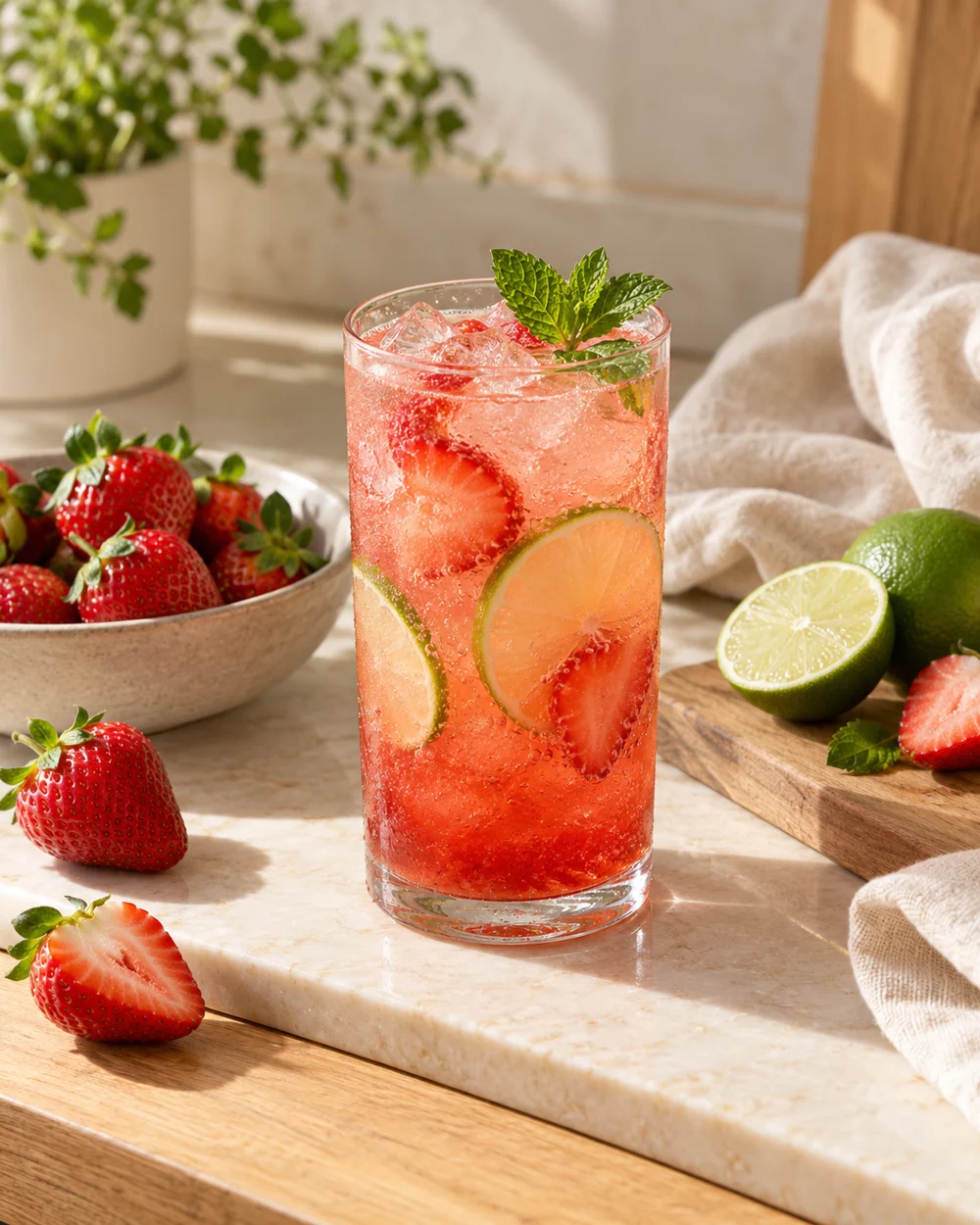
AI-generated editorial concept created for this article. The image is not a technical diagram or a tested result.
Why Pitchers Flatten Sparkling Drinks
Carbon dioxide stays dissolved in cold liquid under pressure. Once a sealed bottle is opened, pressure drops and gas begins escaping. Pouring into a wide pitcher accelerates this by exposing a large liquid surface to open air. Stirring or adding ice to the pitcher further agitates the liquid and releases more gas. The practical result is that a two-litre pitcher of pre-mixed sparkling fruit drink can lose most of its carbonation within fifteen to twenty minutes, even when refrigerated.
Prepare the Flavour Base Ahead of Time
Concentrate the non-sparkling elements into a compact base so the seltzer remains undisturbed until poured. Combine 60 millilitres of fruit juice, a few thin citrus slices, and any sweetener directly in the serving glass or a small individual jug. Stir only the base until the sweetener dissolves. Chilling this base in the refrigerator before service means it will not warm the seltzer when combined, which also helps carbonation last longer in the finished glass.
Choose and Chill the Seltzer Correctly
Store seltzer bottles upright and sealed in the refrigerator until the moment of use. Cold liquid holds carbon dioxide more effectively than room-temperature liquid. A bottle at 4 degrees Celsius retains noticeably more fizz than one at 20 degrees Celsius when poured. Do not shake or roll the bottle before opening. For a single 300-millilitre glass, a 500-millilitre bottle opened and used promptly will still have reasonable carbonation for a second glass if recapped and returned to the refrigerator immediately.
The Pour Sequence That Preserves Bubbles
Add ice to the glass first, then pour the chilled fruit base over the ice. Tilt the glass slightly and pour the seltzer slowly down the inside wall rather than directly into the centre of the liquid. This reduces splashing and agitation. A gentle single stir with a long spoon, no more than one or two slow rotations, is enough to combine without driving out gas. Serve immediately; do not let the assembled glass sit for more than two or three minutes before drinking.
Scaling for a Small Group Without a Pitcher
For four guests, pre-measure four individual portions of fruit base into small cups or glasses and refrigerate them. Keep the seltzer sealed until each person is ready. Assemble each glass one at a time using the pour sequence above. As an illustrative example, four glasses each using 60 millilitres of juice base and 240 millilitres of seltzer can be assembled in under three minutes this way, and each guest receives a properly fizzy drink rather than sharing from a flat communal pitcher.
A little more
to know.
Can I use a narrow-necked carafe instead of building each glass separately?
A narrow carafe reduces surface area compared to a wide pitcher and slows carbonation loss somewhat, but pre-mixing still releases gas over time. Individual assembly remains the most reliable method for guests who are not all drinking simultaneously.
Does the type of fruit juice affect how quickly the drink goes flat?
Juice itself does not significantly change carbonation retention, but pulpy juices with suspended solids can act as nucleation sites, encouraging bubbles to form and escape faster. Strained, clear juices tend to stay fizzy slightly longer after combining with seltzer.
Original editorial guidance and recipe formulations, not independently kitchen-tested. Times are estimates and depend on equipment and product directions. Cooked bases need additional cooling and refrigeration before cold serving. Images are AI-generated illustrations; appearance and yield may vary. Check actual ingredient labels, allergens, and any certification you require. We do not certify products. Read our approach.
Save to Pinterest ↗ANOTHER IDEA FOR THE COUNTER