Guava and Coconut Milk Smoothie
Fresh guava brings a floral, tropical flavour to a blended drink, but its small hard seeds scatter through the pulp and create a noticeably gritty texture when blended whole. Pressing the fruit through a fine-mesh sieve before measuring removes those seeds and leaves a smooth, bright pulp ready to combine with cold coconut milk and ice. This article walks through that straining step, explains the order in which ingredients go into the blender, and offers a single worked example to illustrate the proportions. The steps below describe an illustrative plan rather than a claim of tested or guaranteed results.
Read the note ↓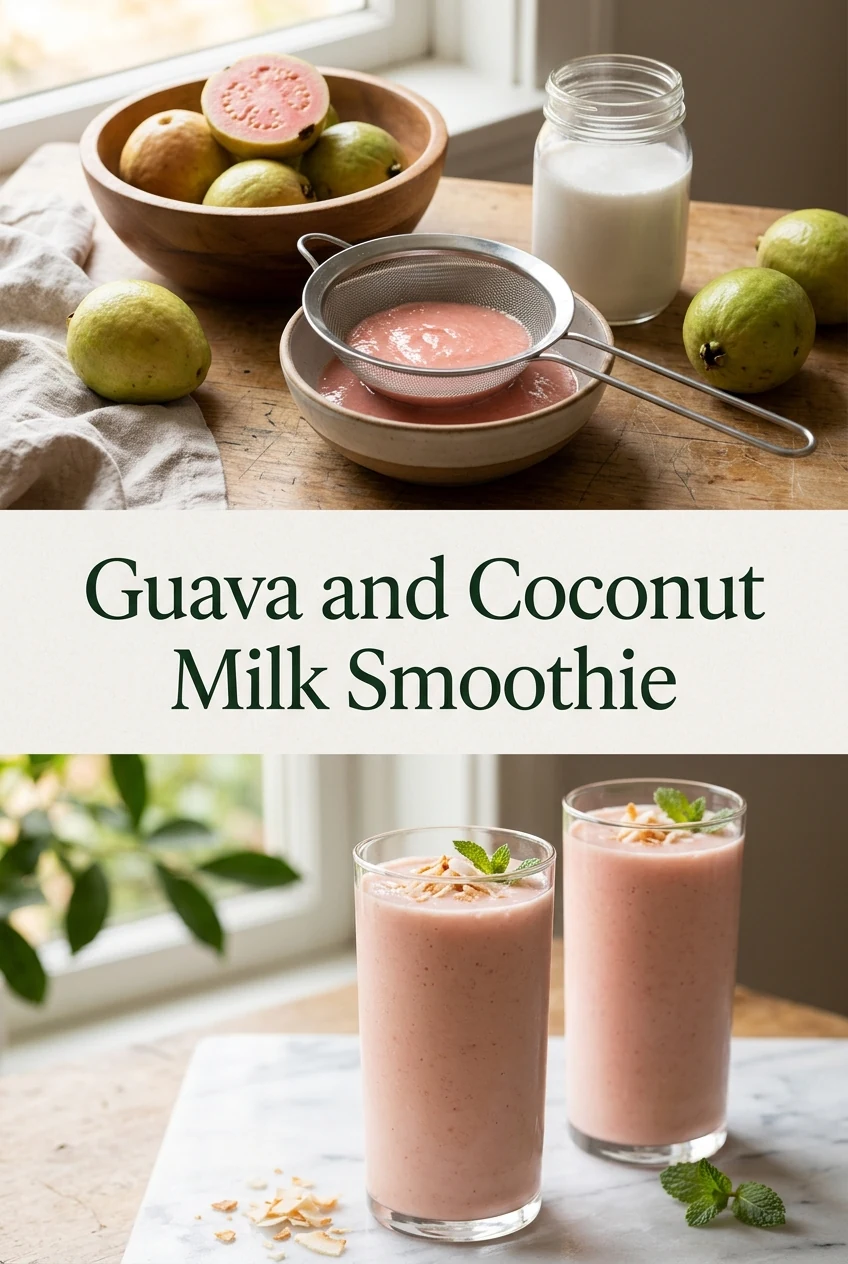
AI-generated editorial concept created for this article. The image is not a technical diagram or a tested result.
Choosing and Preparing the Guava
Select guavas that yield slightly when pressed, similar to a ripe pear. Fruit that is still firm may have less developed flavour, while overripe fruit can turn mushy. Rinse each guava under cool running water, then cut away the stem end and blossom end. Slice the fruit in half lengthways. You do not need to peel the guava, but because firm raw flesh cannot be pressed directly through fine wire mesh by hand, cut each half into rough chunks ready for a brief pulse in the blender to break down the flesh. For the worked example in this article, start with approximately 400 grams of whole guava, which is roughly three medium fruits.
Pressing the Pulp Through a Fine Sieve
Place the guava chunks in the blender jar and pulse on low speed for a few short bursts—just enough to break the fruit into a coarse mash without pulverising the hard stone seeds. Set a fine-mesh sieve over a bowl large enough to catch the strained pulp, then transfer the pulsed fruit into the sieve in batches. Press firmly with the back of a large spoon or a flexible spatula, working the pulp through the mesh while the seeds and skin pieces stay behind. Scrape the underside of the sieve periodically to collect pulp that clings there. Discard the seeds and skin left in the sieve, and rinse the blender jar to remove any stray seeds. From 400 grams of whole fruit, a reasonable illustrative yield is around 200 to 220 millilitres of strained pulp, though actual yield will vary with the variety and ripeness of the fruit. Measure the strained pulp in a jug before moving on.
Gathering the Remaining Ingredients
For this worked example, the plan calls for 200 millilitres of strained guava pulp, 250 millilitres of cold full-fat coconut milk taken from a well-shaken can, and 100 grams of ice cubes. Full-fat coconut milk contributes a creamy body that balances the bright acidity of the guava. If you prefer a lighter result, a reduced-fat coconut milk can be used instead, though the texture will be thinner. A small amount of honey or sugar can be stirred into the pulp at this stage if you want additional sweetness, but taste the pulp first because ripe guava is often sweet enough on its own. Keep the coconut milk refrigerated until the moment you need it so the finished drink stays cold.
Loading the Blender in the Correct Order
The order in which ingredients enter the blender affects how smoothly everything combines. Pour the cold coconut milk into the blender jar first. Liquid at the base helps the blades move freely from the start. Add the strained guava pulp next, then place the ice cubes on top. This sequence positions the ice away from the blades at the outset, which can help the liquid ingredients begin circulating before the ice is drawn down. Secure the lid firmly. Start the blender on a low setting for a few seconds, then increase to a higher speed and blend until the ice is fully broken down and the mixture looks uniform. The total blending time will depend on your specific blender model; follow the guidance in your blender's own instruction manual for blending icy drinks.
Serving the Smoothie
Pour the finished smoothie immediately into chilled glasses. Because this drink contains no stabilisers, the ice will begin to melt and the texture will loosen over time, so it is best enjoyed straight away. The worked example proportions above are intended to fill two standard 250-millilitre smoothie glasses with a small amount to spare for tasting. If you want a thicker consistency, reduce the coconut milk by 30 to 40 millilitres and add a few extra ice cubes. For a thinner, more drinkable result, add an extra 30 millilitres of coconut milk. Adjust within these kinds of ranges to suit your preference, keeping in mind that results will vary with the natural water content of the fruit you use.
A little more
to know.
Can frozen guava pulp be used instead of fresh fruit?
Ready-strained frozen guava pulp is available in many grocery stores and can work well in this recipe because the seeds have already been removed during processing. Thaw the pulp in the refrigerator until it is soft enough to measure, then use it in place of the freshly strained pulp in the same quantity. Because frozen pulp is already cold, you may find you need slightly less ice to achieve a similar texture, so adjust the ice quantity by eye as you blend.
Why does the smoothie sometimes separate after blending?
Separation is a natural result of blending fruit pulp with coconut milk and ice without any added emulsifier or stabiliser. As the ice melts, the liquid portion increases and the denser pulp can settle toward the bottom of the glass. Giving the glass a brief stir with a long spoon before drinking will bring the layers back together. Serving the smoothie immediately after blending and keeping the glasses cold beforehand can slow the rate at which separation becomes noticeable.
Original editorial guidance and recipe formulations, not independently kitchen-tested. Times are estimates and depend on equipment and product directions. Cooked bases need additional cooling and refrigeration before cold serving. Images are AI-generated illustrations; appearance and yield may vary. Check actual ingredient labels, allergens, and any certification you require. We do not certify products. Read our approach.
Save to Pinterest ↗ANOTHER IDEA FOR THE COUNTER