Estimate Sparkling Water Portions Before Opening the Bottle
Reading the label before you twist the cap is one of the simplest ways to avoid running short mid-service. A standard 500 ml bottle of sparkling water looks generous on the counter, yet once you account for glass headroom and any fruit or syrup sharing the space, the usable volume shrinks noticeably. Working through the arithmetic while the bottle is still sealed lets you decide whether to chill a second bottle before guests arrive rather than scrambling once the first is empty.
Read the note ↓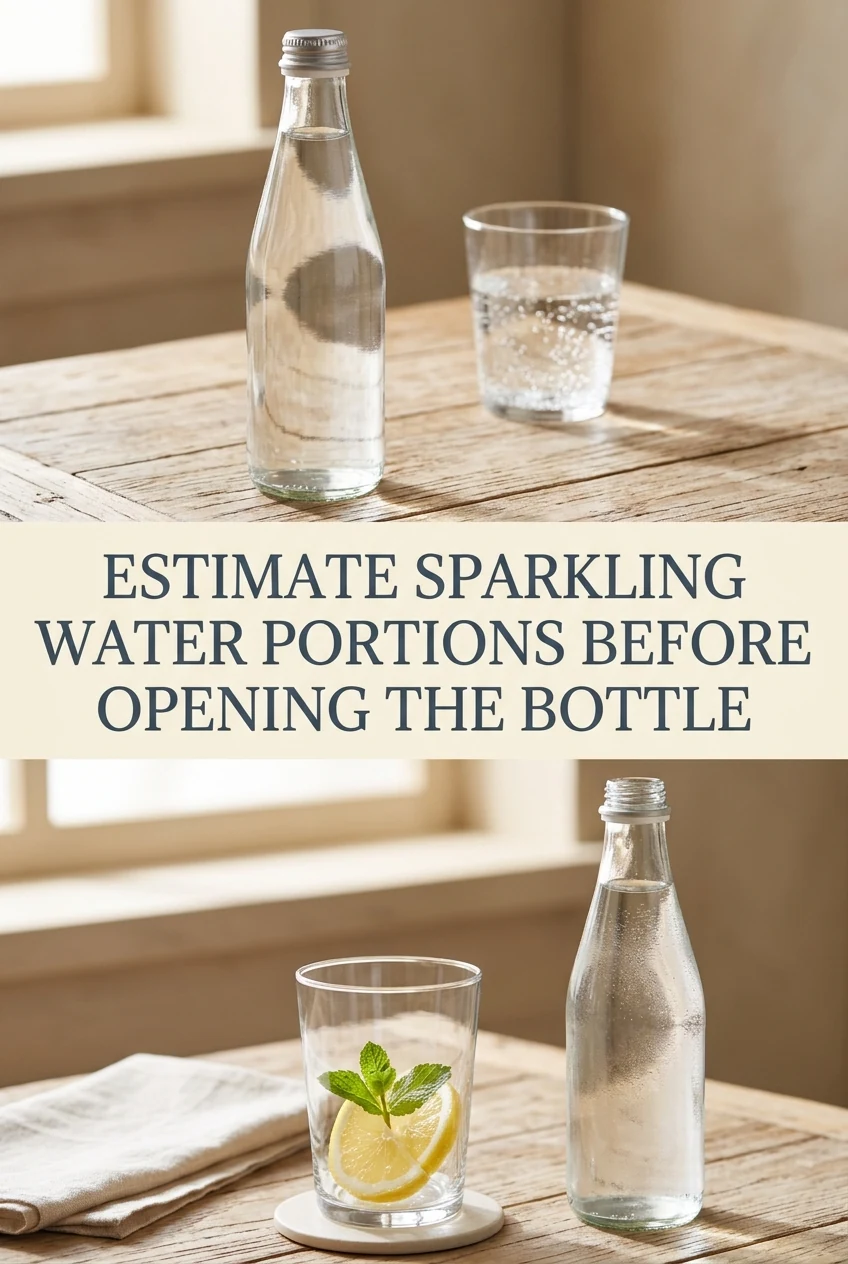
AI-generated editorial concept created for this article. The image is not a technical diagram or a tested result.
Start With the Label Volume
The net volume printed on the bottle is your baseline. A 500 ml bottle contains 500 ml of liquid. That number does not change, but how far it stretches depends entirely on how much of each glass it must fill. Before you open anything, note the label figure and keep it as your fixed starting point for every calculation that follows.
Account for Glass Headroom
Few glasses are filled to the absolute brim. A practical pour typically leaves one to two centimetres of space at the top to prevent spillage and allow for a brief rise in bubbles after pouring. In a standard 250 ml tumbler, leaving roughly 50 ml of headroom means each comfortable serving holds about 200 ml of liquid in total. If sparkling water is the only thing going into the glass, that gives you two full servings from a 500 ml bottle with a small amount remaining. Write down your chosen serving size before you open the bottle so the plan is set.
Subtract Space for Other Ingredients
Sparkling fruit drinks often include sliced citrus, a measured pour of fruit juice, or a spoonful of alcohol-free cordial alongside the sparkling water. Each addition occupies volume in the glass. If you are adding 50 ml of chilled fruit juice and a few ice cubes displacing roughly 30 ml, the sparkling water portion per glass drops to around 120 ml to stay within a 200 ml comfortable fill. Mapping this out in advance means you know how many glasses a single bottle can realistically supply before the cap comes off.
A Worked Example to Illustrate the Planning Process
Suppose you are preparing a sparkling citrus drink for four people. You have one 500 ml bottle of sparkling water. Each glass holds 300 ml to the brim, and you plan to fill each glass to 250 ml to leave headroom. Into each glass you will add 40 ml of freshly squeezed orange juice and ice cubes displacing approximately 30 ml. That leaves 180 ml of sparkling water needed per glass. Four glasses multiplied by 180 ml equals 720 ml of sparkling water required. One 500 ml bottle falls short by roughly 220 ml, so this illustrative plan calls for a second bottle to be chilled and ready. This is a planning estimate based on the numbers above, not a tested result, and your actual pours may vary slightly depending on your glasses and ice.
Keep the Bottle Sealed Until the Moment of Service
Once you have completed your portion estimate on paper, leave the bottle sealed. Do not pre-decant sparkling water into a jug or open it early to check the volume, as this releases carbonation. The planning stage is entirely a label-and-arithmetic exercise. Open the bottle only when glasses are ready and guests are seated so the sparkling water goes directly from bottle to glass with as little delay as practical.
A little more
to know.
Can I estimate portions for different bottle sizes using the same method?
Yes. The approach is the same regardless of bottle size. Read the label volume, decide on your per-glass sparkling water amount after subtracting headroom and other ingredients, then divide the label volume by that per-glass figure. A 750 ml bottle divided by a 150 ml sparkling water portion per glass gives five portions in this illustrative calculation. Adjust the numbers to match your actual glasses and recipe.
What if my glasses are an unusual size?
Measure your glass once using a measuring jug filled with plain tap water before the event. Pour water in up to your intended fill line and note that usable volume. Subtract only the volume of any other ingredients, such as juice or ice displacement, and the remainder is your sparkling water portion for that glass. Use that figure in your bottle calculation the same way as in the worked example above.
Original editorial guidance and recipe formulations, not independently kitchen-tested. Times are estimates and depend on equipment and product directions. Cooked bases need additional cooling and refrigeration before cold serving. Images are AI-generated illustrations; appearance and yield may vary. Check actual ingredient labels, allergens, and any certification you require. We do not certify products. Read our approach.
Save to Pinterest ↗ANOTHER IDEA FOR THE COUNTER