Decide Whether to Use a Blender or a Whisk for a Fruit Milk Drink
Choosing between a blender and a whisk for a fruit milk drink comes down to the physical structure of the fruit you are using. A whisk can dissolve a smooth puree or a fine powder into cold milk, but it cannot break down cell walls or fibrous strands. Understanding this distinction before you start prevents a gritty, uneven drink and saves you from reprocessing the batch.
Read the note ↓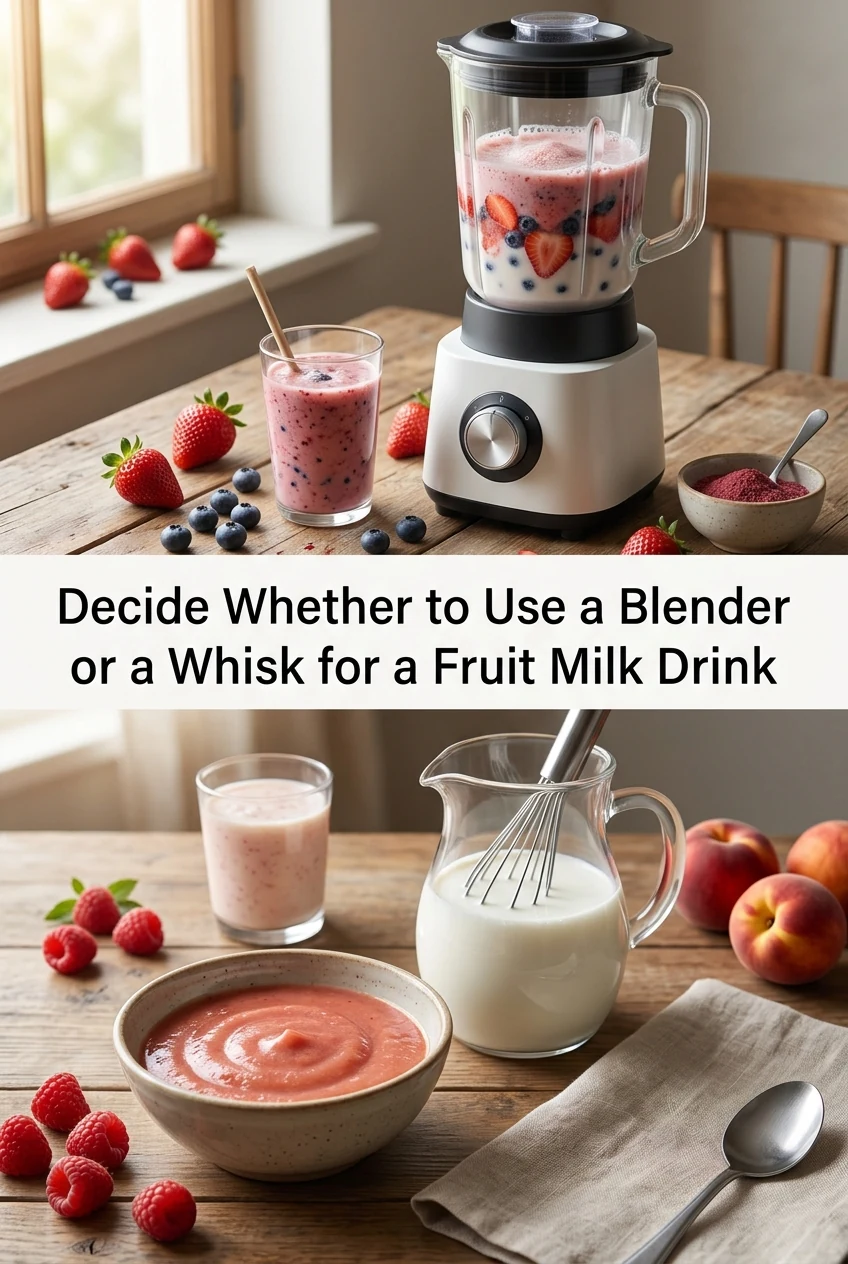
AI-generated editorial concept created for this article. The image is not a technical diagram or a tested result.
Assess the Fruit Before Picking a Tool
Press a small piece of fruit with your fingertip. If it yields easily and releases juice, such as a ripe banana or a very soft mango, a blender will process it cleanly. If it resists pressure or shows visible fibres, such as pineapple or guava, a blender is the only practical option. A whisk cannot shorten fibres or rupture firm cell walls regardless of how long you work it.
When a Whisk Is Sufficient
A whisk works for drinks built on pre-made smooth purees, fruit syrups, or fine powders such as freeze-dried strawberry powder. If you are combining 30 ml of a fully strained commercial passion fruit syrup with 200 ml of cold full-fat milk, a whisk produces a uniform drink in about 20 seconds. The key condition is that no solid fruit particles remain in the liquid before whisking begins.
When a Blender Is Necessary
Use a blender whenever raw fruit pieces enter the drink. A practical starting point for a single serve is 80 g of chopped ripe mango combined with 180 ml of chilled pasteurized whole milk and 15 ml of simple syrup. Blend on medium speed for 20 to 25 seconds, then check for smoothness. This is an illustrative example, not a guaranteed result, because fruit ripeness and blender power vary.
Texture Problems That Signal the Wrong Tool Was Used
If you whisk a drink and find small solid flecks floating or settling within 30 seconds, the fruit was not fully pureed before it entered the milk. If a blended drink feels grainy, the blending time was too short or the fruit was underripe and fibrous. In both cases, passing the finished drink through a fine mesh strainer is a recovery step, though it reduces volume and may thin the texture.
Cleaning and Practical Order of Operations
Blend fruit with a small portion of the milk first, then add the remainder and pulse briefly. This reduces the load on the blades and produces a more even result than adding all liquid at once. Rinse the blender jar immediately after use with warm water before residue dries. A whisk and small jug can be rinsed in seconds, which is a genuine time advantage when making single servings repeatedly during a busy prep session.
A little more
to know.
Can I blend fruit ahead of time and then whisk it into milk to order?
Yes. Blend fruit into a smooth puree, strain if needed, store it covered at 4 degrees Celsius, and use within 24 hours. Whisk the measured puree into cold milk at the time of serving for a faster workflow.
Does the fat content of the milk affect which tool works better?
Fat content influences mouthfeel and how well fruit solids stay suspended, but it does not change the fundamental rule. Fibrous or firm fruit still requires a blender regardless of whether you use skimmed, whole, or plant-based milk.
Original editorial guidance and recipe formulations, not independently kitchen-tested. Times are estimates and depend on equipment and product directions. Cooked bases need additional cooling and refrigeration before cold serving. Images are AI-generated illustrations; appearance and yield may vary. Check actual ingredient labels, allergens, and any certification you require. We do not certify products. Read our approach.
Save to Pinterest ↗ANOTHER IDEA FOR THE COUNTER