Cut Strawberries to a Uniform Size Before Blending for an Even Smoothie Texture
A home blender processes everything in its path at the same speed, so a whole strawberry sitting next to a sliver will finish at different stages. The result is a drink with fibrous chunks alongside over-processed pulp. Halving or quartering each berry to a roughly consistent size before the lid goes on gives the blades an even workload and produces a texture that is uniform from first sip to last.
Read the note ↓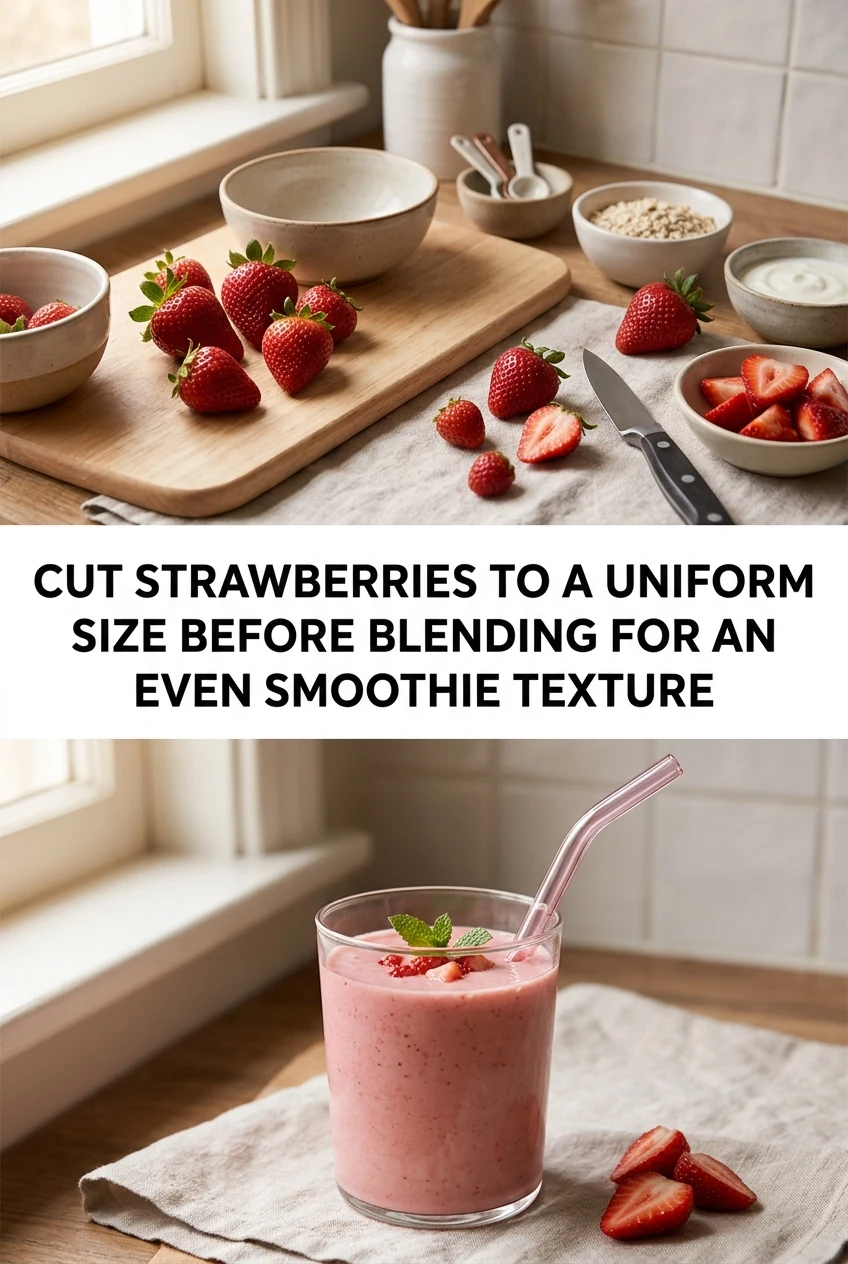
AI-generated editorial concept created for this article. The image is not a technical diagram or a tested result.
Why Piece Size Affects Blending Outcome
Blender blades create a vortex that pulls ingredients downward. Large pieces resist that pull and ride the current instead of contacting the blade edge cleanly. Small, similarly sized pieces cycle through the vortex at comparable rates, so each piece receives roughly equivalent processing time. This is not a guaranteed result but a practical advantage that home cooks consistently observe when they standardize their prep before blending.
How to Hull and Quarter Strawberries Consistently
Remove the hull with a small paring knife by angling the blade in a shallow cone around the green cap, taking as little flesh as possible. Stand each berry on its flat cut end and halve it top to bottom, then halve each piece again to produce quarters. For very large berries, a rough target of pieces no wider than two centimeters keeps them comparable to the smaller berries already quartered.
A Worked Example with Quantities
As an illustrative guide, consider 250 grams of mixed strawberries ranging from small to large. After hulling, small berries are halved, medium berries quartered, and large berries cut into six pieces. All pieces land in a similar size range before blending with 180 milliliters of cold milk. This approach is not a formula but a demonstration of how matching piece size across different berry sizes reduces the chance of unblended chunks.
Layering Order Inside the Blender Jar
Add liquid to the jar first so the blades are not working dry against cold fruit. Place cut strawberries on top of the liquid rather than pressing them against the sides. If you are adding a banana or other soft fruit, layer it between the liquid and the strawberries. This order encourages the vortex to form quickly and draw the fruit pieces downward into the blade zone from the start.
Checking Texture Before Serving
After blending, tilt the jar and watch whether the smoothie flows as a single consistent mass or shows streaks and lumps. If small fibrous threads remain, blend for an additional ten to fifteen seconds rather than starting over. Pouring through a wide-mesh strainer is an option if texture is still uneven, though it removes some fiber. Serve promptly and refrigerate any remainder at 4 degrees Celsius or below within two hours.
A little more
to know.
Does freezing the cut strawberries before blending change the texture outcome?
Frozen pieces blend into a thicker, colder result and can strain some home blender motors. If you freeze them, spread the cut pieces in a single layer on a tray first so they freeze separately rather than clumping, which helps the blades engage each piece individually.
Can I prepare the cut strawberries ahead of time?
Yes. Store hulled and cut strawberries in a covered container in the refrigerator at 4 degrees Celsius or below and use them within one day. Cut surfaces oxidize and the fruit softens over time, so same-day prep gives the best flavor and color in the finished drink.
Original editorial guidance and recipe formulations, not independently kitchen-tested. Times are estimates and depend on equipment and product directions. Cooked bases need additional cooling and refrigeration before cold serving. Images are AI-generated illustrations; appearance and yield may vary. Check actual ingredient labels, allergens, and any certification you require. We do not certify products. Read our approach.
Save to Pinterest ↗ANOTHER IDEA FOR THE COUNTER