Cold Brew in a Refrigerator Jar: Steeping, Filtering and Storing Concentrate
First-time cold brewers often wonder whether to steep on the counter or inside the refrigerator, how to remove fine grounds without a specialty device, and how many days the finished concentrate remains usable. This guide answers those three questions directly, using only a clean lidded jar, a paper filter or fine mesh filter bag, and a second jar for storage. No fixed coffee-to-water ratio is presented as universally correct, because strength depends on your beans and personal taste.
Read the note ↓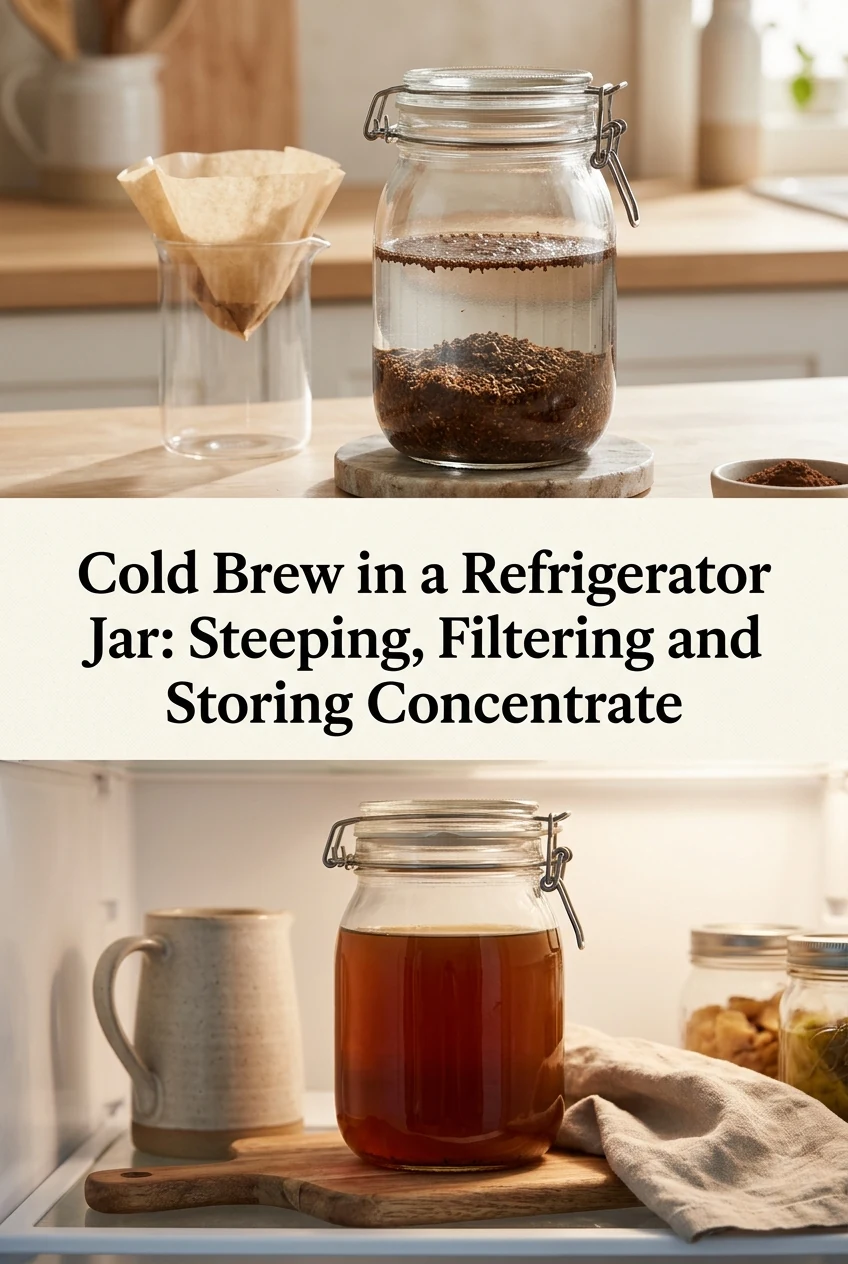
AI-generated editorial concept created for this article. The image is not a technical diagram or a tested result.
Where to Steep: Refrigerator, Not the Counter
Steep your cold brew inside the refrigerator from the very beginning rather than leaving it at room temperature. A sealed jar sitting at room temperature creates a warm, moist environment that encourages bacterial growth, particularly over a steep window of twelve hours or longer. Placing the jar in the refrigerator immediately keeps the contents at or below 4 degrees Celsius throughout the entire steep, which is the safer approach for a beverage you plan to store and consume over several days.
Building the Steep: Jar Size, Grounds and Water
Use a clean lidded glass jar large enough to hold your grounds and water with a few centimetres of headspace. As an illustrative example, a 1-litre jar filled with coarsely ground coffee and cold filtered water, leaving roughly 3 centimetres at the top, gives you room to stir before sealing. Stir gently until all grounds are saturated, then seal the lid and place the jar on a refrigerator shelf. Steep time typically falls between twelve and twenty-four hours; taste guides your final decision.
Filtering Out Fine Grounds Cleanly
After steeping, set a fine mesh filter bag or a paper pour-over filter inside a second clean jar or a large measuring jug. Pour the steeped mixture slowly through the filter, allowing gravity to do the work. Do not press or squeeze the grounds, as this can push fine sediment through. If your first pass still looks cloudy, pour the liquid through a fresh paper filter a second time. Discard the used grounds and rinse the filter bag promptly if you plan to reuse it.
Labelling and Setting a Use-By Window
Once filtered, transfer the concentrate into a clean sealed jar and write the preparation date directly on a piece of masking tape stuck to the jar. Also write a use-by date. A commonly cited home-use window for refrigerated cold brew concentrate is seven to fourteen days, but because home conditions vary, choosing the shorter end of that range is the more cautious decision. Keep the jar sealed when not in use and store it consistently at 4 degrees Celsius or below. Discard it if the smell or appearance changes.
Serving: Diluting, Adding Milk and Handling Leftovers
Pour concentrate over ice in a glass, then add cold water or pasteurized milk to dilute it to your preferred strength. As an illustrative example, pouring from a 1-litre jar of concentrate can easily supply two large glasses over ice when diluted roughly one part concentrate to one part liquid (using roughly 150 to 200 millilitres of concentrate per glass), while leaving the rest stored safely in the refrigerator. Never add milk directly to the storage jar. Return any unused pasteurized milk to the refrigerator promptly, and refrigerate any remaining concentrate immediately after pouring your serving.
A little more
to know.
Can I use a paper towel instead of a coffee filter if I do not have one?
Paper towels vary widely in thickness and fibre composition and are not designed for food filtration, so results are unpredictable. A paper pour-over filter or a dedicated fine mesh filter bag is the more reliable and consistent option for removing fine grounds cleanly.
Does the type of jar lid matter for refrigerator storage?
A lid that creates a reasonably airtight seal, such as a metal screw-top or a clamp-style bail lid, helps limit odour absorption from other refrigerator contents and slows oxidation. Loosely fitting lids allow the concentrate to pick up surrounding smells more readily over several days.
Original editorial guidance and recipe formulations, not independently kitchen-tested. Times are estimates and depend on equipment and product directions. Cooked bases need additional cooling and refrigeration before cold serving. Images are AI-generated illustrations; appearance and yield may vary. Check actual ingredient labels, allergens, and any certification you require. We do not certify products. Read our approach.
Save to Pinterest ↗ANOTHER IDEA FOR THE COUNTER