Choose Between a Wide Shallow Bowl and a Deep Narrow Jug for Whisking Cocoa Into Warm Milk
Whisking cocoa powder into warm milk sounds simple until the powder clumps at the bottom or milk splashes over the rim. The shape of the vessel you choose directly affects how much room the whisk head has to move, how quickly heat escapes, and whether the cocoa disperses evenly. Understanding the practical difference between a wide shallow bowl and a deep narrow jug helps you pick the right container before you pour a single drop of milk.
Read the note ↓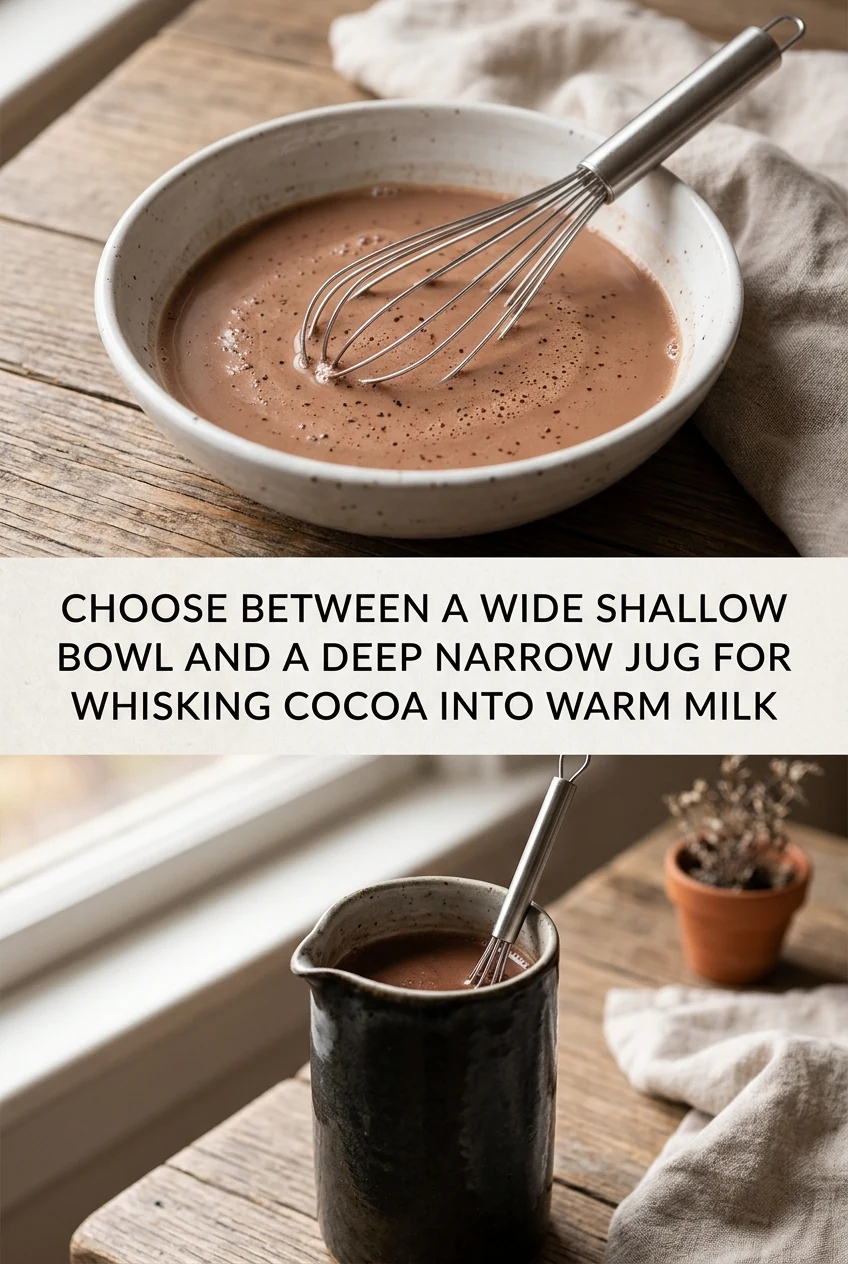
AI-generated editorial concept created for this article. The image is not a technical diagram or a tested result.
How vessel width affects whisk stroke length
A whisk needs lateral clearance to complete a full circular or figure-eight stroke. In a bowl measuring roughly 18 to 20 centimetres across the rim, a standard 25-centimetre balloon whisk can move freely without the wires scraping the sides. In a jug with an internal diameter of 9 to 10 centimetres, the same whisk is forced into short vertical strokes, which are less effective at breaking up cocoa clumps sitting on the base.
How a narrow jug concentrates heat differently
A deep narrow jug retains heat longer because less surface area is exposed to the air. If you warm 250 millilitres of milk to around 65 degrees Celsius in a narrow jug, it stays at that temperature noticeably longer than the same volume spread across a wide bowl. This matters if you are preparing cocoa for more than one cup and need the milk to stay warm while you whisk in stages, though the trade-off is the restricted stroke.
Matching whisk head size to the opening
A useful working rule is to choose a vessel whose internal diameter is at least twice the widest point of the whisk head. A balloon whisk with a head diameter of about 7 centimetres fits comfortably in a bowl 16 centimetres or wider. In a jug narrower than 12 centimetres, consider switching to a smaller flat or coil whisk, which can reach the base without the wires bending against the walls and losing their spring.
Reducing splash when using a wide bowl
A wide bowl gives the whisk room but also gives milk more opportunity to travel over the rim if the stroke is too aggressive. Keep the whisk head submerged below the milk surface and use a controlled wrist rotation rather than a full arm swing. Starting slowly for the first few strokes disperses the cocoa powder into the liquid before you increase speed. Tilting the bowl very slightly away from you also helps direct any movement inward.
Deciding which vessel to use for a single serving versus a batch
For a single 250-millilitre serving, a wide bowl gives better cocoa dispersion and is easier to clean quickly between drinks. For a small batch of two or three servings totalling around 600 to 750 millilitres, a deep narrow jug with a smaller whisk keeps the milk warmer during the mixing process. In both cases, sift the cocoa powder directly into the vessel before adding milk to reduce the number of dry clumps the whisk must break apart.
A little more
to know.
Can I use a fork instead of a whisk in a narrow jug?
A fork can break up surface clumps but its tines do not create the same fluid circulation as a whisk. Cocoa powder sitting at the base of a narrow jug is likely to remain partially unmixed, leaving a gritty layer at the bottom of the finished drink.
Does the material of the bowl, ceramic versus stainless steel, affect the result?
Ceramic retains heat slightly better than thin stainless steel, which can be useful if your kitchen is cool. Stainless steel is lighter and easier to tilt with one hand. Neither material changes how the cocoa disperses; vessel shape and whisk fit remain the deciding factors.
Original editorial guidance and recipe formulations, not independently kitchen-tested. Times are estimates and depend on equipment and product directions. Cooked bases need additional cooling and refrigeration before cold serving. Images are AI-generated illustrations; appearance and yield may vary. Check actual ingredient labels, allergens, and any certification you require. We do not certify products. Read our approach.
Save to Pinterest ↗ANOTHER IDEA FOR THE COUNTER