Choose Between a Narrow Tumbler and a Wide Mug for a Warm Spiced Cocoa Drink
Choosing the right vessel for a warm spiced cocoa affects both how you build the drink and how long it stays at a comfortable temperature. A narrow tumbler and a wide mug behave differently during mixing and during serving. Understanding those differences before you start means you can match the cup to your actual workflow rather than adjusting mid-pour when the cocoa is already hot and the spices are beginning to settle.
Read the note ↓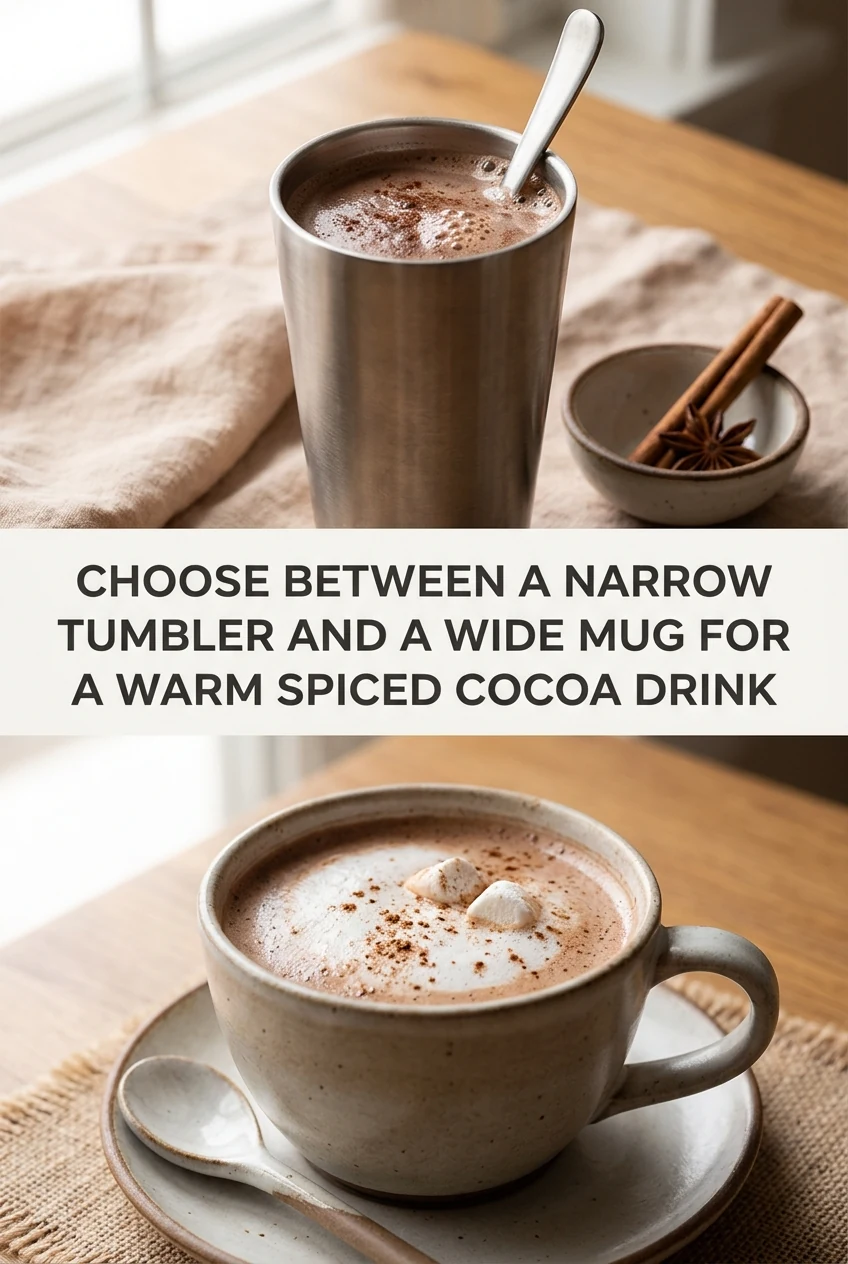
AI-generated editorial concept created for this article. The image is not a technical diagram or a tested result.
How vessel shape affects heat retention
A narrow tumbler exposes less liquid surface area to the surrounding air, which slows heat loss noticeably compared with a wide mug. For a spiced cocoa served at roughly 70 to 75 degrees Celsius, a narrow vessel can hold drinking temperature for several minutes longer. A wide mug with a diameter above roughly 9 centimetres loses heat faster because more surface area radiates warmth outward. If your guest drinks slowly, the narrow tumbler is the practical advantage here.
Why whisking a cocoa slurry in a narrow tumbler is difficult
A cocoa slurry, made by combining unsweetened cocoa powder with a small amount of warm water or milk before adding the rest of the liquid, needs room for a whisk or spoon to move freely. In a tumbler narrower than about 7 centimetres at the opening, a standard balloon whisk cannot rotate without hitting the sides. A long-handled bar spoon can work in a narrow vessel, but it takes longer to dissolve the cocoa fully and risks leaving dry pockets near the base.
When to mix in a separate jug instead
If you prefer a narrow tumbler for serving, build the slurry in a small heatproof jug first. Combine 15 grams of unsweetened cocoa powder with 30 millilitres of hot water and whisk until smooth, then add your spiced milk and stir briefly before pouring into the tumbler. This two-vessel approach gives you the mixing room of a wide container and the heat-retention benefit of a narrow serving cup without compromise. It adds one item to wash but solves both problems cleanly.
When a wide mug is the better choice
If you are mixing directly in the serving cup and your guest drinks promptly, a wide mug with a capacity of 300 to 350 millilitres is genuinely easier to work in. The open shape lets a small whisk or a milk frother reach the base without obstruction, and the cocoa dissolves faster. Pre-warming the mug with hot water for 30 seconds before discarding it and adding your drink reduces the cooling effect of cold ceramic, which is the main drawback of a wide vessel.
Matching the vessel to your serving context
For a café tray where the drink travels a short distance and is consumed within five minutes, a wide pre-warmed mug is practical. For a desk or slow-sipping setting, the narrow tumbler with a jug-mixed slurry is worth the extra step. Neither choice is universally correct. The decision turns on whether mixing convenience or heat retention matters more in your specific situation, and on whether you are comfortable adding a second vessel to your prep routine.
A little more
to know.
Can a double-walled glass tumbler improve heat retention without changing the mixing problem?
Yes. A double-walled glass holds heat closer to a narrow ceramic tumbler's performance and looks appealing on a tray. It does not widen the opening, so the mixing difficulty in a narrow vessel remains. You still need to mix in a separate jug first.
Does the type of spice added to the cocoa affect which vessel works better?
Ground spices like cinnamon or cardamom settle quickly if the drink sits undisturbed, making a wide mug easier for a quick final stir before serving. In a narrow tumbler, a long spoon is needed to reach settled spice at the base.
Original editorial guidance and recipe formulations, not independently kitchen-tested. Times are estimates and depend on equipment and product directions. Cooked bases need additional cooling and refrigeration before cold serving. Images are AI-generated illustrations; appearance and yield may vary. Check actual ingredient labels, allergens, and any certification you require. We do not certify products. Read our approach.
Save to Pinterest ↗ANOTHER IDEA FOR THE COUNTER