Choose a Cold-Drink Spoon That Fits the Glass Opening
A cold-drink spoon that is too wide scrapes the rim on every stir, while one that is too short leaves your fingers in the liquid. Matching bowl width and handle length to your actual glass before you buy saves frustration at the home-cafe counter. This guide walks through a straightforward measuring approach so the spoon moves freely beside ice rather than being wedged against it.
Read the note ↓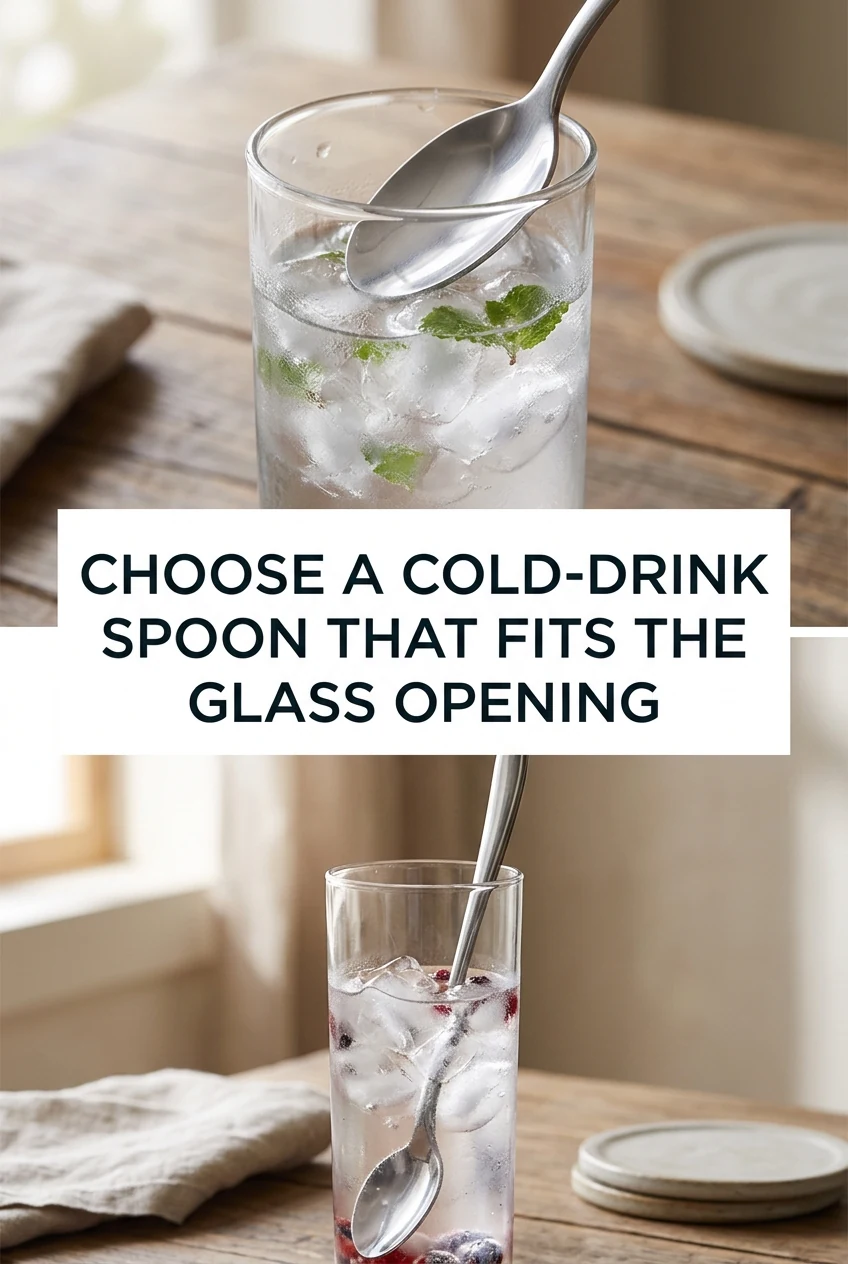
AI-generated editorial concept created for this article. The image is not a technical diagram or a tested result.
Why the Glass Opening Decides Everything
The inner diameter of the glass opening sets a hard limit on the spoon bowl. A tall Thai-tea glass might have an inner opening of roughly 6 cm, while a wide bubble-tea cup can reach 9 cm or more. If the spoon bowl is nearly as wide as the opening, it cannot tilt at the angle needed for a comfortable stir. As a practical rule, aim for a bowl width that is no more than about half the inner opening diameter. That gap leaves room for the bowl to move in a small arc without the handle pressing against the rim. Measure the inner opening with a ruler laid flat across the top of the empty glass, not the outer rim, because the wall thickness of thick glassware can reduce usable space by several millimetres.
Handle Length and the Depth of the Glass
Handle length matters as much as bowl width. The goal is to grip the spoon comfortably above the rim while the bowl reaches the bottom third of the glass, where undissolved syrup or settled grain tends to collect. Measure the interior depth of your glass with a straight ruler or a chopstick marked with a pen, then add roughly 7 to 9 cm for the portion of the handle you want above the rim. A 300 ml tall glass with an interior depth of 14 cm, for example, calls for a total spoon length of around 21 to 23 cm. Long-handled iced-drink spoons sold in kitchen and cafe supply shops commonly run from 20 cm to 30 cm, so knowing your target number before browsing narrows the choice quickly.
A Worked Example: Matching a Spoon to a Teh Tarik-Style Glass
Consider a standard tapered glass used for a home-style milk tea. Inner opening diameter: 6.5 cm. Interior depth: 13 cm. Desired grip clearance above rim: 8 cm. Target total handle length: 13 plus 8 equals 21 cm. Target maximum bowl width: half of 6.5 cm equals roughly 3.2 cm. Browsing a kitchen supply catalogue, a long iced-drink spoon listed at 21.5 cm total length with a 3 cm oval bowl fits both criteria. The bowl clears the opening with about 1.5 cm of space on each side, allowing a relaxed stirring motion beside two or three ice cubes without the handle catching the rim. This is an illustrative plan based on the measurements described, not a result verified through repeated kitchen testing.
Material and Bowl Shape Considerations
Stainless steel spoons resist the temperature contrast between cold liquid and a warm hand without warping. Oval bowls suit most stirring tasks because they move through liquid with less resistance than round bowls of the same width. Some long drink spoons have a twisted or spiral section along the handle, which is a design choice for grip rather than a functional stirring advantage. Avoid spoons with decorative bowl edges that could scratch the interior of glass cups. If you are preparing a drink that includes a flavored syrup, confirm that any vanilla flavoring used is explicitly labeled alcohol-free before adding it to the glass.
Checking Fit Before You Commit
If you can handle the spoon in a shop or have it delivered on approval, place it in the empty glass before filling anything. Lower the bowl to the base and note whether the handle clears the rim without resting on it. Tilt the spoon gently to one side as you would during stirring and check that the bowl does not press against the glass wall. If the spoon passes both checks in an empty glass, it will behave similarly once ice and liquid are added, because ice cubes occupy the center and push the spoon slightly toward the wall rather than away from it. Any drink containing dairy, cooked grain, or fresh fruit should be refrigerated promptly and consumed in a reasonable time rather than left at room temperature; follow the guidance on any packaged ingredient you use.
A little more
to know.
Can I use the same long spoon for both a narrow iced-coffee glass and a wide bubble-tea cup?
Handle length can work across both if it suits the depth of each glass, but bowl width is the limiting factor. A bowl that fits comfortably in a narrow glass may feel too small and inefficient in a wide cup where you want to reach settled tapioca pearls or grain. It is practical to keep one narrower-bowl spoon for tall tapered glasses and a second with a slightly wider bowl for broad-mouth cups.
Does the type of ice affect which spoon I should choose?
Ice shape changes how much space is left inside the glass. Large cubed ice leaves relatively open channels, so a spoon with a bowl close to the half-opening-diameter limit can still move. Crushed or pebble ice packs more densely and leaves less room, which means a slightly narrower bowl becomes easier to maneuver. If you regularly use crushed ice, consider choosing a bowl width closer to one-third of the inner opening diameter rather than one-half.
Original editorial guidance and recipe formulations, not independently kitchen-tested. Times are estimates and depend on equipment and product directions. Cooked bases need additional cooling and refrigeration before cold serving. Images are AI-generated illustrations; appearance and yield may vary. Check actual ingredient labels, allergens, and any certification you require. We do not certify products. Read our approach.
Save to Pinterest ↗ANOTHER IDEA FOR THE COUNTER