Check a Blender Recipe Against Its Own Container Instructions
Before you measure a single piece of fruit, the most useful step is to open the manual that came with your specific blender and read what its jar allows. Recipes are written for general audiences and cannot account for the exact jar size, maximum fill line, or ingredient order that your particular model requires. Matching the recipe to your own container instructions first saves you from overflow, uneven blending, and wasted ingredients. This article walks through how to do that comparison clearly, treating the planning stage and the preparation stage as two separate tasks.
Read the note ↓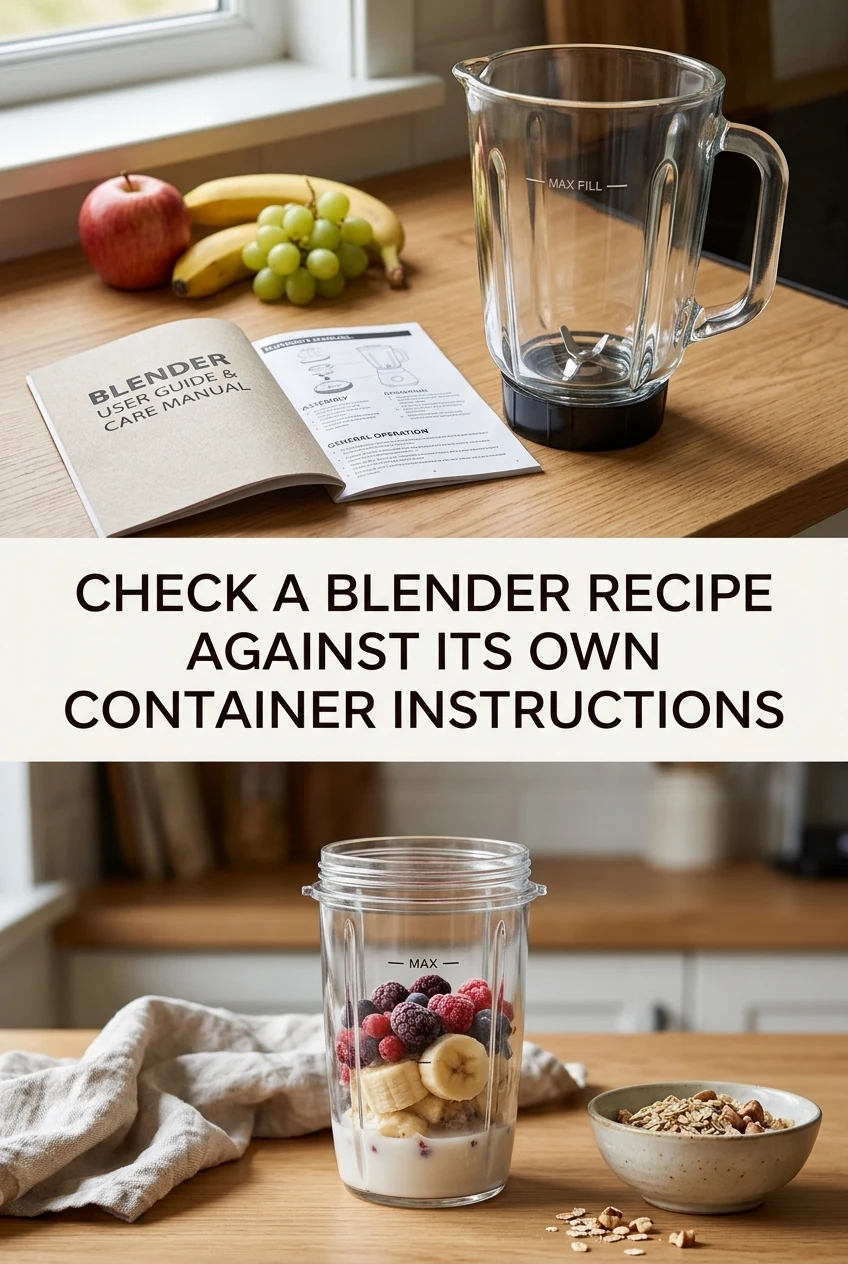
AI-generated editorial concept created for this article. The image is not a technical diagram or a tested result.
Locate Your Blender Manual and Jar Markings Before Anything Else
The manual for your blender is the only document that accurately describes your specific jar. Pull it out before you look at any recipe. Find the section that lists the maximum fill level for liquid ingredients and, separately, any guidance for thick or frozen mixtures, because many manuals state a lower fill point for dense blends than for thin liquids. Also look at the physical markings printed or molded onto the jar itself. These markings are your reference during preparation. If you no longer have the paper manual, visit the manufacturer's official website and search by your exact model number to download the correct version. A manual for a different model from the same brand may carry different limits, so model-specific accuracy matters here.
Read the Recipe in Full Before Touching Any Ingredient
Once you have your manual open, read the entire recipe from start to finish without preparing anything yet. Note the total combined volume of all ingredients the recipe calls for, and note whether the recipe specifies an order for adding them. Recipes sometimes list ice or frozen fruit first, sometimes last, and your jar manual may specify a preferred loading order for your motor and blade assembly. Write down the recipe's total ingredient list on a piece of paper so you can compare it against your jar's markings in one clear view. This is still the planning stage. Nothing goes into the jar yet.
Compare the Recipe Volume Against Your Jar's Actual Markings
Hold your written ingredient list next to the markings on your jar. Add up the volumes of all liquid and soft ingredients the recipe calls for and check whether that combined amount falls at or below the maximum line your manual specifies for that type of blend. If the recipe includes ice or large frozen chunks, your manual may ask you to fill to a lower point to leave room for movement during blending. If the recipe total exceeds what your jar marking allows, you have identified a mismatch before wasting any ingredients. At this point you can decide to halve the recipe, blend in two separate batches, or choose a different recipe that fits your jar. Do not adjust the jar's maximum line or assume a small overflow is acceptable.
A Practical Example Using a Mango and Yogurt Blend
Suppose a recipe calls for two cups of chopped mango, one cup of plain yogurt, half a cup of orange juice, and one cup of ice. That totals four and a half cups of ingredients combined. You check your jar and the manual states the maximum fill for thick blends is four cups. The recipe exceeds your jar's stated limit by half a cup. Rather than proceeding and risking overflow, you decide to split the ingredients across two separate blending sessions, or you reduce the mango to one and a half cups to bring the total to four cups. You make this decision during planning, before any mango is peeled or ice is measured. The jar marking, not the recipe, is the controlling reference.
Follow Your Manual's Loading Order During Preparation
Once you have confirmed the recipe fits your jar, preparation begins. Add ingredients in the order your manual describes, not necessarily the order the recipe lists them. Many manuals ask for liquids to go in first so the blades engage properly from the start. Others specify that ice or hard frozen pieces go in last. Follow your manual's sequence exactly. After loading, check that the total contents sit at or below the fill line before placing the lid. Secure the lid as your manual directs, then blend according to the time and speed settings the manual or recipe recommends. If the recipe suggests a speed or duration your manual advises against for your jar size, follow your manual.
A little more
to know.
What should I do if my recipe does not specify volumes, only weights in grams?
Do not attempt to convert grams into a volume estimate to compare against your jar's markings, because density varies between ingredients and any conversion would be an approximation rather than an accurate measurement. Instead, weigh your ingredients on a kitchen scale as specified by the recipe, then watch the jar's fill markings as you load them. If the ingredients reach your manual's stated maximum fill line for that type of blend, divide the mixture and blend it in separate batches. Your jar marking is the reliable reference, not a calculated conversion.
Can I use the maximum fill line from a jar that looks similar to mine but is a different model?
No. Jar markings and manual specifications are model-specific. A jar that appears identical in shape may have a different stated capacity or a different recommended fill level for thick ingredients. Always use the manual and the physical markings that correspond to your exact model number. If your jar has no visible markings, download the manual for your specific model from the manufacturer's official website to find the correct fill guidance.
Original editorial guidance and recipe formulations, not independently kitchen-tested. Times are estimates and depend on equipment and product directions. Cooked bases need additional cooling and refrigeration before cold serving. Images are AI-generated illustrations; appearance and yield may vary. Check actual ingredient labels, allergens, and any certification you require. We do not certify products. Read our approach.
Save to Pinterest ↗ANOTHER IDEA FOR THE COUNTER