Brew a Small Pot of Oolong and Decide How Long to Steep Each Subsequent Fill
Oolong tea leaves are designed to be steeped multiple times, and that quality makes them practical for a small café pot. The challenge is that each fill requires a different steeping time. Using the same duration for every pour leads to a second cup that tastes either bitter from over-extraction or thin from under-extraction. Knowing how to adjust timing across fills, using your specific tea tin as the reference, produces a consistent experience from the first cup through the last.
Read the note ↓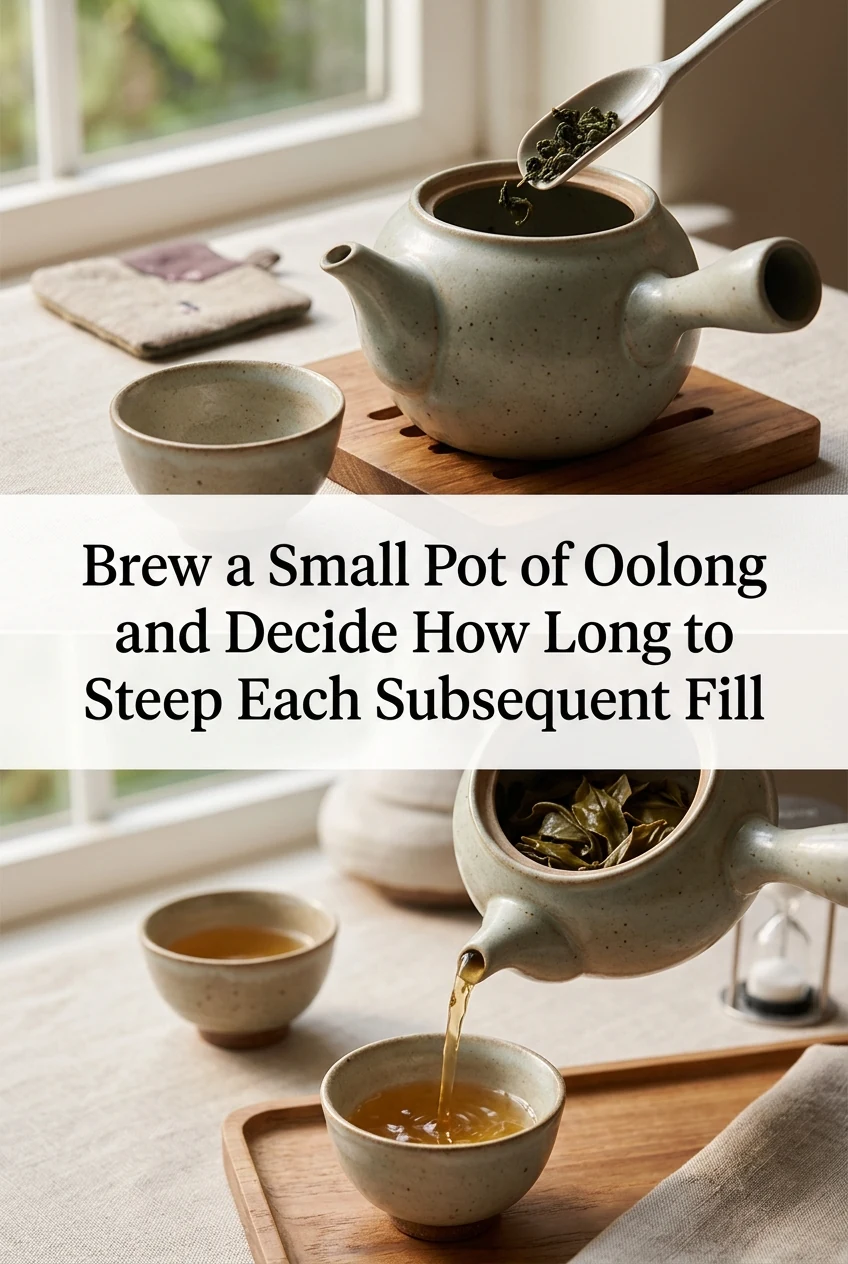
AI-generated editorial concept created for this article. The image is not a technical diagram or a tested result.
Why Oolong Leaves Change Between Steeps
Oolong leaves are partially oxidized and often rolled into tight balls or twisted strips. During the first steep, the leaves absorb water and begin to unfurl, releasing their initial layer of flavor compounds. By the second steep, the leaves are fully open and have already yielded their most easily soluble surface compounds, so extracting the remaining flavor requires more time. A third steep draws from a leaf that has already given up much of its top notes, requiring even longer to develop body. Each fill interacts with a different state of the same leaf.
Reading Your Tin for Re-Steep Guidance
Quality oolong tins and packets frequently include re-steep timing on the label or an enclosed card. This guidance is specific to that tea's oxidation level, leaf size, and processing style, which is why it is more reliable than a generic rule. A lightly oxidized green oolong and a heavily roasted dark oolong behave very differently across multiple steeps. If your tin provides times for a second and third fill, use those numbers as your starting point rather than estimating from another tea's behavior.
A Practical Starting Framework When No Guidance Is Printed
When tin guidance is absent, a common starting approach is to add roughly 15 to 30 seconds to each subsequent steep beyond the first. For example, if the first steep runs two minutes, the second might run two minutes and 20 seconds, and the third around two minutes and 45 seconds. Treat these as adjustable estimates rather than fixed rules. Taste the tea at the lower end of each range and extend by 10-second increments if the flavor seems thin. This is an illustrative framework, not a universal formula.
Water Temperature Across Multiple Fills
Maintain consistent water temperature across all fills. If your first steep used water at approximately 85 degrees Celsius, use the same temperature for subsequent fills. Switching to hotter water on a later steep accelerates extraction unpredictably and can introduce bitterness even with a shorter steep time. A temperature-controlled kettle makes this straightforward. If you are using a standard kettle, allow boiled water to rest for a similar amount of time before each fill to approximate the same starting temperature.
Deciding When the Leaves Are Spent
Most oolong leaves suitable for a café pot yield two to three quality steeps. Signs that the leaves are spent include a noticeably pale color in the cup, a flat or papery flavor, and a lack of aroma when you lift the pot lid. At that point, adding more water and time will not recover meaningful flavor. Discard the leaves and start fresh. Attempting to extend spent leaves beyond their useful range produces a weak cup that does not represent the tea well.
A little more
to know.
Does the amount of leaf used affect how many steeps are possible?
Yes. A more generous leaf quantity relative to pot size generally supports more steeps because there is more material to draw from. A very sparse amount may exhaust its flavor by the second fill. Follow your tin's recommended leaf quantity as the baseline for its stated re-steep guidance.
Should the pot be warmed before the first fill of oolong?
Warming the pot with a small amount of hot water before adding leaves helps maintain water temperature during steeping, particularly with ceramic or clay pots that absorb heat. Swirl the warming water briefly, discard it, then add your leaves and begin the first steep.
Original editorial guidance and recipe formulations, not independently kitchen-tested. Times are estimates and depend on equipment and product directions. Cooked bases need additional cooling and refrigeration before cold serving. Images are AI-generated illustrations; appearance and yield may vary. Check actual ingredient labels, allergens, and any certification you require. We do not certify products. Read our approach.
Save to Pinterest ↗ANOTHER IDEA FOR THE COUNTER