Brew a Small Pot of Darjeeling for Hot and Iced Service From the Same Leaves
Darjeeling brewed in a small teapot can serve two people differently from a single steep if you plan the yield before you pour. One portion goes directly into a warmed cup for immediate hot service, while the second portion goes over ice in a separate glass. The challenge is that the tea destined for ice needs to be brewed slightly stronger to account for dilution, which means splitting the pot at the right moment rather than treating both cups as identical.
Read the note ↓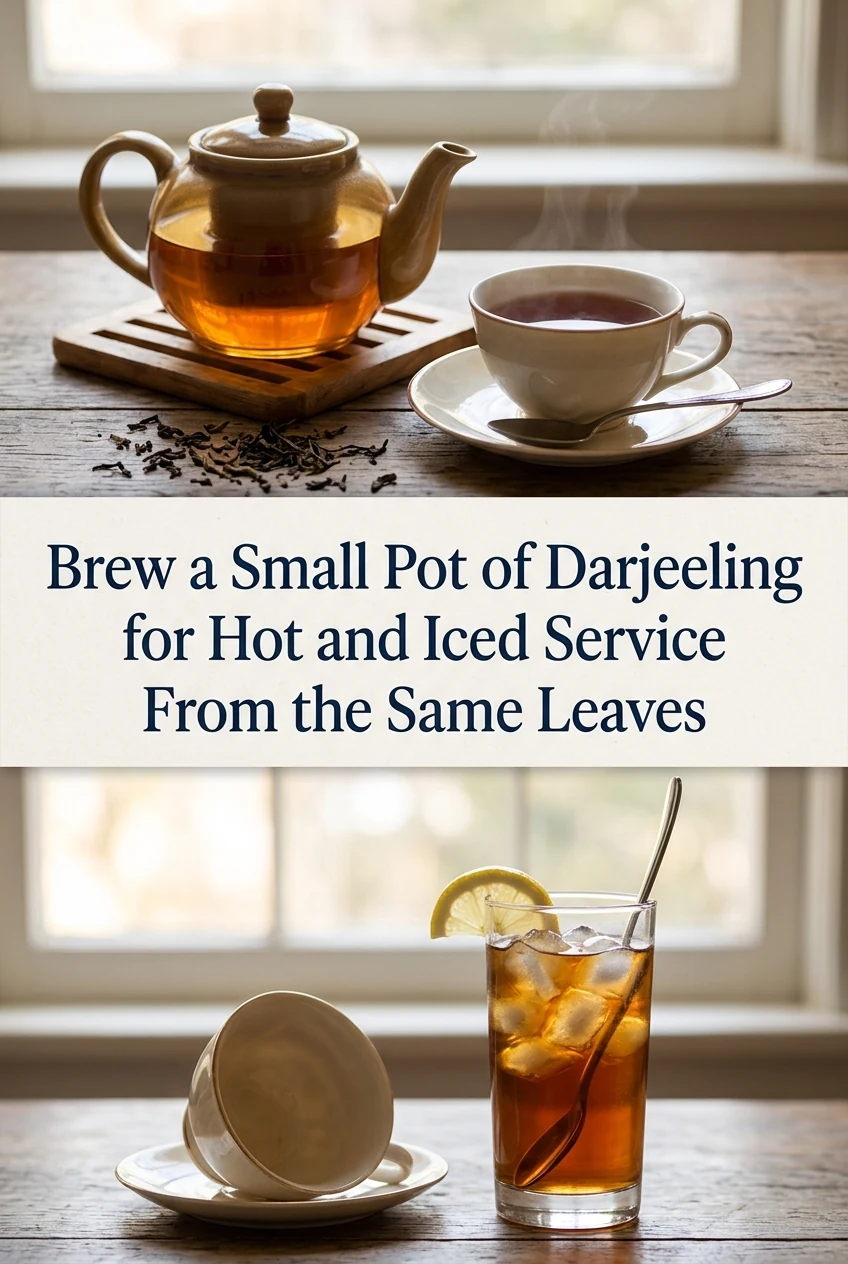
AI-generated editorial concept created for this article. The image is not a technical diagram or a tested result.
Calculate Your Yield Before You Brew
A small teapot holding 400 to 450 millilitres of water gives you enough liquid for one standard hot cup of roughly 180 millilitres and one iced portion that starts at 150 millilitres before ice dilution. Measure your water before heating so you know exactly what you are working with. Brewing blind and then trying to split an unknown volume leads to uneven cups. This is a practical working example, not a fixed rule for all teapots.
Leaf Quantity and Steep Time
Use the quantity of loose Darjeeling leaf recommended on your specific tea's packaging as a starting point, since first flush, second flush, and autumnal Darjeeling vary in leaf size and density. Steep time for Darjeeling is typically two to three minutes in water around 85 to 90 degrees Celsius, but follow your tea supplier's guidance. Over-steeping Darjeeling produces noticeable bitterness that becomes more pronounced once the tea cools or is poured over ice.
Split the Pot at the Right Moment
Pour the hot cup first into a warmed mug as soon as the tea reaches balanced drinking strength, typically around two minutes into the steep. Leave the remaining water in contact with the leaves in the teapot for an additional 45 to 60 seconds. This staggered timing allows the second portion to extract the extra strength and body needed to withstand dilution from melting ice. Once that additional time has elapsed, decant the remaining liquid completely into a separate heat-safe vessel off the leaves to halt extraction before pouring over ice.
Pour Over Ice Without Over-Diluting
Fill a tall glass with ice cubes, then pour the reserved hot tea portion directly over the ice in a steady stream. The hot liquid melts some ice immediately, which is the intended dilution. Use enough ice to chill the drink quickly but not so much that the tea becomes watery. As a working guide, 150 millilitres of tea poured over a glass filled roughly two-thirds with ice cubes produces a well-chilled drink without excessive dilution for most palates.
Adding Milk to Either Portion
Cold whole milk or pasteurised oat milk can be added to the iced portion after pouring over ice. Add it last so you can judge the colour and adjust the amount. For the hot cup, add milk after pouring into the warmed mug. Darjeeling's lighter body means a small amount of milk, around 20 to 30 millilitres, is usually enough before the tea character becomes muted. Taste before adding more.
A little more
to know.
Can I brew the tea ahead of time and refrigerate the iced portion?
Yes. Pour the iced portion into a sealed container and refrigerate at 4 degrees Celsius or below within two hours of brewing. Consume within 24 hours for best flavour. Do not leave brewed tea at room temperature for extended periods before refrigerating.
Why does Darjeeling sometimes turn cloudy when poured over ice?
Cloudiness in chilled black tea is caused by tannins and caffeine binding together as the temperature drops rapidly, a process sometimes called tea cream. It is harmless and more common with certain flush types. Brewing at a slightly lower temperature or cooling the tea more gradually before icing can reduce it.
Original editorial guidance and recipe formulations, not independently kitchen-tested. Times are estimates and depend on equipment and product directions. Cooked bases need additional cooling and refrigeration before cold serving. Images are AI-generated illustrations; appearance and yield may vary. Check actual ingredient labels, allergens, and any certification you require. We do not certify products. Read our approach.
Save to Pinterest ↗ANOTHER IDEA FOR THE COUNTER