Avocado and Cocoa Cold Smoothie With Plain Yogurt
Ripe avocado blends into a naturally creamy base, but when cocoa powder is added without a binding ingredient the mixture tends to turn grey and separate within minutes. Plain yogurt acts as that binding ingredient here, holding the cocoa evenly through the avocado flesh and giving the finished drink a consistent colour and texture long enough to pour and serve. This article walks through ingredient selection, the correct loading order for the blender, and the importance of serving the smoothie immediately after blending rather than letting it sit.
Read the note ↓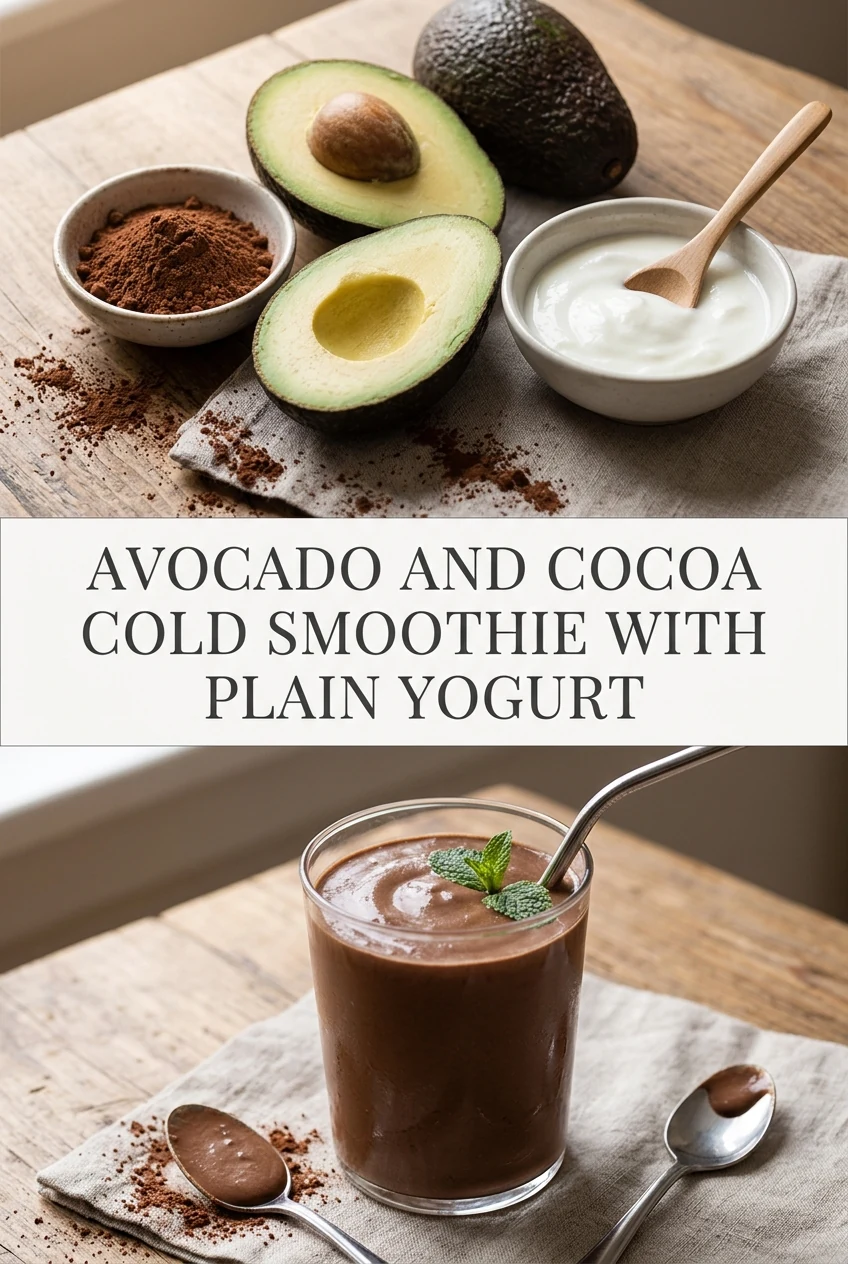
AI-generated editorial concept created for this article. The image is not a technical diagram or a tested result.
Choosing the Right Avocado and Checking Ripeness
The avocado must be fully ripe before it goes into the blender. Press the skin gently near the stem end; a ripe fruit gives slightly without feeling mushy. The flesh inside should be a consistent pale green with no large brown patches. One medium ripe avocado yields roughly 120 to 150 grams of usable flesh once the skin and stone are removed, which is enough for a single large glass or two smaller servings when combined with the other ingredients. Avoid avocados that feel hollow or have fibrous streaks through the flesh, as those textures do not blend smoothly and leave the finished drink with an uneven consistency.
Selecting Cocoa Powder, Yogurt and Cold Milk
Use unsweetened natural cocoa powder or unsweetened Dutch-process cocoa powder. Both dissolve into the blended mixture when combined with liquid, though Dutch-process cocoa produces a slightly darker colour. Check the label to confirm no alcohol-based additives are listed. Plain yogurt, meaning unflavoured and unsweetened, works as the binding ingredient; full-fat plain yogurt contributes a thicker texture while low-fat plain yogurt produces a slightly thinner result. For this worked example, use 80 grams of plain yogurt. Cold whole milk or cold semi-skimmed milk both work; use 180 millilitres straight from the refrigerator. Chilled milk keeps the blended drink cold without requiring added ice, which would dilute the cocoa flavour. If you prefer a sweeter drink, a small spoonful of honey or sugar can be added before blending.
Loading the Blender in the Correct Order
Loading order matters because it affects how evenly the cocoa powder incorporates and how smoothly the avocado breaks down. Follow these steps for the worked example: First, pour the 180 millilitres of cold milk into the blender jar. Liquid at the bottom helps the blades move freely from the first second of blending. Second, add the 80 grams of plain yogurt directly on top of the milk. Third, scoop the avocado flesh, approximately 130 grams, into the jar. Fourth, measure one level tablespoon of unsweetened cocoa powder and add it last, placing it on top of the avocado rather than pressing it against the sides of the jar. Adding cocoa on top prevents it from clumping against the dry walls before blending begins. If you are adding a sweetener, add it at this stage as well. Secure the lid firmly before starting the blender.
Blending to a Uniform Texture
Start the blender on a low speed setting for approximately ten seconds to begin breaking down the avocado and pulling the cocoa powder into the liquid. Then increase to a higher speed and blend for a further twenty to thirty seconds, or until the mixture looks completely smooth with no visible flecks of avocado or cocoa. Stop the blender and check the texture by tilting the jar gently; a well-blended smoothie moves as a single consistent mass rather than showing separate layers. If the blender has a pulse function, a few short pulses at the end can help finish any remaining lumps near the sides. This is an illustrative plan based on typical blender behaviour, not a tested result, and your specific blender model may require a different approach according to its own manufacturer instructions.
Serving Immediately and Avoiding Separation
Pour the smoothie into a chilled glass straight after blending. Avocado flesh begins to oxidise once it is exposed to air, and the cocoa and avocado mixture will start to separate and grey if left to stand. Serving immediately after blending is the practical solution rather than any storage method. For the worked example using one medium avocado, 80 grams of yogurt and 180 millilitres of milk, the blender jar will hold roughly 350 to 380 millilitres of finished smoothie, which fills one standard 400-millilitre smoothie glass comfortably. Drink it while it is still cold for the best texture and colour.
A little more
to know.
Can I use cocoa powder that contains added sugar?
Yes, sweetened cocoa powder can be used, but it will make the finished smoothie noticeably sweeter. If you use sweetened cocoa powder, taste the blended mixture before adding any additional honey or sugar to avoid an overly sweet result.
Why does the smoothie turn grey if I leave it to stand?
Avocado flesh contains enzymes that react with oxygen in the air, causing the green colour to darken and grey. Blending breaks the flesh into very small particles, which increases the surface area exposed to air. The yogurt helps hold the mixture together during blending, but it does not stop oxidation from occurring over time. Serving the smoothie immediately after blending is the straightforward way to enjoy it before the colour changes.
Original editorial guidance and recipe formulations, not independently kitchen-tested. Times are estimates and depend on equipment and product directions. Cooked bases need additional cooling and refrigeration before cold serving. Images are AI-generated illustrations; appearance and yield may vary. Check actual ingredient labels, allergens, and any certification you require. We do not certify products. Read our approach.
Save to Pinterest ↗ANOTHER IDEA FOR THE COUNTER