Assemble a Sparkling Fruit Drink in the Right Pouring Order
The order in which you build a sparkling fruit drink in a glass determines whether you end up with a foamy overflow, flat bubbles or a well-layered drink with carbonation intact. Most overflow problems happen when syrup or juice is poured into a glass already filled with sparkling water, triggering a rapid release of dissolved gas. Reversing the order, placing the fruit base and ice first and adding sparkling water last, gives you a practical way to avoid that problem at home.
Read the note ↓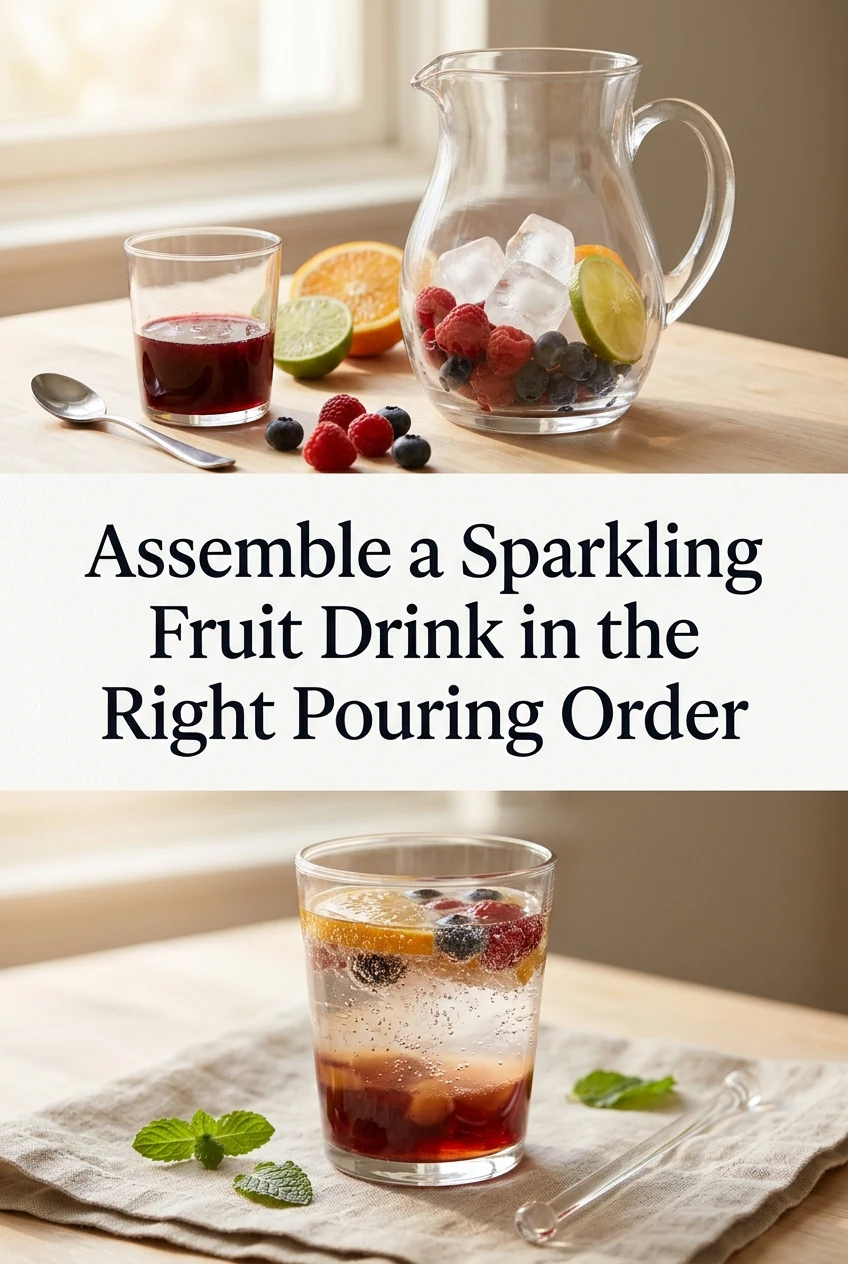
AI-generated editorial concept created for this article. The image is not a technical diagram or a tested result.
Why Pouring Order Affects Carbonation
Carbonated water holds dissolved carbon dioxide under pressure. When a sugary or acidic liquid is introduced into a full glass of sparkling water, it acts as a nucleation trigger, causing bubbles to form rapidly at many points simultaneously. This produces the foam surge familiar from adding syrup to a seltzer glass. Adding carbonated water last, over a denser fruit base, allows the gas to release more gradually because the mixing happens from the bottom up rather than all at once.
The Assembly Sequence Step by Step
Start with a clean glass. Add your fruit syrup or juice concentrate first, using a measured amount such as 30 to 45 millilitres for a 300-millilitre glass, which is an illustrative starting range rather than a fixed rule. Add ice next, filling the glass to roughly two thirds. Finally, pour sparkling water slowly down the inside wall of the tilted glass rather than directly onto the ice. This wall-pour slows the mixing and reduces the foam surge at the surface.
Choosing Between Fresh Juice and Syrup as the Base
Fresh citrus juice and fruit syrups behave differently in this assembly. Fresh juice is thinner and mixes more readily with sparkling water, producing a lighter result. A fruit syrup made with dissolved sugar is denser and tends to sit below the sparkling water briefly, giving you a visible layered effect before stirring. If you want a uniform drink, stir gently once after pouring. If you want the layered look for serving, skip stirring and let the guest combine it themselves.
Managing Ice to Avoid Over-Dilution
Ice added before the sparkling water chills the glass and slows the release of carbonation, which helps preserve bubbles. However, ice that has been sitting at room temperature for several minutes will already be melting and will dilute the drink faster. Use ice directly from the freezer when possible. For a 300-millilitre glass, four to six standard ice cubes is a workable fill without leaving so little room that the sparkling water overflows when poured.
Serving Immediately After Assembly
Sparkling fruit drinks lose carbonation quickly once assembled, especially in a warm room. Serve the drink within a minute or two of adding the sparkling water. If you are making several drinks for a small group, assemble them one at a time rather than lining up all glasses and filling them in stages. Pre-assembled drinks left standing lose their effervescence before they reach the table, which defeats the purpose of using sparkling water in the first place.
A little more
to know.
Does the type of sparkling water, such as seltzer versus naturally sparkling, change how I should pour?
The pouring technique applies to both. Naturally sparkling water and manufactured seltzer both contain dissolved carbon dioxide that reacts to nucleation triggers. The wall-pour method and the order of ingredients work the same way regardless of the source of carbonation.
Can I pre-mix the fruit base and sparkling water in a jug for a group?
You can, but carbonation drops noticeably within minutes in a wide jug, especially if stirred. For groups, it is more practical to set out the fruit base and a chilled bottle of sparkling water and let guests pour their own glasses using the correct order.
Original editorial guidance and recipe formulations, not independently kitchen-tested. Times are estimates and depend on equipment and product directions. Cooked bases need additional cooling and refrigeration before cold serving. Images are AI-generated illustrations; appearance and yield may vary. Check actual ingredient labels, allergens, and any certification you require. We do not certify products. Read our approach.
Save to Pinterest ↗ANOTHER IDEA FOR THE COUNTER