Arrange Finished Baked Goods Without Covering Them in Loose Powder
A home-cafe tray looks polished when baked goods sit cleanly on a plate without a cloud of icing sugar or cocoa drifting toward the drinks beside them. This technique is about placement decisions and a controlled approach to any optional dusting, keeping the drink station free from airborne powder that can settle into open cups. Nothing here claims a tested kitchen result; this is a practical arrangement method you can adapt to your own setup.
Read the note ↓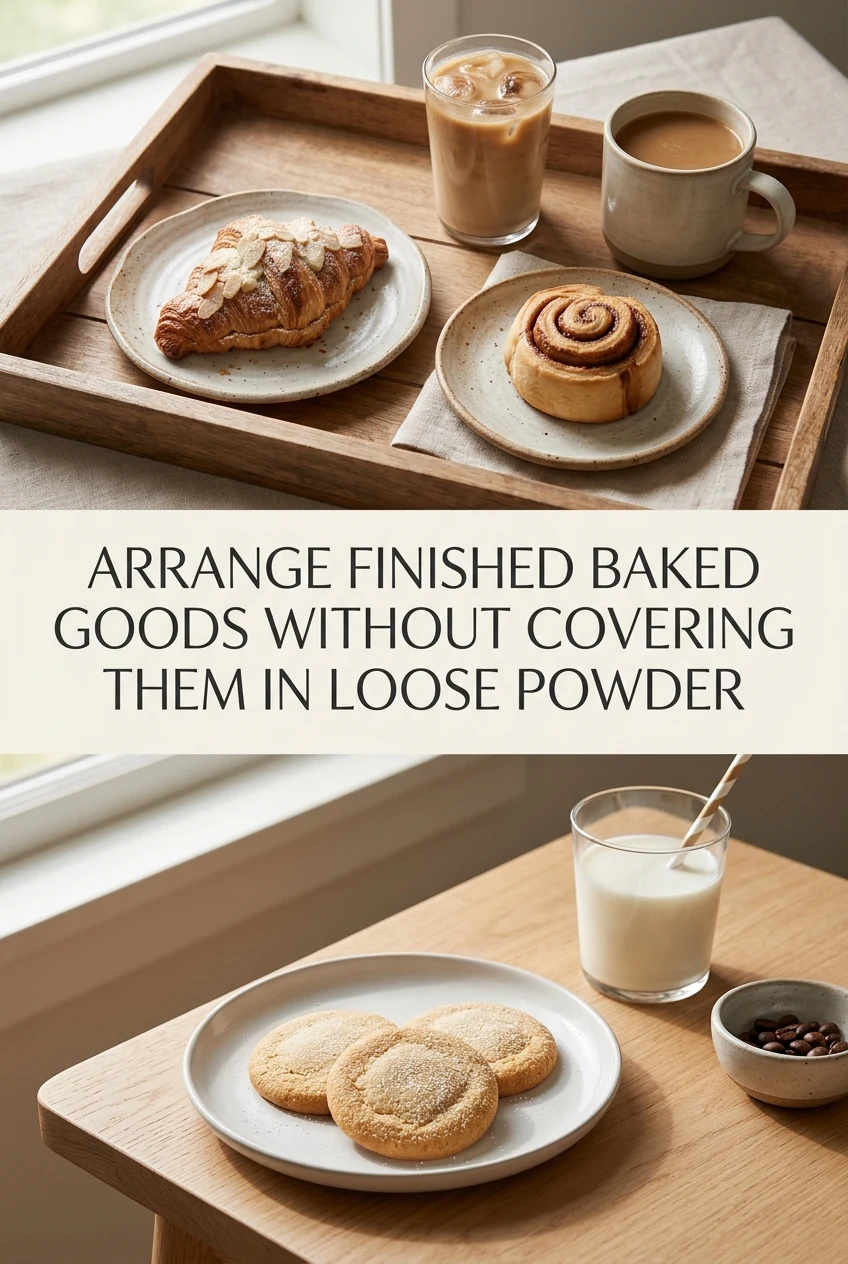
AI-generated editorial concept created for this article. The image is not a technical diagram or a tested result.
Choose a Plate That Gives Each Piece Its Own Space
Start with a clean, flat serving plate large enough that baked goods do not touch one another. Crowding causes pieces to press together and dislodge any surface finish they already have. A useful rule of thumb for a home-cafe tray is to leave at least two finger-widths of clear plate between each item. For a worked example, imagine six small cardamom shortbread rounds on a 28 cm round plate: place one in the centre, then space the remaining five evenly around it, each sitting roughly 3 cm from its neighbour. This layout leaves the rim clear and gives you a visible boundary between the food and the edge of the tray.
Handle Pieces at the Base, Not the Top
Pick up each baked good from its base or sides rather than pressing down on the top surface. This matters most for items that have been lightly dusted before baking, such as a sesame-topped roll or a piece finished with a small amount of ground cinnamon mixed into the dough. Gripping from the top compresses the surface and can flick loose particles outward. Use a small offset spatula or a clean pastry lifter to transfer items from a cooling rack to the plate one at a time. Set each piece down gently rather than sliding it, which drags the base and can tilt the item.
Keep Optional Dusting Measured and Done Away from the Drink Station
If a recipe calls for a light dusting of icing sugar or ground spice after baking, apply it before the plate moves to the drink station, not after. Measure a small amount into a fine-mesh sieve, hold the sieve low over the individual piece rather than sweeping it across the whole plate, and tap once or twice. This limits how far the powder travels. For the shortbread example, a quarter teaspoon of icing sugar passed through a fine sieve held 5 cm above one biscuit produces a visible but contained finish. Once the plate is at the drink station, no further dusting should happen. Any remaining powder in the sieve goes back into a sealed container.
Position the Plate Relative to Open Cups
On a home-cafe tray, the drink cups are usually the tallest items. Place the serving plate to one side of the cups rather than directly in front of them, so that if any residual surface powder does shift when a guest lifts a piece, it moves away from the open drinks. A simple tray layout for two people might be: two cups at the back of the tray, the plate of baked goods at the front left, and a small folded napkin at the front right. This arrangement keeps a clear boundary between the food zone and the liquid zone without requiring any physical barrier.
Refrigerate Perishable Items Promptly and Correctly
Some baked goods that pair with tea or grain-based drinks contain fillings or toppings that need refrigeration, such as a cream cheese swirl made with full-fat cream cheese or a custard-filled pastry. Follow the specific guidance that came with your recipe or the filling product. Do not leave these items at room temperature for longer than the recipe or product label specifies. When refrigerating, cover the plate loosely with a sheet of baking paper rather than plastic wrap pressed directly onto a decorated surface, which can pull off a glaze or stick to a soft topping. Halal-certified gelatin-set items should also be stored according to the recipe directions. This article does not assign a shelf life to any item; defer to the source recipe for that information.
A little more
to know.
Can I dust the whole plate instead of individual pieces to save time?
Dusting the whole plate means powder collects in the gaps between pieces and on the rim, and it is more likely to become airborne when the plate is moved or when a guest lifts an item. Dusting each piece individually before the plate goes to the tray takes slightly longer but keeps the powder where it is intended to be. If time is short, skip the dusting step entirely; a cleanly arranged plate without any powder still looks considered and deliberate.
What if a baked good has already been finished with a thick glaze that is still slightly tacky?
Allow the glaze to set fully on the cooling rack before transferring the item to the serving plate. A tacky glaze will pick up any debris from the plate surface and may stick to a napkin or to a neighbouring piece if they are placed too close together. Check the recipe for the expected setting time for that particular glaze, as this varies by recipe and by the temperature of your kitchen. Once the glaze is firm to a light touch at the edge, it is generally ready to plate.
Original editorial guidance and recipe formulations, not independently kitchen-tested. Times are estimates and depend on equipment and product directions. Cooked bases need additional cooling and refrigeration before cold serving. Images are AI-generated illustrations; appearance and yield may vary. Check actual ingredient labels, allergens, and any certification you require. We do not certify products. Read our approach.
Save to Pinterest ↗ANOTHER IDEA FOR THE COUNTER