Weigh a Syrup Portion Directly into a Drink Glass
Measuring syrup by weight rather than by volume removes the guesswork that comes with spoons and small measuring cups. When you tare a drink glass on a kitchen scale and dispense syrup straight into it, you skip the intermediate measuring vessel entirely, which means one fewer item to wash and one fewer transfer that could leave syrup clinging to the sides of a cup. This article walks through the straightforward process of placing a glass on a scale, zeroing the display, and adding a 10 g syrup dose as a clear, repeatable example.
Read the note ↓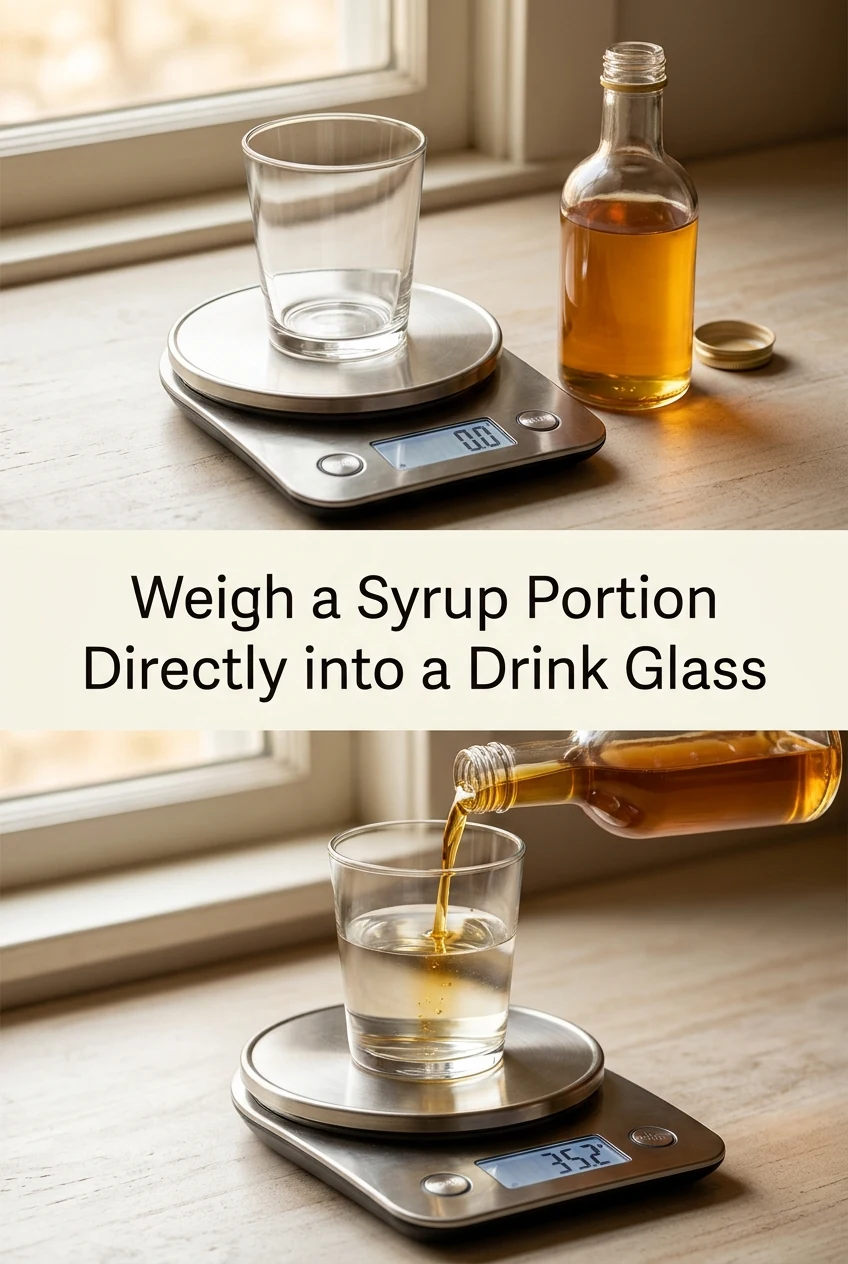
AI-generated editorial concept created for this article. The image is not a technical diagram or a tested result.
Choose a Suitable Glass and Scale
Not every glass sits stably on every scale platform. Before you begin, place the glass you plan to use on the scale and confirm it sits flat without rocking. A wide, flat-bottomed tumbler or a low, broad glass tends to sit more securely than a tall, narrow glass. Check that the scale platform is large enough to support the base of the glass fully. A kitchen scale that reads in 0.1 g increments gives you enough precision for a 10 g syrup dose, though a scale reading in whole grams is also workable for this size of portion. Make sure the scale is on a level, stable surface before you proceed.
Tare the Glass
Place the empty, dry glass on the scale platform. Press the tare or zero button so the display reads 0.0 g with the glass in place. This step subtracts the weight of the glass from any subsequent reading, so the number you see from this point forward reflects only what you add to the glass. If the display drifts slightly while the glass is sitting still, wait a moment for it to settle before you tare. Some scales have a brief stabilisation period after an item is placed on them, and taring before the reading settles can introduce a small offset.
Dispense 10 g of Syrup
With the display reading 0.0 g, slowly pour or squeeze syrup from your batch container directly into the glass. Watch the scale display as you pour and stop when it reads 10.0 g. Pouring slowly near the target weight gives you better control and reduces the chance of overshooting. If you do add a little too much, note the actual reading rather than trying to remove syrup, since removing syrup from the glass introduces its own inaccuracy. For this illustrative example, 10 g is a practical starting dose for a small-batch syrup in a single drink, and it is easy to scale up or down in future sessions once you have tasted the result at this amount.
Taste and Note the Result
After dispensing the syrup, add the other components of your drink as you normally would, then taste it. Pay attention to whether the sweetness level suits the drink. Write down the exact weight you used alongside the name of the syrup batch and the drink you made. This record becomes the starting point for your next session. If 10 g felt like too much or too little sweetness for your preference, you have a precise number to adjust from rather than a vague recollection of how many spoonfuls you used. Keeping even a brief handwritten note preserves that information for future reference.
Practical Considerations for Repeated Use
Once you have a dose weight that works for a particular syrup and drink combination, you can reproduce it consistently every time you make that drink. The process remains the same: place the glass, tare, dispense to the target weight. If you switch to a different syrup with a noticeably different concentration or ingredient ratio, treat it as a new starting point and taste again at 10 g before deciding whether to adjust. Different syrups made with different ingredient ratios will taste different at the same weight, so the recorded dose is specific to a given batch rather than a universal figure. Storing your dose notes with your syrup batch notes keeps everything in one place.
A little more
to know.
Does the shape of the glass affect the weight reading?
No. A scale measures mass regardless of the shape or size of the container sitting on it. What matters is that the glass sits stably on the platform and that you tare it before adding anything. The shape of the glass affects how the syrup looks and how easy it is to pour other ingredients in afterward, but it has no bearing on the accuracy of the weight reading itself.
What if my scale only reads in whole grams rather than tenths?
A scale that displays whole grams is still practical for a 10 g syrup dose. You will be working to the nearest gram rather than the nearest tenth, which is a reasonable level of precision for this kind of task. Dispense until the display shows 10 g and note that your actual amount could be anywhere from roughly 9.5 g to 10.4 g depending on where the scale rounds. For most small-batch syrup applications at this dose size, that range is close enough to give you a useful, repeatable starting point.
Original editorial guidance and recipe formulations, not independently kitchen-tested. Times are estimates and depend on equipment and product directions. Cooked bases need additional cooling and refrigeration before cold serving. Images are AI-generated illustrations; appearance and yield may vary. Check actual ingredient labels, allergens, and any certification you require. We do not certify products. Read our approach.
Save to Pinterest ↗ANOTHER IDEA FOR THE COUNTER