Use a Tare Sequence When a Recipe Has Several Dry Additions
When a matcha drink recipe calls for several dry ingredients added one after another into the same bowl or pitcher, a tare sequence turns a single kitchen scale into a precise running record. Instead of measuring each powder into a separate spoon and hoping nothing spills, you add directly to the vessel, read the display, write the number down, then zero the scale before the next addition. The written log is the safety net: if you accidentally press tare too soon, the previous recorded weight tells you exactly what was already in the bowl, so you can calculate what is still missing without guessing.
Read the note ↓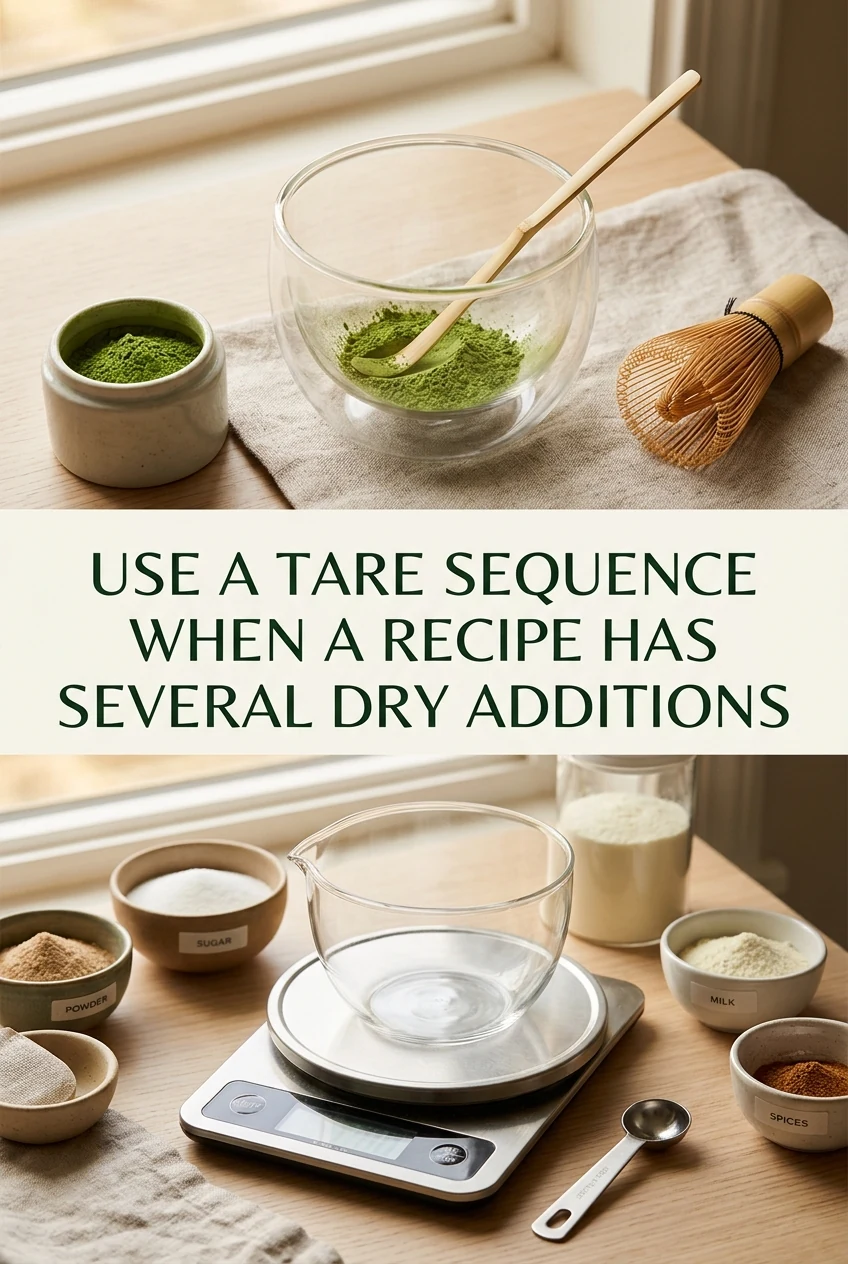
AI-generated editorial concept created for this article. The image is not a technical diagram or a tested result.
What a Tare Sequence Actually Is
A tare sequence is a home-cafe workflow, not a tested laboratory protocol. The idea is straightforward: every time you add a dry ingredient, you pause to note the weight of that addition shown on the display before you press tare again. You end up with a short column of numbers, one per ingredient, written on a notepad or a sticky note beside the scale. Those numbers are your checkpoint log. The sequence itself does not change how the scale works or guarantee any particular accuracy beyond what your scale already offers; it simply makes the information visible and recoverable at each step.
Setting Up Before You Start
Place your mixing bowl or spouted pitcher on the scale and write down its empty weight at the top of your notepad, then press tare so the display reads zero. Have a pen within reach before you open any containers. Write the name of each ingredient in order down the left side of the page, leaving a blank beside each name for the measured weight you will record. If your recipe calls for ceremonial-grade matcha, a small amount of coconut sugar, and a pinch of fine sea salt, list all three in the order you plan to add them. This preparation takes under a minute and establishes the baseline you need if you ever have to audit your vessel.
Working Through a Matcha Blend Example
Consider an illustrative plan for a cold matcha base: 4 g ceremonial-grade matcha, 6 g coconut sugar, and 1 g fine sea salt, all sifted into a small pitcher before liquid is added. Spoon the matcha in slowly until the display reads 4 g. Write '4' beside 'matcha' on your notepad. Press tare. Add coconut sugar until the display reads 6 g. Write '6' beside 'coconut sugar.' Press tare. Add sea salt until the display reads 1 g. Write '1' beside 'sea salt.' Your notepad now shows 4, 6, 1. Total dry weight is 11 g, which you can verify by placing a second empty bowl on the scale, zeroing it, and tipping the contents in if you ever want to cross-check. This example is an illustrative plan; adjust amounts to match your own recipe.
Recovering from an Accidental Tare
If you press tare mid-addition or before recording an amount, the display resets to zero and that ingredient's partial amount appears lost. This is where your log provides an exact recovery path. Lift the vessel off the scale; the display will read a negative number equal to the gross weight that was resting on the platform when tare was pressed. Take the absolute value of that number. Sum your recorded empty vessel weight and all previously completed ingredient weights, then subtract that baseline sum from the gross weight. The difference is the exact amount of the current ingredient already sitting in the vessel. Set the vessel back down on the scale (which returns to zero), subtract that partial amount from your recipe target, and add only the remaining difference. Record the full target weight in your log before zeroing the scale again.
Keeping the Workflow Tidy
A few habits keep the sequence clean. Use a scale that displays at least one decimal place for small amounts like matcha, where a gram or two matters noticeably. Keep the notepad dry and away from the bowl to avoid smudging. If you are making a batch that includes a liquid ingredient such as cold water or oat milk, finish all dry additions first, record the final dry total, then switch to measuring liquids separately or in the same vessel depending on your recipe. For any preparation that includes perishable dairy or plant-based milk, refrigerate promptly once mixed and follow the guidance on your specific product's packaging rather than relying on a general storage estimate.
A little more
to know.
Does the tare sequence work on any kitchen scale?
The workflow works on any scale that has a tare button, which includes most digital kitchen scales sold for home use. The sequence itself is just a note-taking habit layered on top of whatever scale you already own. Check your scale's manual for its minimum measurable increment, since very small amounts like 1 g of matcha are easier to add accurately on a scale that resolves to 0.1 g.
Can I use this approach when a recipe also calls for alcohol-free vanilla flavoring?
Yes. Treat the alcohol-free vanilla flavoring as you would any other addition: add it in the order your recipe specifies, read and record its weight, then press tare before the next ingredient. Because liquid flavorings add volume as well as weight, make sure your bowl or pitcher has enough headroom before you begin the sequence. Always choose a vanilla flavoring that is explicitly labeled alcohol-free to stay consistent with halal ingredient standards.
Original editorial guidance and recipe formulations, not independently kitchen-tested. Times are estimates and depend on equipment and product directions. Cooked bases need additional cooling and refrigeration before cold serving. Images are AI-generated illustrations; appearance and yield may vary. Check actual ingredient labels, allergens, and any certification you require. We do not certify products. Read our approach.
Save to Pinterest ↗ANOTHER IDEA FOR THE COUNTER