Store a Small Syrup Batch in the Right Refrigerator Spot
Where you place a homemade syrup inside the refrigerator matters more than most home cooks expect. The door shelves are the warmest zone because they open and close repeatedly throughout the day, causing temperature swings that can shorten how long a syrup stays usable. A middle or lower shelf positioned toward the back of the cabinet holds a steadier cold and gives a small batch its best chance of lasting through the week.
Read the note ↓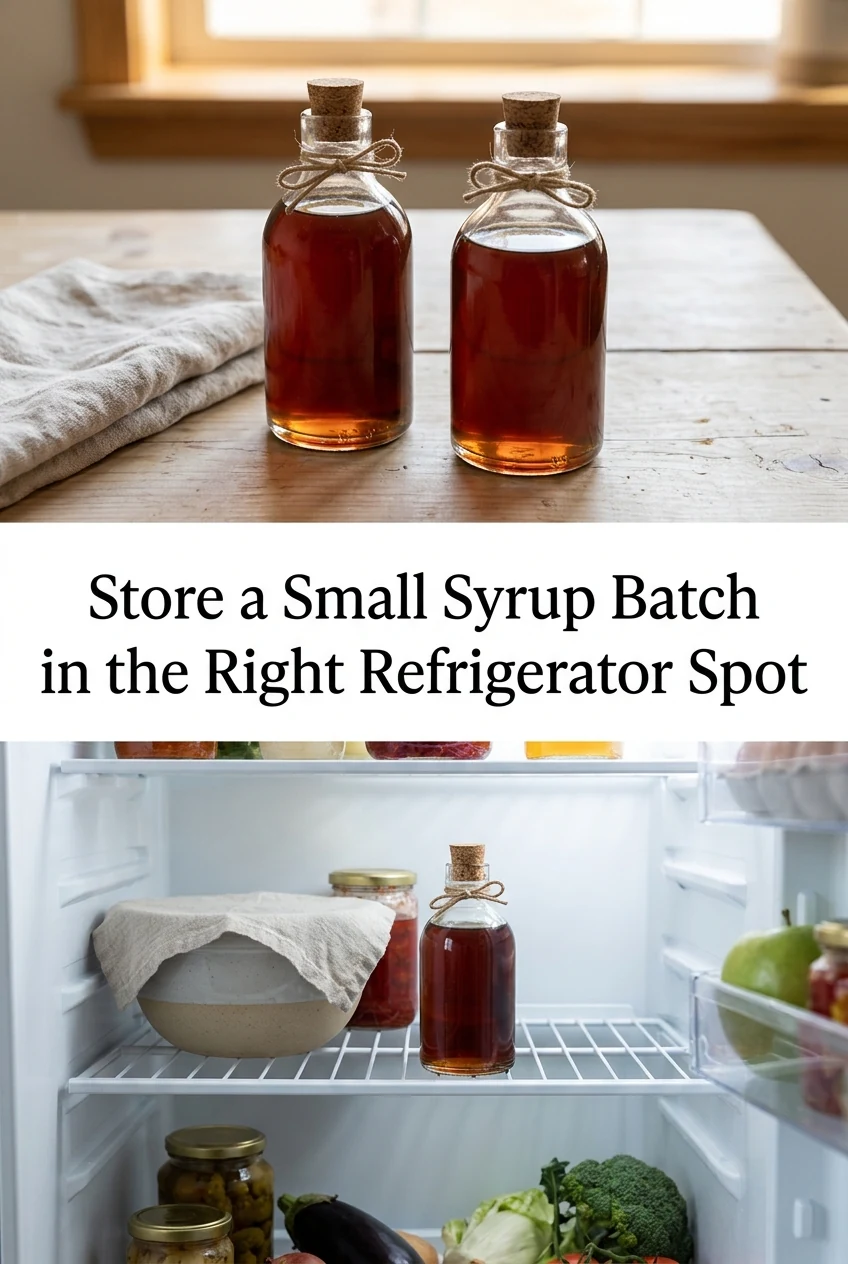
AI-generated editorial concept created for this article. The image is not a technical diagram or a tested result.
Why Door Storage Works Against You
Every time the refrigerator door opens, warm room air contacts whatever is stored in the door pockets. A simple sugar syrup kept there can cycle between roughly 4 and 10 degrees Celsius repeatedly across a single day. That repeated warming encourages microbial activity faster than continuous cold storage does. Moving the bottle even one shelf inward, away from the door seal, reduces how much ambient heat reaches it during each opening cycle.
Choosing the Right Shelf Position
Middle and lower shelves toward the back of the refrigerator cabinet stay closest to the cooling element airflow and experience the fewest temperature fluctuations. For a small 240 to 480 millilitre syrup bottle, a lower middle shelf works well because cold air sinks and collects there. Avoid placing the bottle directly against the back wall if your refrigerator tends to form frost patches, as contact freezing can change the syrup texture and cause separation.
Container Choice and Sealing
A clean glass bottle with a tight-fitting lid or a food-safe squeeze bottle with a secure cap both work for short-term refrigerator storage. Fill the container leaving minimal headspace, because a large air gap above the syrup allows more oxygen contact. Label the bottle with the date you made the syrup. As an illustrative example, a 1-to-1 sugar and water syrup made on Monday and stored correctly on a middle shelf is typically still suitable for use through the following week.
Recognising When a Syrup Has Turned
Visual and smell checks are your practical tools here. Cloudiness that was not present when you made the syrup, an off or sour odour, or visible mould at the surface or lid are clear signs to discard the batch. A syrup that has simply separated slightly from sitting can sometimes be gently swirled back together, but any fermented or sharp smell means the batch should not be used regardless of how recently it was made.
Returning the Bottle Promptly After Use
Refrigerator life depends not only on where the bottle sits but on how long it spends outside the cold. Pour what you need, recap the bottle, and return it within a few minutes. Leaving it on the counter while you prepare a drink, then leaving it out while you clean up, adds unnecessary time at room temperature. For food safety, return perishable syrups to cold storage within two hours of removal, or within one hour if your kitchen is above 32 degrees Celsius.
A little more
to know.
Does a higher sugar concentration change where I should store the syrup?
A richer syrup, such as a 2-to-1 ratio, is more resistant to spoilage than a 1-to-1 batch, but the same shelf position advice applies. Steady cold storage is still the safest approach regardless of concentration.
Can I store syrup in a plastic water bottle if I have no glass container?
A food-safe plastic bottle with a secure cap is acceptable for short-term refrigerator storage. Check that the plastic is rated for food contact and that the cap creates a proper seal before filling it with syrup.
Original editorial guidance and recipe formulations, not independently kitchen-tested. Times are estimates and depend on equipment and product directions. Cooked bases need additional cooling and refrigeration before cold serving. Images are AI-generated illustrations; appearance and yield may vary. Check actual ingredient labels, allergens, and any certification you require. We do not certify products. Read our approach.
Save to Pinterest ↗ANOTHER IDEA FOR THE COUNTER