Still Mulberry and Lemon Cooler Strained Into a Serving Jug
Fresh mulberries release their deep colour within minutes of being pressed, but they also shed fine pulp fibres that turn a cooler murky and give it an uneven texture. Straining the juice carefully before combining it with still water and lemon juice is the step that separates a clear, jewel-toned drink from a cloudy one. This guide walks through pressing, measuring, and assembling a mulberry and lemon cooler that stays visually clean from the first pour to the last.
Read the note ↓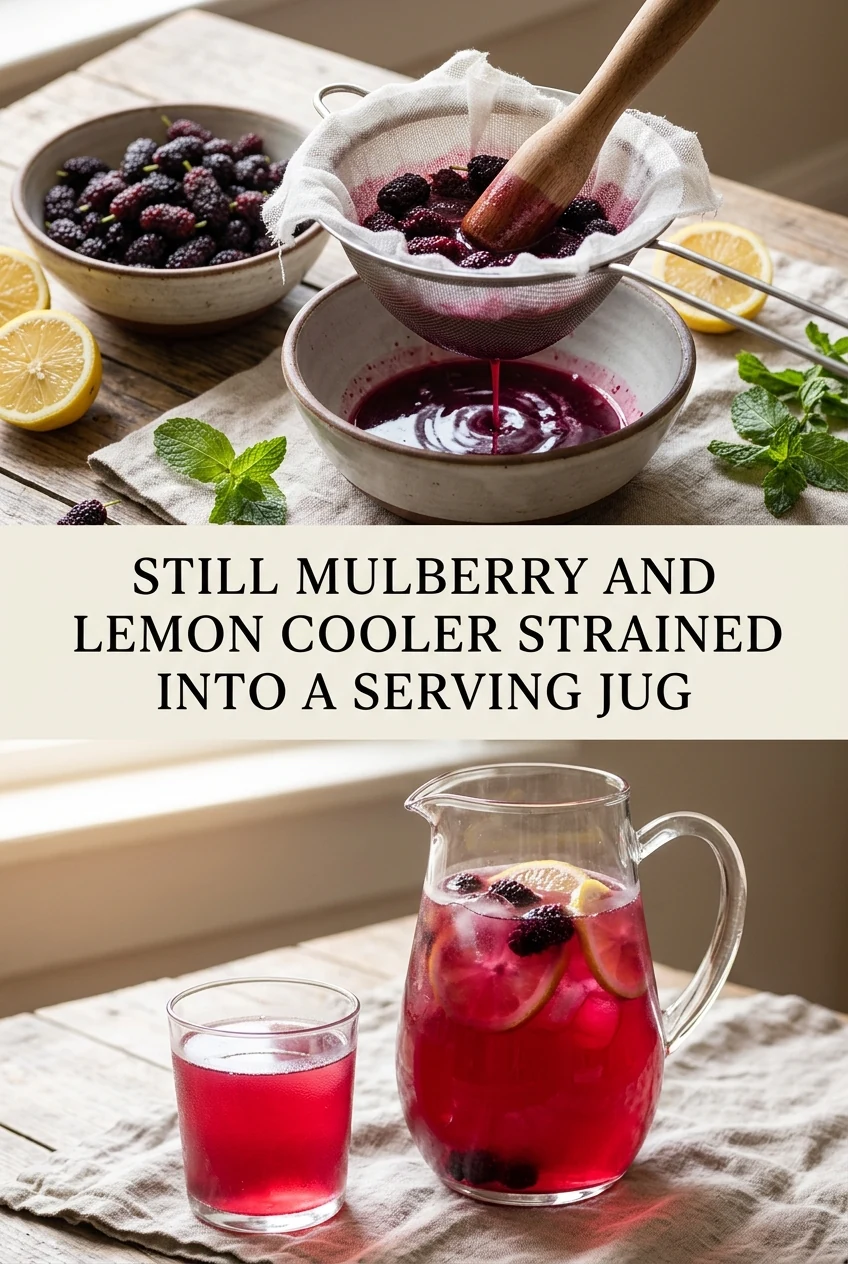
AI-generated editorial concept created for this article. The image is not a technical diagram or a tested result.
Preparing and pressing the mulberries
Rinse 200 grams of fresh mulberries under cold running water and drain them in a colander. Place them in a fine-mesh sieve set over a bowl and press firmly with the back of a large spoon, working in small circular motions across the fruit. Avoid rushing this step. Pressing too hard at once forces pulp fibres through the mesh. Work the fruit gradually and scrape the underside of the sieve with the spoon to collect juice that clings to the mesh.
Why measuring strained juice before diluting matters
Mulberries vary in water content depending on ripeness, so 200 grams of fruit might yield anywhere from 80 to 130 millilitres of strained juice. Measuring the juice before adding still water lets you keep a consistent ratio. A workable starting point is one part strained juice to three parts still water, so 100 millilitres of juice would combine with 300 millilitres of water. Adjusting from a measured base is more reliable than estimating by eye after dilution.
Adding lemon juice without overpowering the mulberry
Freshly squeezed lemon juice brightens the mulberry flavour but can dominate if added without restraint. Start with 20 millilitres of lemon juice per 400 millilitres of assembled drink, stir, and taste before adding more. The lemon should be detectable as a background sharpness rather than the primary flavour. Strain the lemon juice through the same fine sieve to remove any pips or pulp that would add bitterness or cloudiness to the finished cooler.
Sweetening and assembling in the serving jug
Dissolve any sugar or simple syrup in the strained mulberry juice before adding still water, since sugar disperses more evenly in a smaller, more concentrated volume. Pour the sweetened juice into the serving jug first, then add the still water slowly down the side of the jug to avoid disturbing the colour layers if you want a brief visual gradient before stirring. Add ice after the liquids are combined so the ice does not dilute the drink unevenly during assembly.
Keeping the cooler clear during service
Even well-strained mulberry juice can develop a fine sediment as it sits, particularly if any pulp passed through the mesh. Stir the jug gently before each pour rather than letting it stand unstirred for long periods. If the cooler is being served over more than an hour, keep the jug refrigerated at 4 degrees Celsius or below and return it promptly after each use. Discard any unused portion that has been left at room temperature for more than two hours.
A little more
to know.
Can I use frozen mulberries if fresh ones are unavailable?
Frozen mulberries work but release more liquid as they thaw, which can make the juice harder to strain cleanly. Thaw them fully in a sieve over a bowl, collect the thaw liquid separately, and press the softened fruit gently. The yield will likely be higher but the pulp finer and more persistent.
How long can the strained mulberry juice be stored before assembling the drink?
Store strained mulberry juice in a sealed container at 4 degrees Celsius or below and use it within 24 hours for best colour and flavour. Do not store it at room temperature. Assemble the full cooler close to serving time rather than in advance.
Original editorial guidance and recipe formulations, not independently kitchen-tested. Times are estimates and depend on equipment and product directions. Cooked bases need additional cooling and refrigeration before cold serving. Images are AI-generated illustrations; appearance and yield may vary. Check actual ingredient labels, allergens, and any certification you require. We do not certify products. Read our approach.
Save to Pinterest ↗ANOTHER IDEA FOR THE COUNTER