Set Up Separate Dry and Wet Zones for Matcha Preparation
A small dedicated counter space can make daily matcha preparation noticeably smoother. The core idea is simple: keep everything that must stay dry on one side and everything that involves water on the other. When your matcha tin, measuring spoon and sifter never share a surface with a dripping whisk or a damp bowl, the powder stays loose and clump-free session after session. This article walks through a practical two-zone layout sized for a typical home kitchen counter, with concrete placement suggestions drawn from common tool dimensions.
Read the note ↓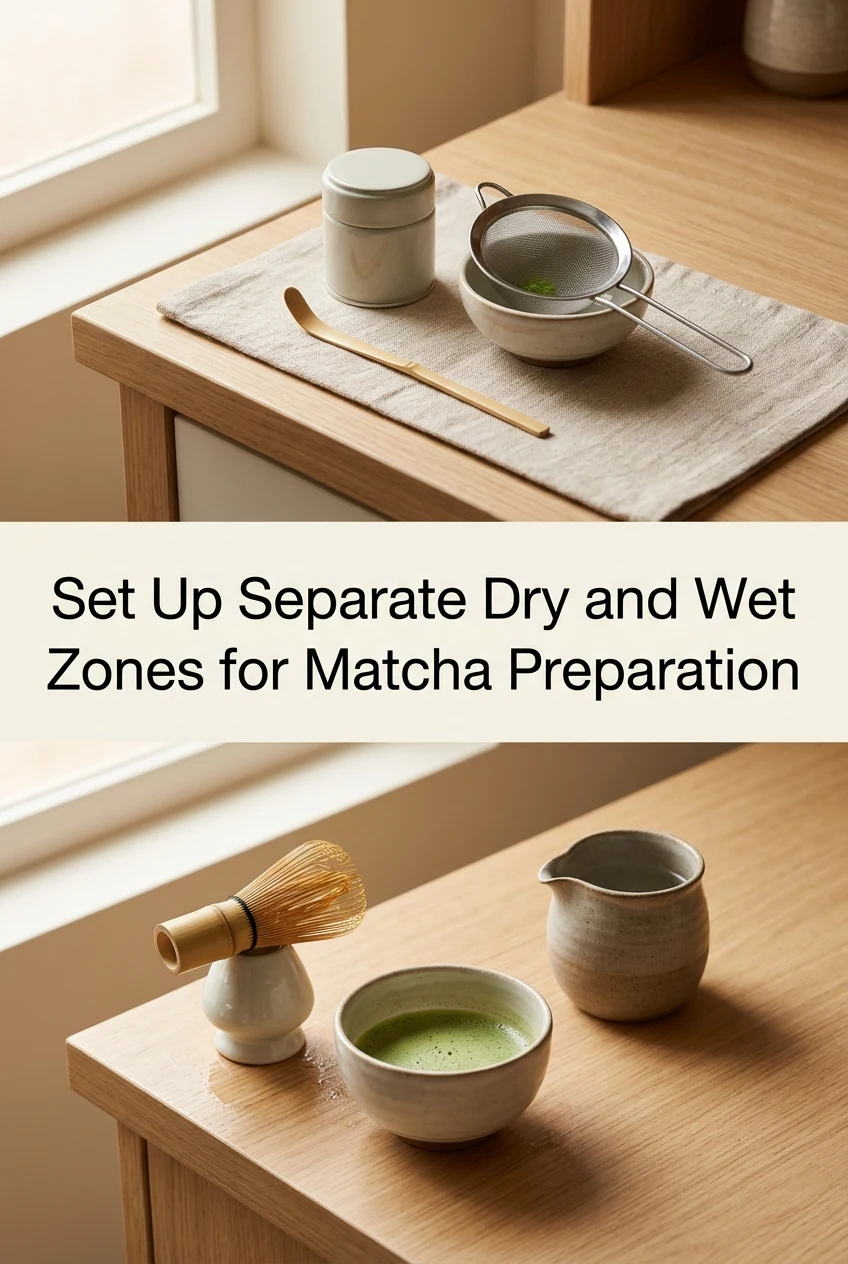
AI-generated editorial concept created for this article. The image is not a technical diagram or a tested result.
Why Two Zones Make a Difference
Matcha powder is finely milled and absorbs ambient moisture readily. A whisk rested directly beside an open tin, or a wet hand reaching across to the scoop, introduces enough dampness to cause clumping in the powder that remains in the tin. Separating the counter into a dry storage-and-measuring zone and a wet mixing-and-whisking zone removes that risk without requiring any special equipment. The separation also creates a logical workflow: you move from left to right, or from back to front, in a consistent order, which makes the routine faster and easier to keep tidy.
Choosing and Measuring Your Counter Space
A workable two-zone setup fits on roughly 60 centimetres of clear counter depth and about 80 centimetres of width, though you can adapt the proportions to what you have. Divide the width roughly in half. The dry zone occupies one side and the wet zone the other, with a small neutral gap of about 10 centimetres between them acting as a visual and practical boundary. Before committing to a layout, place your actual tools on the counter and check that the tin can be opened fully without the lid swinging over the wet side, and that the bowl sits far enough from the tin that splashes during whisking cannot reach it. Adjust the gap width until both conditions are met.
Setting Up the Dry Zone
The dry zone holds your matcha tin, a fine-mesh sifter, a dedicated dry measuring scoop and a small tray or mat to contain any stray powder. Keep the tin closed whenever you are not actively measuring. Store the scoop on the tray rather than inside the tin, so it stays dry between uses. If you use a bamboo or stainless-steel scoop, wipe it with a dry cloth and allow it to air-dry completely before returning it to the tray after any accidental contact with moisture. A small silicone mat works well as a base because it is easy to lift and shake clean over a bin. Position the sifter directly above your chawan or a small bowl placed temporarily in the dry zone only during sifting, then move the bowl to the wet zone before adding water.
Setting Up the Wet Zone
The wet zone is where your chawan or mixing bowl lives during and after preparation. Place a folded absorbent cloth or a small drip mat here to catch water from the kettle spout and from the whisk after rinsing. Your chasen rests in its holder in this zone. After whisking, rinse the chasen under cool running water as directed by the maker, then return it to its holder in the wet zone to dry. Keep your kettle or hot-water dispenser at the back of the wet zone so the pour travels away from the dry side. A small pitcher for pre-measured water can sit here too, making the pour more controlled.
A Worked Example of the Routine in Practice
To illustrate how the zones work together, consider a counter that is 80 centimetres wide. The dry zone occupies the left 35 centimetres, the neutral gap is 10 centimetres, and the wet zone takes the right 35 centimetres. The matcha tin and tray sit at the back left, the sifter in front of them. The kettle sits at the back right, the chawan in the centre right, and the chasen holder at the front right. The routine begins entirely in the dry zone: open the tin, scoop the powder onto the sifter, sift into the chawan, then move the chawan across the gap into the wet zone. From that point all activity stays on the right: add hot water from the kettle, whisk, drink, then rinse the chasen and bowl. The tin is closed and the scoop returned to its tray before any water is involved. This sequence is illustrative of how the layout can work; your own results will depend on your specific tools and counter dimensions.
A little more
to know.
Can I set up the two zones on a small kitchen trolley instead of a fixed counter?
Yes. A trolley with a single flat surface works the same way as a counter provided it is stable and level. Mark the boundary with a mat or a folded cloth and check that the trolley does not wobble when you whisk vigorously, since movement could shift tools across the boundary. Wheel the trolley close to a water source so you are not carrying a full bowl far across the kitchen.
What should I do if my counter is too narrow to keep the zones clearly separate?
Work sequentially rather than simultaneously. Complete all dry-zone steps, close the tin and move it to a cupboard or shelf, then bring the chawan to the counter for the wet steps. This front-to-back or cupboard-to-counter approach achieves the same separation when side-by-side space is limited. A small wooden or bamboo tray can also define a contained dry zone that you lift and store before beginning the wet steps.
Original editorial guidance and recipe formulations, not independently kitchen-tested. Times are estimates and depend on equipment and product directions. Cooked bases need additional cooling and refrigeration before cold serving. Images are AI-generated illustrations; appearance and yield may vary. Check actual ingredient labels, allergens, and any certification you require. We do not certify products. Read our approach.
Save to Pinterest ↗ANOTHER IDEA FOR THE COUNTER