Separate a Recipe's Ingredient Amount from Its Shopping Amount
A recipe lists the amount of an ingredient you need ready to use, not the amount you need to buy. When you purchase whole fruit, a bunch of herbs, or an unpeeled root, some of that weight never reaches the bowl. Recording the gap between what you buy and what you actually use is a straightforward planning habit that keeps your shopping list honest and your prep estimates realistic.
Read the note ↓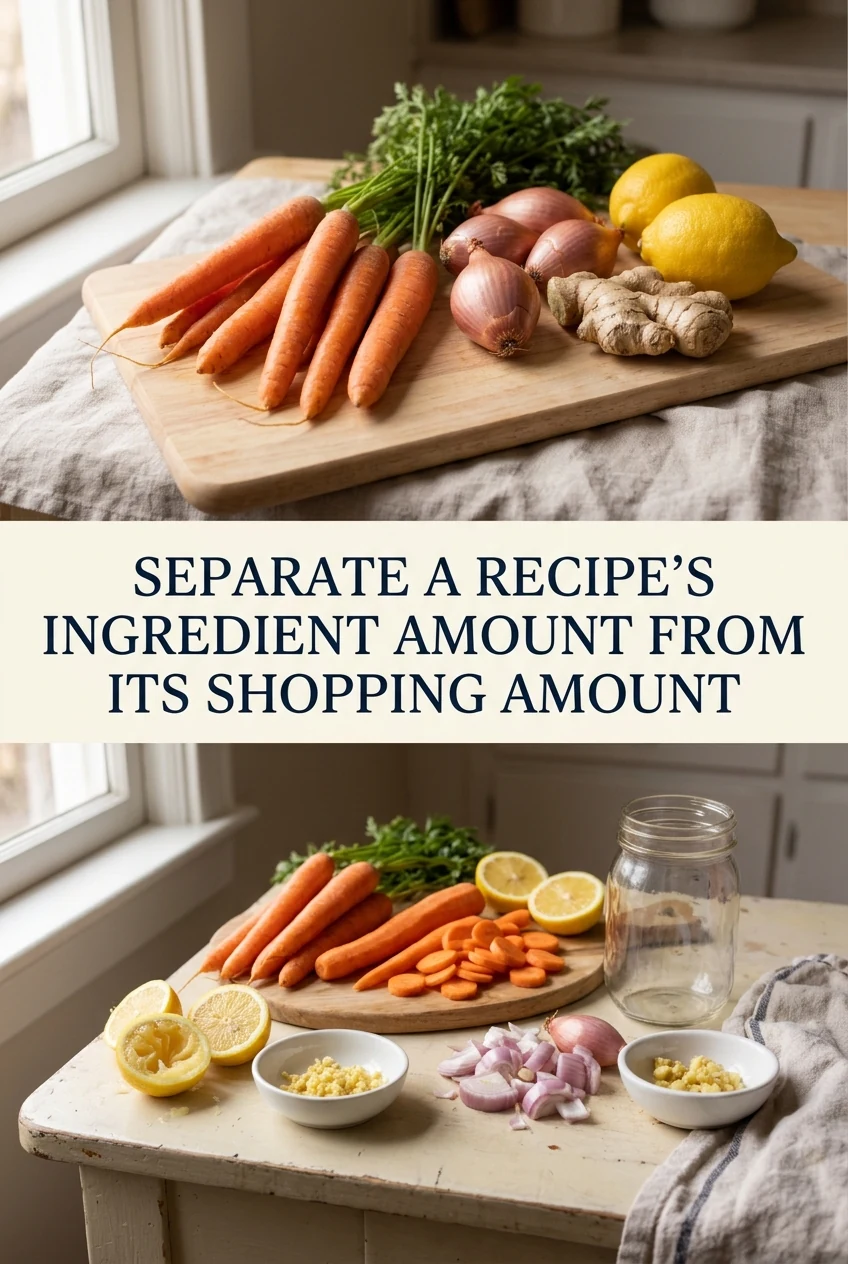
AI-generated editorial concept created for this article. The image is not a technical diagram or a tested result.
Why the Two Numbers Are Always Different
A recipe that calls for 200 g of diced mango means 200 g of flesh, trimmed and cubed, ready to fold into a drink or dessert. The whole mango sitting on your counter includes skin, pit, and fibrous core — none of which count toward that 200 g. If you shop for exactly 200 g of whole mango by weight, you will almost certainly fall short once you trim it. The difference between the purchased weight and the usable weight is called trimming loss, and it varies by the individual piece of fruit, its ripeness, and how carefully you work. No single percentage applies universally, which is why recording your own observed loss matters more than relying on a printed yield estimate.
How to Record Your Own Trimming Loss
Before you begin prep, weigh the whole, untrimmed ingredient and write that number down. After trimming, peeling, pitting, or hulling, weigh only the usable portion and write that number down too. Subtract the usable weight from the purchased weight to find your trimming loss for that session. Keep a simple log — a notebook page or a notes app entry works fine — with the date, the ingredient, the purchased weight, and the usable weight. Over several prep sessions you will build a personal reference that reflects your knife technique, your preferred suppliers, and the typical produce you actually buy. This is an illustrative planning approach, not a laboratory-tested yield guarantee.
A Worked Example: Mango for a Batch of Mango Lassi
Suppose your cafe recipe calls for 400 g of mango flesh to make eight servings of mango lassi. You have not prepped this variety before, so you do not yet have a personal loss figure. You buy three medium mangoes and weigh them together: 780 g whole. After peeling and removing the pits, you weigh the usable flesh: 490 g. Your trimming loss for this session is 290 g, meaning roughly 37 percent of the purchased weight was discarded. You needed 400 g and you got 490 g, so this batch is covered. In your log you write: three mangoes, 780 g purchased, 490 g usable, 290 g loss. Next time you plan to make this recipe, you can use that logged ratio as a starting reference — not a guarantee — when estimating how many mangoes to add to your shopping list. If your recipe also calls for alcohol-free vanilla flavoring, confirm the product label states it contains no alcohol before purchasing.
Separating the Two Columns in Your Planning Notes
A clean way to keep this straight is to maintain two columns whenever you write a prep plan. Label the first column Recipe Amount and the second column Shopping Amount. The Recipe Amount column holds exactly what the recipe states: 400 g mango flesh, 30 g fresh mint leaves, 150 g hulled strawberries. The Shopping Amount column holds your best estimate of what to purchase based on your logged trimming loss from previous sessions. Leave the Shopping Amount column blank for any ingredient you have not yet logged, and note that you will weigh and record on the day. This separation prevents the common mistake of buying recipe quantities and then discovering you are short after trimming begins.
Handling Perishables and Prompt Refrigeration
Once you have trimmed and portioned fresh fruit or other perishables, refrigerate them promptly in a covered container. Do not leave trimmed produce at room temperature while you complete other tasks. How long trimmed ingredients remain suitable for use depends on the specific ingredient, your refrigerator's actual temperature, and conditions you control in your own kitchen — no general storage lifespan applies across all situations. Check the appearance and smell before each use, and when in doubt, prep fresh. If you are working with halal-certified gelatin or any other ingredient that requires a specific certification, verify the product label before purchase rather than assuming a brand meets your requirements.
A little more
to know.
What if my trimming loss varies a lot between sessions for the same ingredient?
Variation is normal and expected. Fruit size, ripeness, and your trimming approach all shift the numbers. Rather than averaging your logs into a single figure and treating it as fixed, keep the individual session entries visible so you can see the range. When shopping, use the higher end of your observed loss as a conservative guide so you are less likely to fall short.
Should I log trimming loss for packaged or pre-cut ingredients?
Pre-cut or pre-peeled ingredients sold by usable weight generally need no trimming log because what you buy is close to what you use. However, if you notice consistent waste — for example, soft or discoloured pieces you discard from a pre-cut pack — it is worth noting that too, so your shopping estimate accounts for it.
Original editorial guidance and recipe formulations, not independently kitchen-tested. Times are estimates and depend on equipment and product directions. Cooked bases need additional cooling and refrigeration before cold serving. Images are AI-generated illustrations; appearance and yield may vary. Check actual ingredient labels, allergens, and any certification you require. We do not certify products. Read our approach.
Save to Pinterest ↗ANOTHER IDEA FOR THE COUNTER