Separate a Baking Tin's Outer Dimensions from Its Usable Interior
A tin's nominal label or retail footprint does not always reflect the usable interior space your batter actually occupies. Rolled rims, welded handles, and tapered walls can mean the interior base is smaller than the outer dimensions suggest. When you compare two tins for a recipe swap, or scale a batter between sizes, working from external measurements introduces errors that compound once you calculate area or volume. This note walks through a straightforward interior-measurement habit suited to a home cafe prep routine, illustrated with one worked example. It is a planning technique, not a laboratory-tested result.
Read the note ↓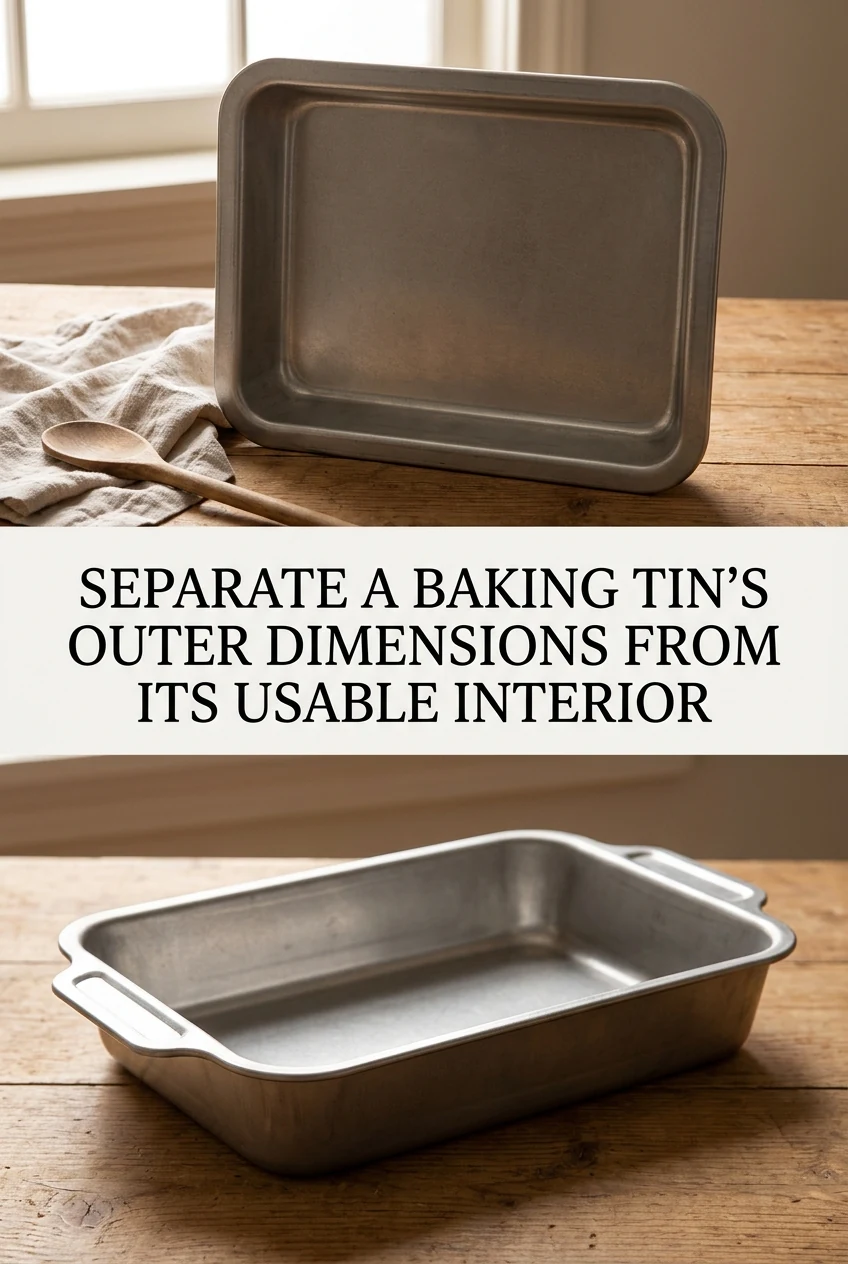
AI-generated editorial concept created for this article. The image is not a technical diagram or a tested result.
Why the Outer Shell Misleads You
Retail packaging and outer pan profiles can easily mislead you when estimating usable capacity. While bakeware is often labelled by its top rim dimensions, retail packaging may cite overall external footprints, and rolled rims or riveted handles add bulk that batter cannot occupy. In addition, many tins taper inward toward the bottom. A 20 cm springform, for instance, may carry a rolled collar where the base plate sits recessed, leaving a baking floor that measures closer to 18.8 cm to 19.2 cm across. A loaf tin measured from handle to handle can misrepresent usable interior length by several centimetres. None of this is a defect; it simply highlights why recipe calculations require measuring the actual interior cavity rather than the tin's outer envelope.
Tools and Approach for Interior Measurement
You need a flexible measuring tape or a rigid ruler that can lie flat inside the tin, plus a straight-edged card or small set square to confirm the ruler sits at the base rather than riding up a curved corner. Measure the interior base length and width (or diameter) at the lowest flat point, pressing the tape against the inside wall rather than hooking it over the outer rim. For depth, stand the ruler vertically inside the tin and read from the base to the top of the interior wall, ignoring any outward flare or rolled lip above that point. Record all three figures. For a round tin, one diameter measurement across the widest flat interior point is sufficient; confirm it is consistent in two perpendicular directions to check for slight oval distortion common in older pressed tins.
Worked Example: Swapping a Square Tin for a Round One
Suppose a recipe calls for a 20 cm square tin and you want to use a round tin instead. You measure the square tin's interior: 18.6 cm by 18.6 cm, depth 6.8 cm. Its usable base area is 18.6 multiplied by 18.6, giving approximately 346 square centimetres. You then measure your round tin's interior diameter: 21.4 cm, depth 7.2 cm. Its usable base area is calculated using the formula for a circle: radius is half the diameter, so 10.7 cm; area equals 3.14159 multiplied by 10.7 multiplied by 10.7, giving approximately 360 square centimetres. The round tin holds a slightly larger base area, so the batter layer will be marginally shallower. This is an illustrative plan based on these specific measurements, not a universal prediction. Adjust your expected bake time by checking doneness through your usual visual and tactile cues rather than relying on a fixed timer.
Applying Interior Depth to Volume Comparisons
Base area alone does not capture everything. A tin that is 2 cm deeper than the recipe's original tin will hold considerably more batter before it risks overflowing, and a shallower tin raises the opposite concern. Multiply your interior base area by your interior depth to get a rough interior volume in cubic centimetres. Compare that figure to the volume you calculate from the recipe tin's interior measurements. If your replacement tin's volume is within roughly ten percent of the original, the swap is a reasonable starting point for your planning. If the difference is larger, consider splitting the batter between two tins or adjusting the recipe quantity. Always fill tins to no more than two-thirds depth as a general working habit, leaving room for rise.
Recording Measurements for Your Prep Notes
Keep a simple written log of every tin in your home cafe kit, noting the label size, the measured interior base dimensions, and the measured interior depth. A small index card taped inside a cupboard door works well. When a recipe quotes a tin size, you can cross-reference your log rather than re-measuring each time. If you acquire a new tin, measure it before its first use and add it to the log. This habit removes guesswork from recipe scaling and makes it straightforward to substitute tins confidently. For perishable batters containing dairy, eggs, or other temperature-sensitive ingredients, refrigerate promptly if preparation is interrupted, and follow your recipe's guidance on resting or chilling times.
A little more
to know.
Does the thickness of a silicone tin wall matter the same way as a metal rim?
Silicone moulds have flexible walls that can bow outward slightly when filled, so the interior measurement taken before filling may differ a little from the shape the batter actually settles into. Measure the interior of a silicone mould while it is sitting flat and unsupported on your work surface, and treat that figure as an approximate guide rather than a precise fixed dimension. The same principle applies as with metal tins: measure the interior, not the outer surface.
If a recipe lists a tin by volume rather than dimensions, how do I use my interior measurements?
Multiply your measured interior base area in square centimetres by your measured interior depth in centimetres to get a volume in cubic centimetres. One cubic centimetre equals one millilitre, so you can convert directly to millilitres and then to litres for comparison with a recipe that quotes capacity in litres. This gives you a working estimate for planning purposes. Actual usable fill capacity will be less than the full interior volume because you leave headroom for rise, so compare your calculated interior volume to the recipe's stated volume rather than expecting them to match exactly.
Original editorial guidance and recipe formulations, not independently kitchen-tested. Times are estimates and depend on equipment and product directions. Cooked bases need additional cooling and refrigeration before cold serving. Images are AI-generated illustrations; appearance and yield may vary. Check actual ingredient labels, allergens, and any certification you require. We do not certify products. Read our approach.
Save to Pinterest ↗ANOTHER IDEA FOR THE COUNTER