Scoop or Weigh: Portioning Brown Sugar for Iced Coffee Syrups
Brown sugar behaves differently from white sugar the moment you pick up a measuring spoon. Its natural moisture content causes the crystals to clump and compact, meaning a loosely filled tablespoon and a firmly packed one can hold meaningfully different amounts of sugar. For a small-batch iced coffee syrup where you might use only two or three tablespoons of sugar total, that variation changes the finished sweetness in a way you will notice in the cup.
Read the note ↓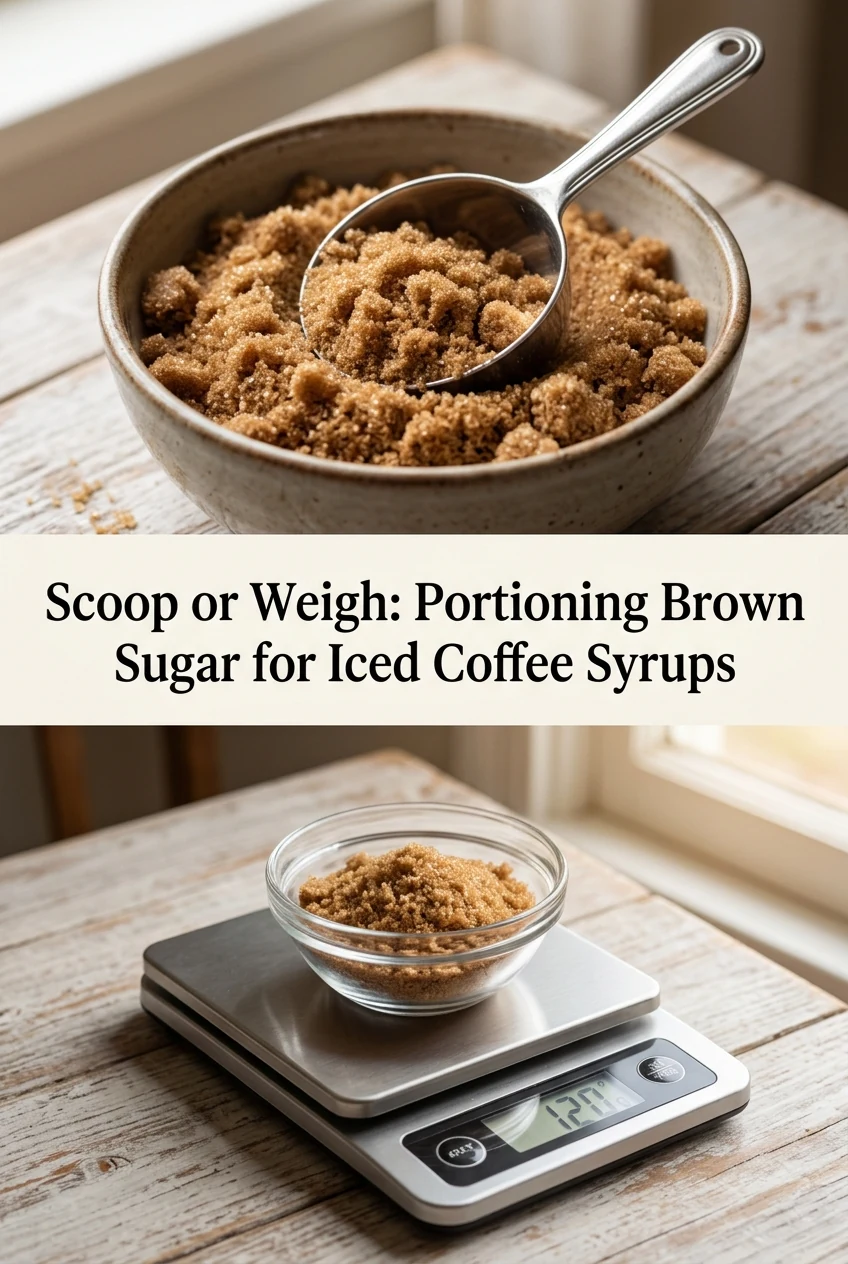
AI-generated editorial concept created for this article. The image is not a technical diagram or a tested result.
How Packing Changes the Volume Reading
A loosely spooned tablespoon of light brown sugar typically holds around 9 to 10 grams, while a firmly packed tablespoon of the same sugar can hold 13 to 15 grams. That is a difference of roughly 30 to 40 percent in a single spoon. Across a three-tablespoon small-batch syrup recipe, the packed version could add nearly 15 grams more sugar than the loose version, producing a noticeably sweeter syrup. These figures are illustrative ranges, not guaranteed measurements for every brand.
Why a Scale Removes the Ambiguity
Weighing brown sugar on a kitchen scale bypasses the packing question entirely. You set a small bowl on the scale, zero it, and add sugar until the display reads your target weight. For a simple small-batch syrup using equal parts sugar and water by weight, 60 grams of brown sugar dissolved into 60 millilitres of water gives a consistent starting point you can reproduce exactly next time without guessing whether your spoon was packed or not.
When a Spoon Is the Only Tool Available
If you do not have a scale, choose one consistent method and stick to it every time you make the same syrup. Either always pack the sugar firmly into the spoon and level it with a straight edge, or always spoon it in loosely without pressing. Write down which method you used when you first make a batch you like. Switching between methods between batches is the main source of inconsistency, not the spoon itself.
Dissolving Brown Sugar Without Scorching
Combine your measured sugar and water in a small saucepan over low to medium-low heat. Stir gently until the sugar fully dissolves, which usually takes two to four minutes for a 60 to 120 gram batch. Remove from heat as soon as the liquid is clear and no granules remain visible. Prolonged high heat can darken the syrup further and shift its flavour. Allow the syrup to cool before tasting and adjusting, as sweetness perception changes with temperature.
Storing the Finished Syrup Safely
Pour the cooled syrup into a clean, sealed jar or bottle and refrigerate it promptly. A simple brown sugar syrup without added preservatives should be used within two weeks when stored at 4 degrees Celsius or below. Label the jar with the date you made it. Do not leave the syrup at room temperature for extended periods. If you see any cloudiness, off smell, or mould, discard the batch and make a fresh one.
A little more
to know.
Does dark brown sugar behave the same way as light brown sugar when measuring?
Dark brown sugar contains more molasses, making it stickier and more prone to clumping than light brown sugar. It tends to pack even more densely into a spoon, so the gap between a loose and packed scoop can be slightly larger. Weighing is especially useful here.
Can I use the syrup straight from the fridge in iced coffee?
Yes, cold syrup dissolves readily into iced coffee because the drink is already liquid and you are stirring it in. Unlike adding sugar directly to a cold drink, the syrup is already dissolved and will incorporate evenly with a few stirs.
Original editorial guidance and recipe formulations, not independently kitchen-tested. Times are estimates and depend on equipment and product directions. Cooked bases need additional cooling and refrigeration before cold serving. Images are AI-generated illustrations; appearance and yield may vary. Check actual ingredient labels, allergens, and any certification you require. We do not certify products. Read our approach.
Save to Pinterest ↗ANOTHER IDEA FOR THE COUNTER