Scoop or Spoon: Portioning Matcha Powder Consistently Across Drinks
Bamboo chasaku scoops look identical but hold different amounts depending on how you fill them, which is why one matcha latte tastes grassy and the next tastes thin. Settling on a gram target and learning to measure it reliably with either a scale or a leveled scoop removes that guesswork. This guide walks through both methods so you can choose the one that fits your kitchen setup and repeat it accurately across every drink you make.
Read the note ↓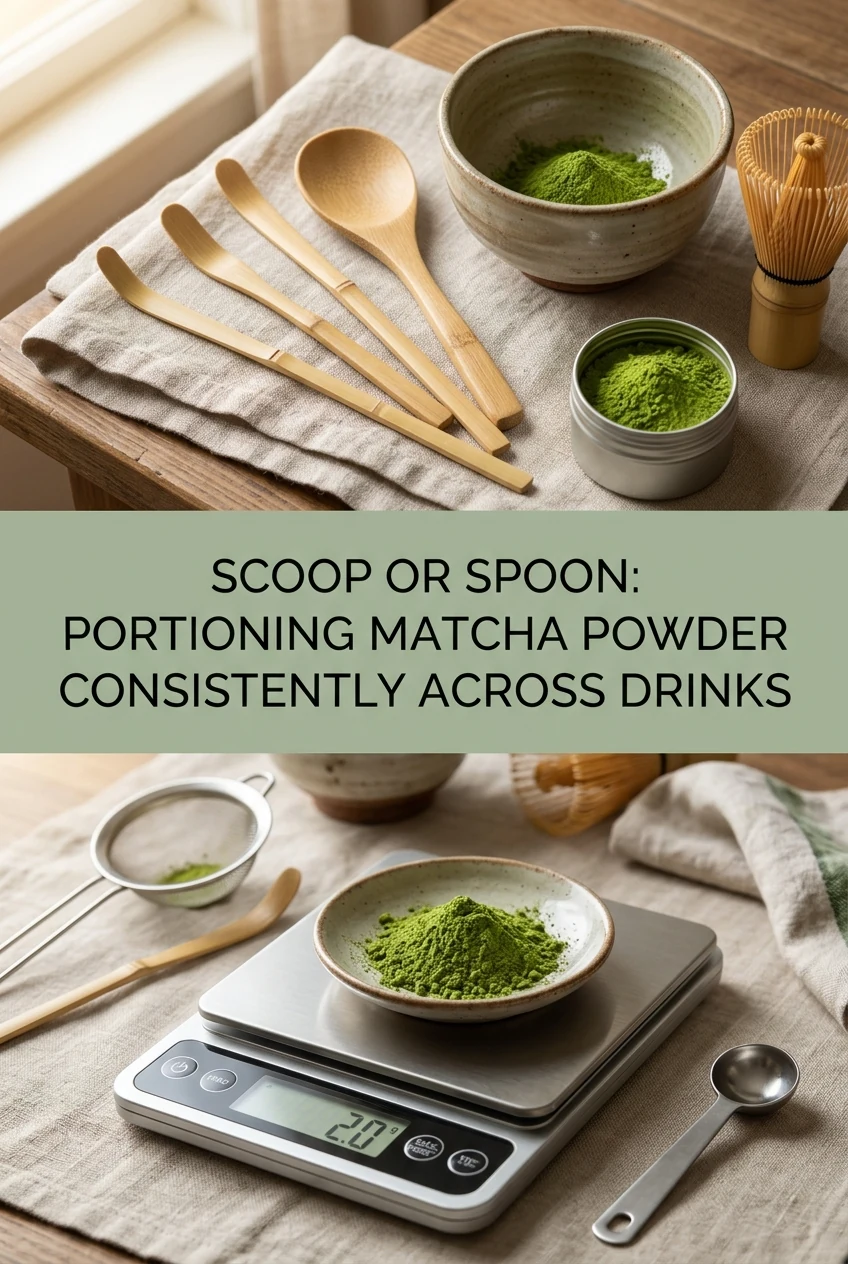
AI-generated editorial concept created for this article. The image is not a technical diagram or a tested result.
Why Scoops Produce Uneven Results
A bamboo chasaku typically holds somewhere between 1 and 2 grams of matcha depending on scoop depth, powder density, and whether you take a shallow or generously mounded scoop on the curved tip. Matcha also clumps when humid, so a packed scoop on a damp morning weighs more than one measured on a dry afternoon. These small differences compound across multiple drinks. Understanding that the scoop is a shape, not a calibrated measure, is the first step toward fixing inconsistency.
Choosing a Gram Target for Your Drink Size
A practical starting range for a single 240 ml matcha drink is 1.5 to 2 grams of powder. Ceremonial-grade matcha at 2 grams in 240 ml produces a noticeably stronger, more vegetal cup than 1.5 grams in the same volume. Pick one number, write it on a small label inside your matcha tin, and use it consistently for a week before deciding to adjust. Changing both the amount and the milk ratio at the same time makes it impossible to identify what shifted the flavor.
Using a Small Kitchen Scale Accurately
Place a small bowl on a scale and press tare. Spoon matcha in slowly until the display reads your target, for example 1.5 g. A scale accurate to 0.1 g costs little and removes all guesswork. One practical note: matcha powder is light enough that a scale rated only to whole grams will not give you useful readings at these quantities. Confirm your scale resolution before relying on it for matcha portioning.
Leveling a Measuring Spoon Repeatably
If you prefer using volume rather than a scale, use a standard measuring spoon rather than a bamboo chasaku. A traditional chasaku has an open curved blade without side walls or a rim, making it impossible to level flush with a straight edge. With a small measuring spoon, dip into the powder, lift without packing, and draw a flat straight edge such as the back of a butter knife across the rim to level it flush. Weigh that leveled spoon on a scale once to confirm its gram value, and you have a repeatable unit for daily use.
Sifting Before Measuring and Why It Matters
Matcha clumps form before you ever open the tin, especially near the bottom where powder compresses. Sifting 5 to 10 grams through a fine-mesh strainer into a small bowl before measuring gives you aerated, lump-free powder that dissolves more evenly in water. Measure from the sifted pile rather than directly from the tin. This step also makes whisking faster because the chasen does not have to break apart dense clumps during the initial mix.
A little more
to know.
Can I use a regular teaspoon instead of a chasaku or scale?
A level quarter-teaspoon of sifted matcha weighs roughly 0.6 to 0.8 grams depending on the powder, so two level quarter-teaspoons gets you close to 1.5 grams. Verify your specific teaspoon against a scale at least once before relying on it.
Does the type of matcha affect how much I should use?
Culinary-grade matcha is often more bitter and less smooth than ceremonial grade, so many people use slightly less of it per drink to avoid an astringent result. Start at 1 gram per 240 ml and adjust upward rather than beginning at the same dose as ceremonial grade.
Original editorial guidance and recipe formulations, not independently kitchen-tested. Times are estimates and depend on equipment and product directions. Cooked bases need additional cooling and refrigeration before cold serving. Images are AI-generated illustrations; appearance and yield may vary. Check actual ingredient labels, allergens, and any certification you require. We do not certify products. Read our approach.
Save to Pinterest ↗ANOTHER IDEA FOR THE COUNTER