Savory Labneh and Olive Toast Plate for a Café Tray
A labneh and olive toast plate looks simple, but the sequence in which you build it determines whether the bread arrives crisp or already softened beneath the spread. This article walks through a logical assembly order — toasting last, spreading immediately, plating on a dry surface — so the plate reaches the tray in the condition you intended. The steps below describe one illustrative approach rather than a tested or guaranteed result.
Read the note ↓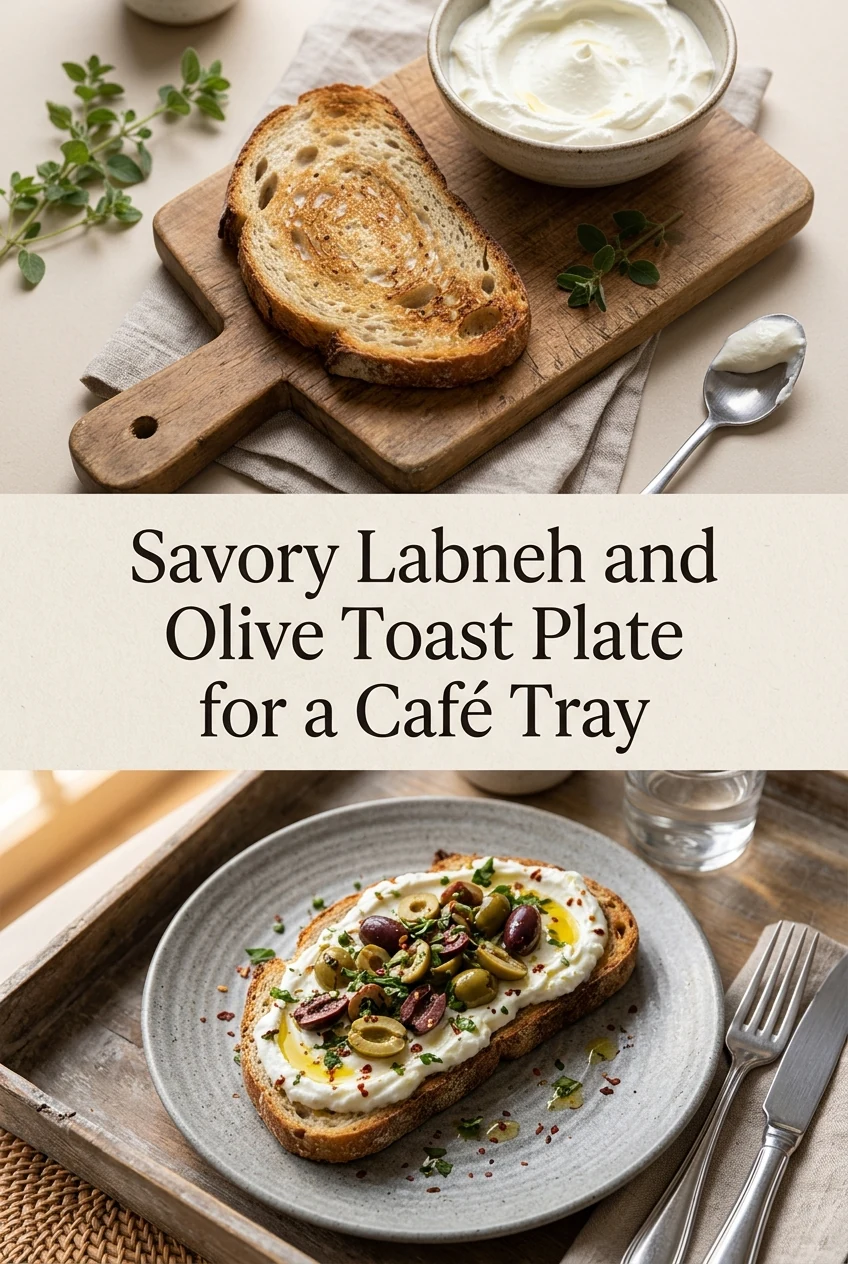
AI-generated editorial concept created for this article. The image is not a technical diagram or a tested result.
Why Sequence Matters for Bread Texture
Labneh is a strained yogurt cheese with a notably high moisture content. When spread onto bread that has been sitting at room temperature, that moisture begins transferring into the crumb within a few minutes. The result is a softened, slightly gummy surface before the plate even leaves the counter. Toasting the bread as the final warm step — rather than toasting it ahead and letting it cool while you prepare other components — keeps the outer crust firm long enough for the plate to reach the guest. Preparing every other element first, so the toast slot in your workflow is genuinely the last action before plating, is the practical fix for this common café sequencing problem.
Preparing the Olive and Herb Topping in Advance
Because olives and dried herbs require no heat, they can be portioned well before service. Use pitted black or green olives — or a mix — and slice them into rounds roughly three to four millimetres thick. A small prep bowl holding enough sliced olives for one plate might contain around eight to ten rounds, depending on olive size and how generously you want the plate dressed. Measure a small pinch of dried oregano or dried thyme into a separate tiny dish. Having these components ready means that once the toast comes out, you move directly to spreading and topping without pausing to slice or measure. This pre-portioning step is what makes the tight assembly window workable.
Toasting Bread to Order
Choose a sturdy bread that holds its structure under a spread — sourdough, a seeded loaf, or a dense whole-grain slice are common café choices. Toast one or two slices per order in whatever toaster or contact grill your café uses, following the equipment's own settings rather than a universal time or temperature. The goal is a surface that feels firm and dry to the touch when it comes out. Place the toast directly onto a clean, dry wooden board or a dry ceramic plate — not onto a surface that has any residual moisture from a damp cloth wipe, as that moisture wicks upward into the bread immediately.
Spreading Labneh to the Edges
Open a portion of packaged labneh — many cafés use single-serve tubs for consistency — and use a small offset spatula or the back of a spoon to spread it across the toast. Carry the spread all the way to the crust edge rather than leaving a bare border. An even layer roughly four to five millimetres deep gives enough presence without the labneh pooling or sliding. Spreading to the edge also means every bite from the guest's first to last includes the topping, which is a small detail that reads as considered rather than rushed. Work quickly; the toast is still warm at this point and the labneh will soften slightly on contact, making it easier to spread smoothly.
Arranging Olives and Herbs, Then Serving Immediately
Lay the pre-sliced olive rounds across the labneh surface in a loose single layer. For two slices of toast, ten rounds distributed evenly across both pieces gives reasonable coverage without crowding. Scatter the pinch of dried herbs over the top. At this point the plate is complete. Place it on the tray and move it to the guest without delay. If the café uses a dry wooden board as the serving surface, confirm it is free of any liquid before the toast goes down. This entire assembly — from toast out of the toaster to tray — is intended to take under ninety seconds once the prep components are ready. That window is illustrative; your actual pace will depend on your station layout and familiarity with the steps.
A little more
to know.
Can the toast be prepared a few minutes ahead during a busy rush?
Toasting ahead and holding the bread introduces the exact moisture-transfer problem this approach is designed to avoid. If your café faces a rush, consider whether a second toaster slot or a staggered order sequence allows you to keep toasting close to the moment of assembly rather than building a backlog of pre-toasted slices.
Which packaged labneh works best for spreading on toast?
Look for a labneh labeled as a strained yogurt cheese with a firm, spreadable consistency. Some packaged versions are looser and more pourable, which can make edge-to-edge spreading harder to control. A firmer product holds its shape on the toast surface more reliably, though the specific brand that works best will depend on what is available through your supplier.
Original editorial guidance and recipe formulations, not independently kitchen-tested. Times are estimates and depend on equipment and product directions. Cooked bases need additional cooling and refrigeration before cold serving. Images are AI-generated illustrations; appearance and yield may vary. Check actual ingredient labels, allergens, and any certification you require. We do not certify products. Read our approach.
Save to Pinterest ↗ANOTHER IDEA FOR THE COUNTER