Retain an Ingredient Package Label When Decanting a Small Working Portion
Decanting a small working portion of an ingredient into a countertop jar or scoop container is a practical home-cafe habit, but it creates a quiet information gap the moment the original package leaves the workspace. The full name, ingredient list, allergen notices, net weight, and the maker's own storage directions all stay on that outer bag or tin, not on the jar you reach for every morning. This note describes a straightforward technique for keeping that label information accessible without altering the original package or committing the ingredient to an unlabelled permanent container.
Read the note ↓
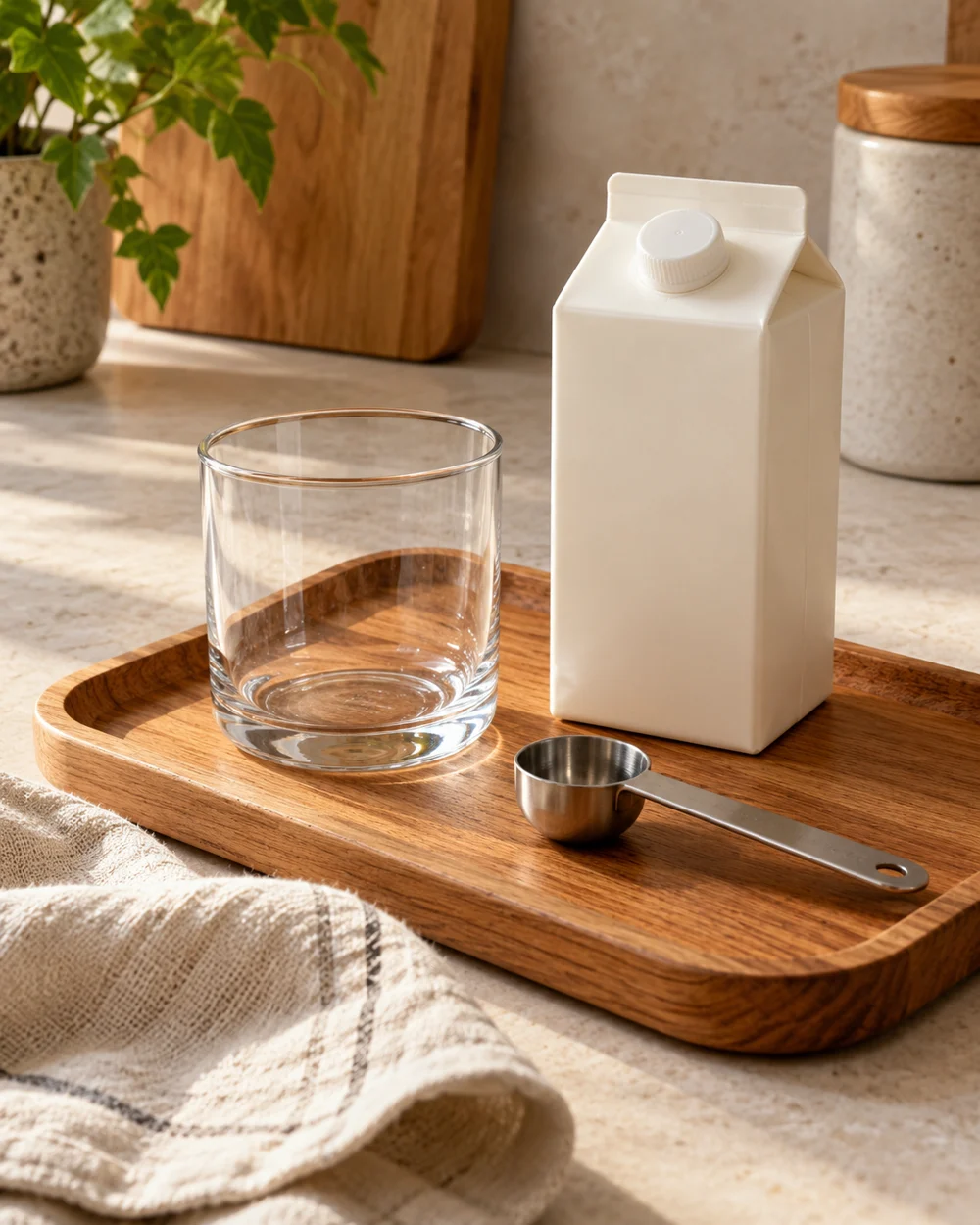
AI-generated editorial concept created for this article. The image is not a technical diagram or a tested result.
Why the Label Matters More Than It Seems
A package label carries details that are easy to underestimate until they are needed. The ingredient list confirms whether a flavoring is alcohol-free, whether a gelatin product carries a halal certification mark, or whether a cocoa powder contains added sugar. The storage directions reflect what the maker has determined for that specific product, covering temperature, humidity exposure, and whether the container should be resealed tightly after each use. Once an ingredient is in a plain jar, none of that information travels with it. If a guest asks about allergens, or if you want to check whether the product needs refrigeration after opening, you are left guessing unless the original package is still at hand.
The Core Technique: Label Retention Without Permanent Transfer
The technique rests on one principle: the working jar is a temporary holding vessel, not a permanent home. Keep the original sealed package in a designated storage spot, and decant only the quantity you expect to use within a short, realistic session, such as enough matcha or cocoa for a week of daily drinks. Attach a small adhesive note to the working jar that reads the product name and directs anyone who needs details to the original package. Do not write invented storage durations on that note. Instead, write the phrase 'see original pack for storage directions' so the maker's actual guidance remains the reference. This approach means the jar never becomes the sole source of truth about the ingredient.
A Worked Example: Decanting Matcha Powder for a Home Cafe Station
This is an illustrative plan, not a tested or verified result. Suppose you have a 30-gram tin of ceremonial-grade matcha. The tin's label states to store away from light and heat and to use promptly after opening. You decide to keep the tin sealed in a cool cupboard and decant a smaller portion into a dark-lidded scoop jar that sits beside your electric whisk. Before filling the jar, cut a strip of masking tape and write on it: 'Matcha — [brand name] — see original tin for storage and ingredients.' Press the tape strip firmly to the side of the jar. Measure out roughly 10 grams into the jar using the scoop that came with the tin, then reseal the original tin and return it to the cupboard. Each time the jar runs low, you return to the original tin, re-read its directions, and refill only what you need for the next short stretch of use. The jar is never topped up from an unidentified source, and the original tin's label remains the governing reference throughout.
Handling Perishable Ingredients and Refrigeration
Some ingredients require refrigeration after opening, and the maker's label will say so. If you are decanting a portion of, for example, a halal-certified dairy creamer powder that the label instructs to refrigerate after opening, the working jar must also be kept refrigerated. Do not leave a refrigeration-required ingredient at room temperature simply because the jar is more convenient on the counter. Attach the same label-reference tape strip to the jar, and place the jar in the refrigerator alongside the original package. Prompt refrigeration follows the maker's direction, not a general assumption about powder stability. If the label does not specify refrigeration, follow what it does say rather than applying a universal rule.
Keeping the System Simple and Sustainable
A label-retention habit only holds if it is low-effort enough to repeat every time. A roll of masking tape and a fine-tip marker kept in one drawer near the storage area is usually sufficient. Write legibly and include the product name and the instruction to consult the original package. If you use multiple similar-looking powders, such as two different cocoa products, a brief distinguishing note on each jar prevents mix-ups. Avoid decanting into containers that are difficult to clean between refills, since residue from a previous batch can affect the next. When a package is fully used, discard the corresponding jar label and start fresh with the new package's information. The goal is a workspace where every jar can be traced back to a labelled source without effort.
A little more
to know.
Can I just photograph the original label and skip the tape note on the jar?
A photograph is a useful backup, but it requires you to locate and open the image each time someone asks about the ingredient. A physical note on the jar makes the reference immediate and visible to anyone at the station, including a helper who may not have access to your photo library. Using both together is a reasonable approach.
What should I do if the original package has already been discarded before I set up the working jar?
If the original package is gone, you no longer have access to the maker's ingredient list, allergen information, or storage directions. In that situation, the safest step is to treat the ingredient as unverified for allergen and storage purposes and to source a fresh package so you can read and retain the label from the start. Do not reconstruct label information from memory or from an unrelated online source, as product formulations can vary.
Original editorial guidance and recipe formulations, not independently kitchen-tested. Times are estimates and depend on equipment and product directions. Cooked bases need additional cooling and refrigeration before cold serving. Images are AI-generated illustrations; appearance and yield may vary. Check actual ingredient labels, allergens, and any certification you require. We do not certify products. Read our approach.
Save to Pinterest ↗ANOTHER IDEA FOR THE COUNTER