Read the Instructions for Ready-Rolled Pastry Before Unwrapping It
Ready-rolled pastry sheets look straightforward until you unroll one at the wrong temperature and watch it crack straight down the middle. The fix is simple: read the pack before you open it. Every brand prints its own storage, resting, and oven guidance directly on the label, and those directions reflect how that particular dough was made. Treating them as optional is where most home-cafe pastry projects go wrong before they even begin.
Read the note ↓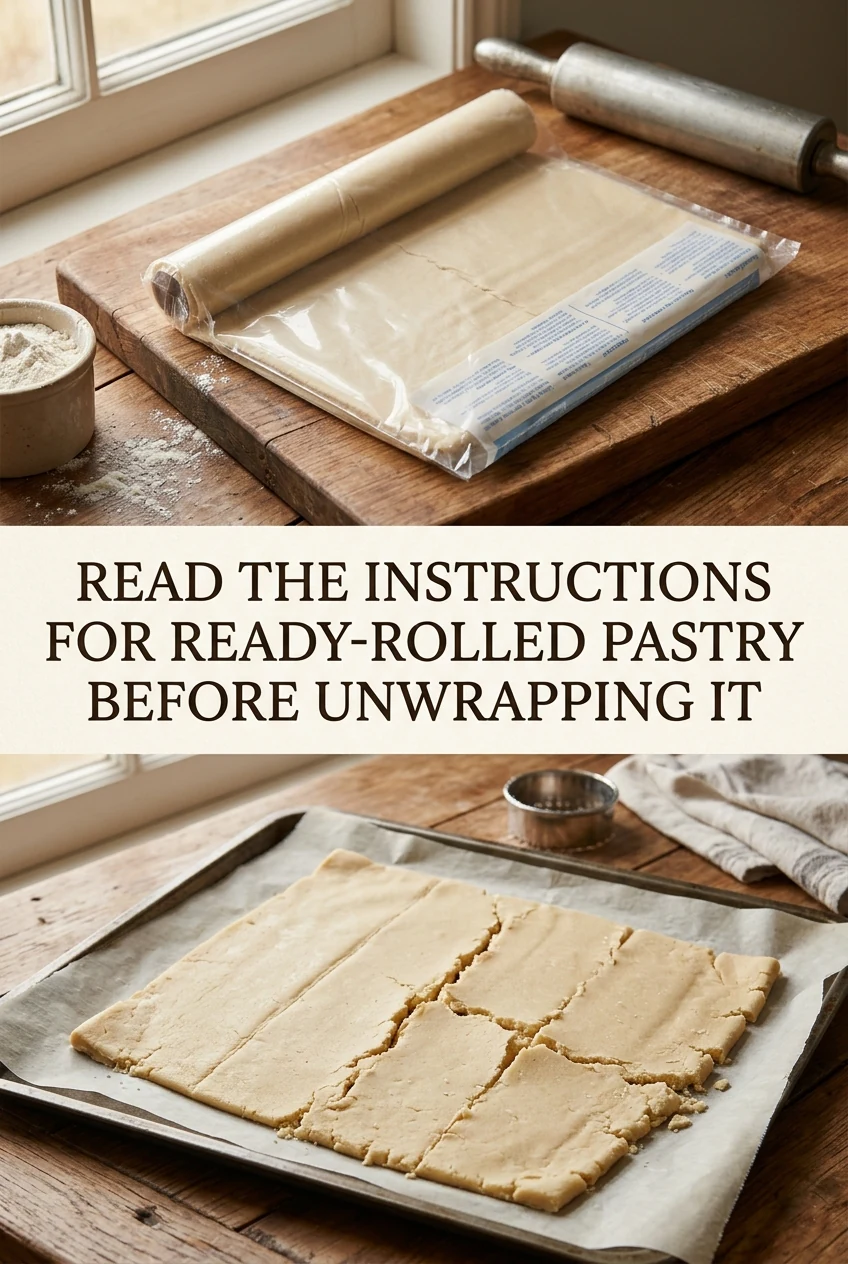
AI-generated editorial concept created for this article. The image is not a technical diagram or a tested result.
Why the Pack Instructions Come First
Ready-rolled pastry is a manufactured product, not a homemade one, so the maker has already set the fat ratio, thickness, and moisture level. Their printed directions account for those decisions. One brand may specify that the sheet must rest at room temperature for a set number of minutes before unrolling; another may say to unroll it straight from the fridge. Neither instruction is interchangeable. Opening the pack before reading those directions means you are guessing at conditions the maker has already worked out. Check the label for three distinct pieces of information before you do anything else: how the pastry should be stored before use, how long and at what stage it should rest, and what oven temperature and baking time the maker recommends for your intended use.
Storage Directions Are Not the Same as Preparation Directions
Storage and preparation are separate stages, and the pack usually addresses them separately. Storage directions tell you where to keep the pastry until you are ready to use it, typically a refrigerator shelf rather than the door, and they will note whether the product can be frozen. Preparation directions begin once you have decided to bake. They may tell you to remove the sheet from the fridge a specific number of minutes before unrolling, or they may instruct you to keep it cold right up to the moment it goes into the oven. Do not assume that because the pastry feels pliable it is ready to unroll; follow the maker's stated resting guidance. Once the pack is open and the pastry is unrolled, it is a perishable item. If you are not using the full sheet immediately, wrap any unused portion tightly, refrigerate it promptly, and follow whatever the pack says about using it within a stated period.
Oven Settings Come from the Pack, Not from a Generic Recipe
A generic tart recipe might call for a particular oven temperature, but that figure was written for a particular dough. The ready-rolled sheet in your fridge may be a different thickness or fat content entirely. Use the temperature and timing range printed on your specific pack as your starting point, then adjust only for your oven's known behaviour, such as whether it runs hot or requires a longer preheat. Fan and conventional oven settings often differ, and many packs print both. If yours lists only one, check whether your oven matches that type and adjust accordingly based on your oven's own manual, not on a universal conversion rule.
A Worked Illustrative Plan: Matcha Custard Tartlets
This is an illustrative plan, not a kitchen-tested result. Suppose you have one sheet of ready-rolled shortcrust pastry sized at roughly 320 mm by 230 mm. You want to cut rounds for six small tartlet tins, each with an internal diameter of about 70 mm. A 95 mm cutter will produce rounds that, once pressed into each tin, line the base and give a shallow wall. Before cutting anything, read the pack. If the maker says to rest the sheet for ten minutes at room temperature before unrolling, set a timer. Once rested and unrolled, cut your rounds, press them gently into lightly greased tins, and refrigerate the lined tins while you prepare the filling. For the filling, whisk together eggs, a small amount of caster sugar, full-fat milk, a measured quantity of matcha powder, and a few drops of alcohol-free vanilla flavoring. Pour the mixture into the chilled pastry cases. Bake according to the pack's stated temperature and time range, checking the pastry colour and filling set toward the end of that window. Remove from the oven and allow to cool in the tins before turning out. Refrigerate any tartlets not served immediately.
Keeping Your Home-Cafe Workflow Consistent
The value of reading the pack every time, even when you have used the same brand before, is that manufacturers occasionally update their formulations or instructions. A batch bought months later may carry revised guidance. Building the habit of checking storage, resting, and baking directions as a fixed first step means you are always working from current information rather than memory. Keep the pack nearby while you work so you can refer back to the baking time range without having to guess. Once the pastry is used and any remainder is stored, discard the pack only after confirming you have noted anything relevant for next time.
A little more
to know.
Can I use the oven temperature from my tart recipe instead of the one on the pastry pack?
Use the pack's stated temperature as your primary reference, since it reflects the specific fat content and thickness of that sheet. Your recipe's temperature was written for a different dough. If the two figures differ noticeably, start with the pack's guidance and adjust only for your oven's known behaviour.
What should I do with leftover pastry once the sheet is unrolled and cut?
Wrap any unused portion tightly to prevent it drying out, refrigerate it promptly, and follow whatever guidance the pack prints about using it within a stated period. Do not leave unrolled pastry sitting at room temperature for an extended time, as it is a perishable product once the packaging is open.
Original editorial guidance and recipe formulations, not independently kitchen-tested. Times are estimates and depend on equipment and product directions. Cooked bases need additional cooling and refrigeration before cold serving. Images are AI-generated illustrations; appearance and yield may vary. Check actual ingredient labels, allergens, and any certification you require. We do not certify products. Read our approach.
Save to Pinterest ↗ANOTHER IDEA FOR THE COUNTER