Prepare Mini Pastry Cases with a Separate Jam Filling
Mini tartlet cases filled with a spoonful of good jam make a tidy, manageable project for a home café setting. This guide builds a measured workflow around standard mini tartlet tins, keeping the pastry and the jam filling as two distinct stages. Nothing here is a tested laboratory result — it is an illustrative plan drawn from sound baking principles, designed to help you think through dimensions, quantities, and timing before you begin.
Read the note ↓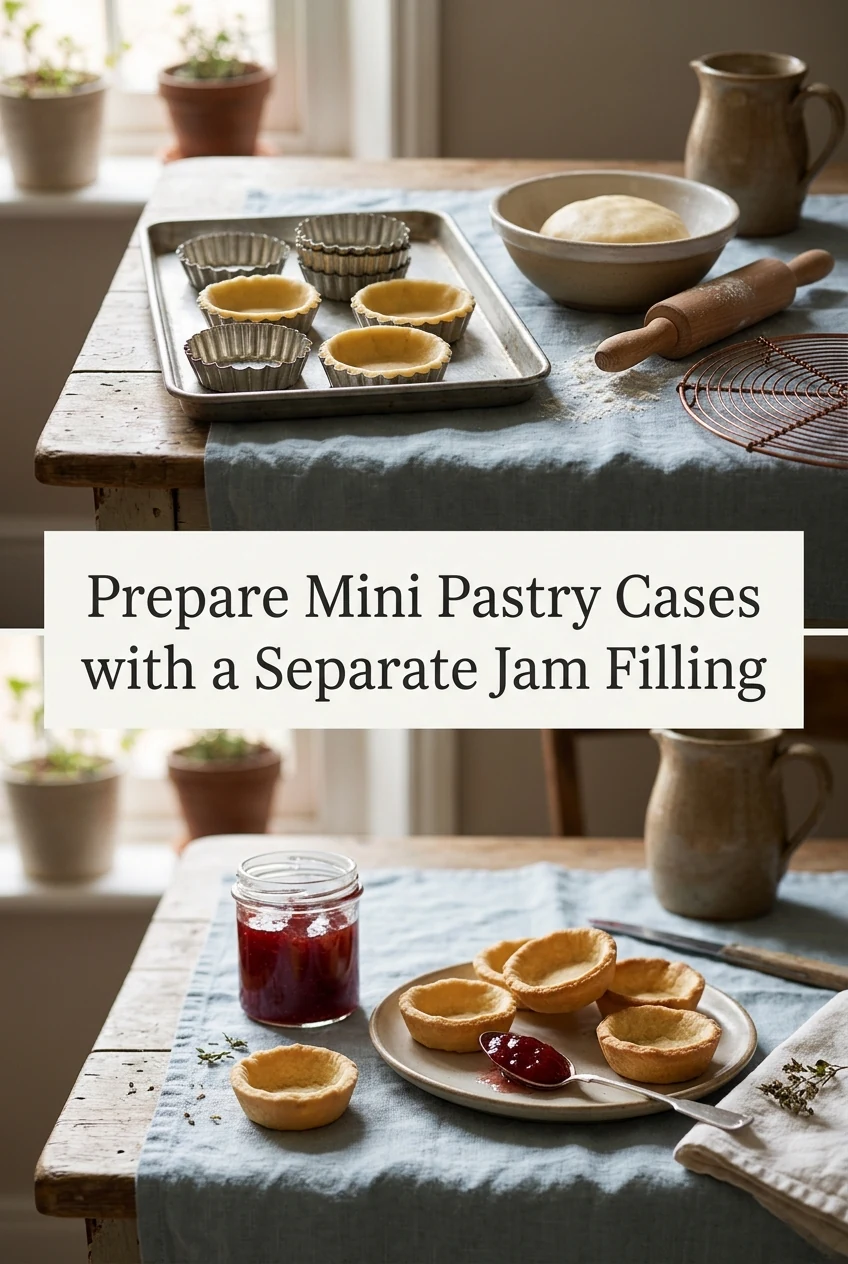
AI-generated editorial concept created for this article. The image is not a technical diagram or a tested result.
Understand Your Tin Dimensions Before You Start
Mini tartlet tins vary. A common size has a base diameter of roughly 5 cm and a rim diameter of about 7 cm, with sides approximately 1.5 cm deep. Before mixing any pastry, measure your own tins with a ruler. Count how many tins you have, because that number sets your batch size. For this illustrative plan, twelve tins of the dimensions above are used as the worked example. Knowing the internal volume of each tin helps you judge how thick to roll the pastry and how much filling each case will hold once baked. A case with 1.5 cm sides will hold roughly one level teaspoon of jam filling without overflowing, though your actual capacity depends on how the pastry shrinks during baking.
Make a Small-Batch Shortcrust Pastry
For twelve tins of the dimensions described, a starting point is 150 g plain flour, 75 g cold unsalted butter cut into small cubes, a pinch of fine salt, and two to three tablespoons of cold water added gradually. Rub the butter into the flour until the mixture resembles coarse breadcrumbs, then add cold water a little at a time, pressing the dough together until it just holds. Wrap the dough and rest it in the refrigerator for at least 30 minutes before rolling. Roll on a lightly floured surface to a thickness of about 3 mm. Cut rounds slightly larger than the rim diameter of your tins — for a 7 cm rim, a 9 cm cutter gives enough pastry to ease into the sides without stretching. Press each round gently into a tin, trim any excess flush with the rim, and prick the base a few times with a fork. Chill the lined tins again for 15 minutes before baking.
Blind Bake the Pastry Cases
Blind baking sets the pastry before any filling goes in, which keeps the base crisp. Line each chilled pastry case with a small square of baking paper and fill with baking beans or uncooked rice to hold the sides in place. Follow your own oven's behaviour rather than assuming a universal temperature; a moderate oven setting that you know works for shortcrust pastry in your kitchen is the right guide. Bake with the weights in place until the sides look set, then remove the paper and weights and return the cases to the oven briefly until the bases are dry and lightly coloured. Remove from the tins and allow to cool completely on a wire rack before adding any filling. Warm pastry will cause jam to loosen and potentially make the base soggy.
Prepare the Separate Jam Filling
The jam filling is kept entirely separate from the pastry stage, which is the key technique in this workflow. Choose a good-quality halal-suitable jam — strawberry, raspberry, or apricot all work well. Spoon the jam into a small bowl and stir it briefly to loosen it if it is very stiff. Do not heat the jam unless the label on your chosen product suggests warming for use; follow the maker's own directions. For the twelve cases in this example, roughly 12 level teaspoons of jam is a useful starting quantity, giving one teaspoon per case. You can add a small amount of alcohol-free vanilla flavoring to the jam if you wish — check the label explicitly confirms it is alcohol-free before using it. Stir to combine. Keep the filled bowl covered and refrigerated until you are ready to spoon the jam into the cooled cases.
Fill the Cases and Manage Refrigeration
Once the pastry cases are fully cool, spoon one level teaspoon of the prepared jam into each case. Work steadily so the cases are filled in a single session rather than leaving some sitting open. Because jam is a perishable filling once it is in an open pastry case, the filled tartlets should be refrigerated promptly. Place them in a single layer in a covered container and refrigerate them. Serve them within a timeframe that reflects your own refrigerator's performance and the perishability of the specific jam you have used — do not rely on an invented shelf life. If you are serving them at a home café gathering, bring them out of the refrigerator shortly before serving rather than leaving them at room temperature for extended periods.
A little more
to know.
Can I use a different size of tartlet tin with the same quantities?
Yes, but you will need to recalculate. Larger tins will yield fewer cases from the same amount of pastry, and each case will hold more jam. Smaller tins will yield more cases but each will hold less filling. Measure your tins first, then adjust your pastry quantity and your jam quantity accordingly before you begin mixing anything.
Why is the jam added after baking rather than before?
Adding jam before baking causes it to bubble, caramelise unevenly, and can make the pastry base wet and difficult to handle. Keeping the pastry and jam as two separate stages — baking the cases empty and spooning in the jam once everything is cool — gives you more control over the texture of both components and makes it easier to adjust the filling quantity to suit each individual case.
Original editorial guidance and recipe formulations, not independently kitchen-tested. Times are estimates and depend on equipment and product directions. Cooked bases need additional cooling and refrigeration before cold serving. Images are AI-generated illustrations; appearance and yield may vary. Check actual ingredient labels, allergens, and any certification you require. We do not certify products. Read our approach.
Save to Pinterest ↗ANOTHER IDEA FOR THE COUNTER