Prepare a Two-Serving Semolina Milk Dessert
A cooked semolina milk dessert is one of the quieter pleasures of a home café setup. Fine semolina is measured dry, stirred into warm milk, and cooked until it thickens into a spoonable, creamy texture that sits comfortably in a small bowl or wide cup. This illustrative plan walks through a two-serving batch using straightforward ratios and a stovetop method. It is not a kitchen-tested result, but a coherent worked example built around sound technique, halal ingredients, and prompt handling of a perishable dairy preparation.
Read the note ↓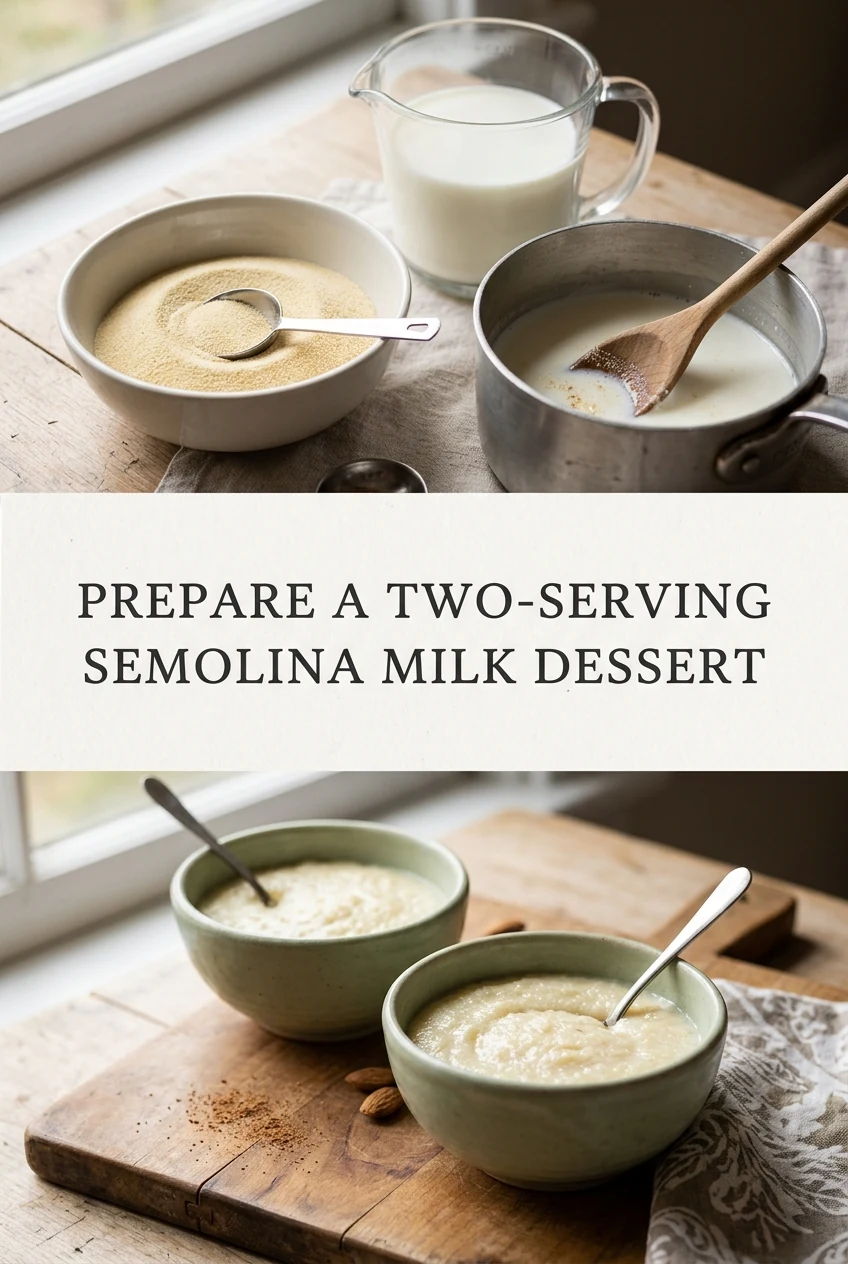
AI-generated editorial concept created for this article. The image is not a technical diagram or a tested result.
Gather Your Ingredients and Equipment
For two servings you will need 500 ml of full-fat dairy milk, 60 g of fine semolina measured dry on a kitchen scale, 30 g of white sugar, a small pinch of fine salt, and a few drops of alcohol-free vanilla flavoring. Check the label of your vanilla flavoring to confirm it is explicitly alcohol-free before using it. You will also need a medium heavy-based saucepan, a wooden spoon or silicone spatula, a kitchen scale, a measuring jug, and two serving bowls or wide cups. Having everything measured and within reach before you begin keeps the cooking stage smooth, because semolina thickens quickly once it reaches temperature and does not wait for you to locate a spoon.
Measure the Semolina Separately
Weigh 60 g of fine semolina into a small dry bowl and set it aside. This step is deliberate: measuring semolina dry and separately before any liquid is involved keeps the method distinct from making a slurry. A slurry involves mixing a starch or flour with cold liquid first to prevent lumps, which is a different technique suited to different preparations. Here, the semolina is added to milk that is already warm and moving, which disperses it evenly without pre-mixing. Do not combine the semolina with the milk in advance. Keeping them apart until the correct moment is the practical foundation of this approach.
Warm the Milk and Add the Semolina
Pour 500 ml of milk into your saucepan and place it over a medium-low heat on your stovetop. Stir gently and continuously as the milk warms. You are looking for the milk to become steaming and just beginning to show small bubbles around the edges, which indicates it is hot but not yet at a rolling boil. At this point, reduce the heat to low and begin adding the 60 g of dry semolina in a slow, steady stream with one hand while stirring constantly with the other. Adding it gradually while stirring prevents the semolina from clumping. Once all the semolina is in, continue stirring without stopping. The mixture will begin to thicken noticeably within two to four minutes of steady stirring over low heat. The exact time will vary depending on your stove and pan, so watch the texture rather than the clock.
Sweeten, Flavor, and Portion
When the semolina has thickened to a soft, spoonable consistency that holds its shape briefly when you lift the spoon, remove the pan from the heat. Stir in the 30 g of sugar and the small pinch of salt. The residual heat will dissolve the sugar fully. Add a few drops of your alcohol-free vanilla flavoring and stir to distribute it evenly. Taste the mixture and adjust the sugar if needed. Spoon the finished dessert equally between your two serving bowls or cups. In this worked example, the 500 ml of milk and 60 g of semolina produce a quantity that divides naturally into two generous portions. Serve the dessert warm if you prefer it that way, or allow it to cool slightly before eating. A light dusting of ground cinnamon on top is an optional finish that adds a gentle aroma without altering the base preparation.
Handle and Store the Finished Dessert Promptly
Because this dessert is made with dairy milk and is not preserved in any way, it is a perishable preparation. If you are not eating both portions immediately, transfer any uneaten portion into a clean covered container and refrigerate it promptly. Do not leave it at room temperature for an extended period. When refrigerated, the semolina dessert will firm up considerably as it cools, which is a natural result of the starch setting. You can eat it cold directly from the refrigerator or gently reheat it in a small saucepan over low heat with a splash of milk stirred in to loosen the texture. No invented shelf life is given here; use your own judgment and standard food-safety practice for cooked dairy preparations in your household.
A little more
to know.
Can I use a plant-based milk instead of dairy milk in this recipe?
You can substitute a plant-based milk such as oat milk or soy milk in the same 500 ml quantity, but be aware that the final texture and richness will differ from a dairy version. Some plant-based milks are thinner or have a more pronounced flavor of their own, which will affect the finished dessert. This illustrative plan is built around full-fat dairy milk, so a plant-based version is an adaptation rather than a direct equivalent, and the thickening behavior may vary.
Why does the dessert firm up so much after refrigeration?
Semolina contains starch granules that absorb liquid and swell during cooking. As the cooked dessert cools, those starch granules set more firmly, which is why the texture changes from soft and spoonable when warm to noticeably firmer when cold. This is a natural property of cooked semolina and not a sign that anything went wrong. Stirring in a small amount of warm milk when reheating helps restore a softer, more spoonable consistency.
Original editorial guidance and recipe formulations, not independently kitchen-tested. Times are estimates and depend on equipment and product directions. Cooked bases need additional cooling and refrigeration before cold serving. Images are AI-generated illustrations; appearance and yield may vary. Check actual ingredient labels, allergens, and any certification you require. We do not certify products. Read our approach.
Save to Pinterest ↗ANOTHER IDEA FOR THE COUNTER