Prepare a Small Cocoa and Oat Cookie Dough Without a Stand Mixer
Mixing cocoa cookie dough by hand is straightforward once you understand why order matters. Cocoa powder clumps when it meets fat or moisture unevenly, leaving bitter dark streaks through the finished cookie. Sifting first and adding ingredients in deliberate stages solves this without any powered equipment. This guide covers a small batch sized for one standard baking tray, roughly twelve cookies, using a single mixing bowl and a wooden spoon or flexible spatula.
Read the note ↓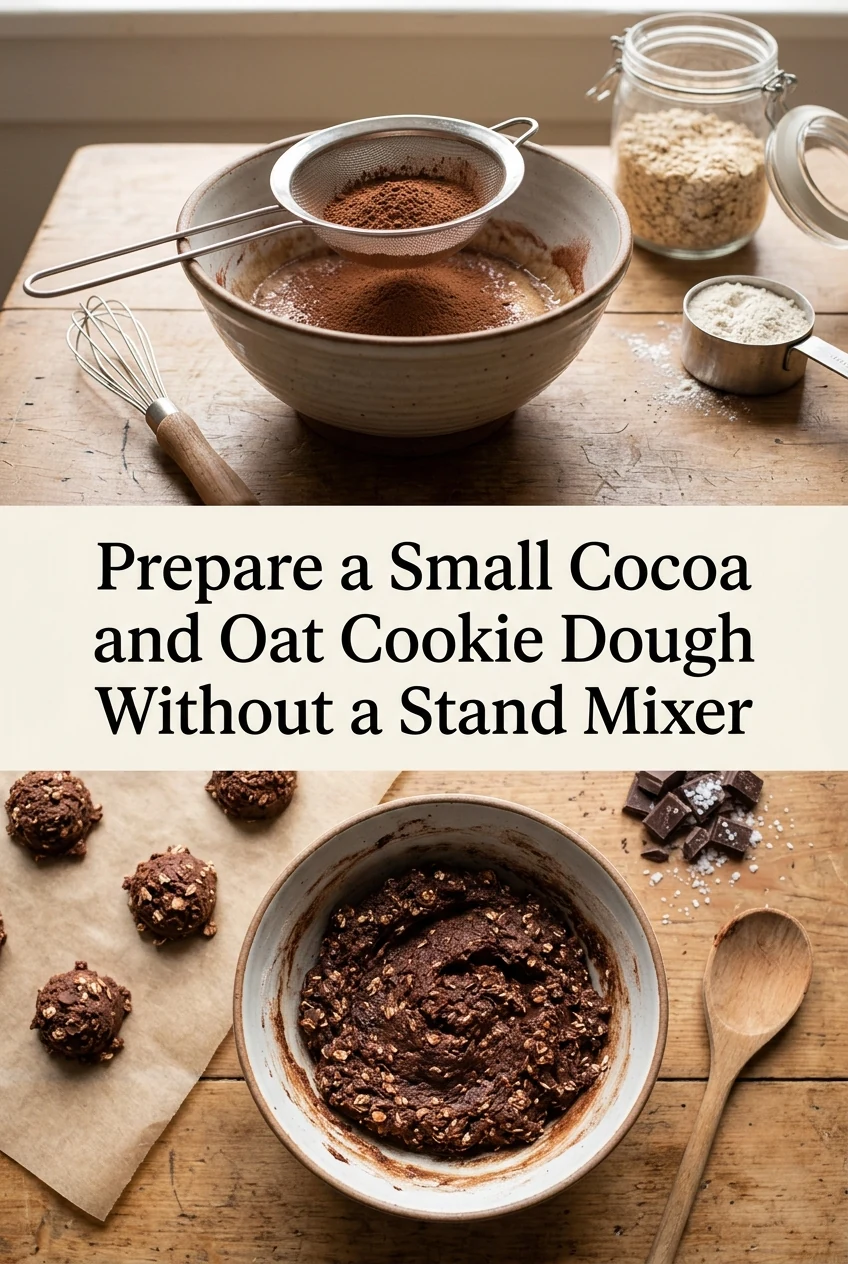
AI-generated editorial concept created for this article. The image is not a technical diagram or a tested result.
Sift the Cocoa Before Anything Else
Measure 30 grams of unsweetened cocoa powder into a fine-mesh sieve held over a small bowl and tap it through. Do this before you combine any other ingredients. Cocoa compacts during storage and contains natural oils that cause it to form hard granules. Sifting breaks those apart so the powder disperses evenly when it meets the fat. Set the sifted cocoa aside and do not stir it into anything yet.
Cream the Fat and Sugar by Hand
Place 115 grams of softened unsalted butter and 100 grams of light brown sugar in your mixing bowl. Use a wooden spoon to press and fold the two together against the side of the bowl for about two minutes until the mixture looks pale and cohesive. Softened butter, not melted, is essential here. Melted butter will make the dough greasy and flat. The mixture should look smooth and uniform when you lift the spoon.
Fold In the Sifted Cocoa in Two Additions
Add half the sifted cocoa to the butter and sugar mixture and fold slowly with a spatula, scraping the bottom of the bowl each time. Once no dry powder is visible, add the remaining cocoa and repeat. Two additions prevent the cocoa from puffing out of the bowl and ensure it distributes before the oats arrive. After both additions the mixture should look uniformly dark brown with no pale streaks.
Add the Oats and Bind the Dough
Stir in one large egg and half a teaspoon of alcohol-free vanilla flavoring until combined, then fold in 90 grams of rolled oats and a pinch of fine salt. The oats will make the dough feel stiff and slightly sticky. If dry patches remain at the bottom of the bowl after folding, press the dough down firmly with the back of the spoon and fold again. The dough is ready when oats are evenly distributed and no cocoa streaks remain.
Portion and Rest Before Baking
Scoop the dough into twelve equal portions using a tablespoon measure, placing each one on a lined baking tray with at least four centimeters of space between them. Press each portion gently to about one centimeter thickness. Rest the tray in the refrigerator for fifteen minutes before baking. This short chill firms the fat slightly so the cookies hold their shape rather than spreading too thin. Bake according to your oven's actual behavior at around 170 to 180 degrees Celsius.
A little more
to know.
Can I use quick oats instead of rolled oats in this dough?
Quick oats absorb moisture faster and produce a denser, less chewy texture. The dough will still come together, but the finished cookie will be softer and less distinct in texture than one made with rolled oats.
How should I store the baked cookies?
Store cooled cookies in an airtight container to protect them from ambient humidity and keep them from drying out. Do not seal them while still warm, as trapped condensation will soften their texture.
Original editorial guidance and recipe formulations, not independently kitchen-tested. Times are estimates and depend on equipment and product directions. Cooked bases need additional cooling and refrigeration before cold serving. Images are AI-generated illustrations; appearance and yield may vary. Check actual ingredient labels, allergens, and any certification you require. We do not certify products. Read our approach.
Save to Pinterest ↗ANOTHER IDEA FOR THE COUNTER