Prepare a Small Batch of Oat Cookies for a Coffee Tray
A full cookie recipe typically yields three or four dozen, far more than a single coffee tray needs. Scaling down to one tray of eight to ten cookies changes how you portion dough, space pieces, and judge doneness, because a smaller total mass in the oven behaves differently than a crowded sheet. Getting these decisions right before you mix saves wasted ingredients and avoids underbaked centers or overbaked edges on the finished tray.
Read the note ↓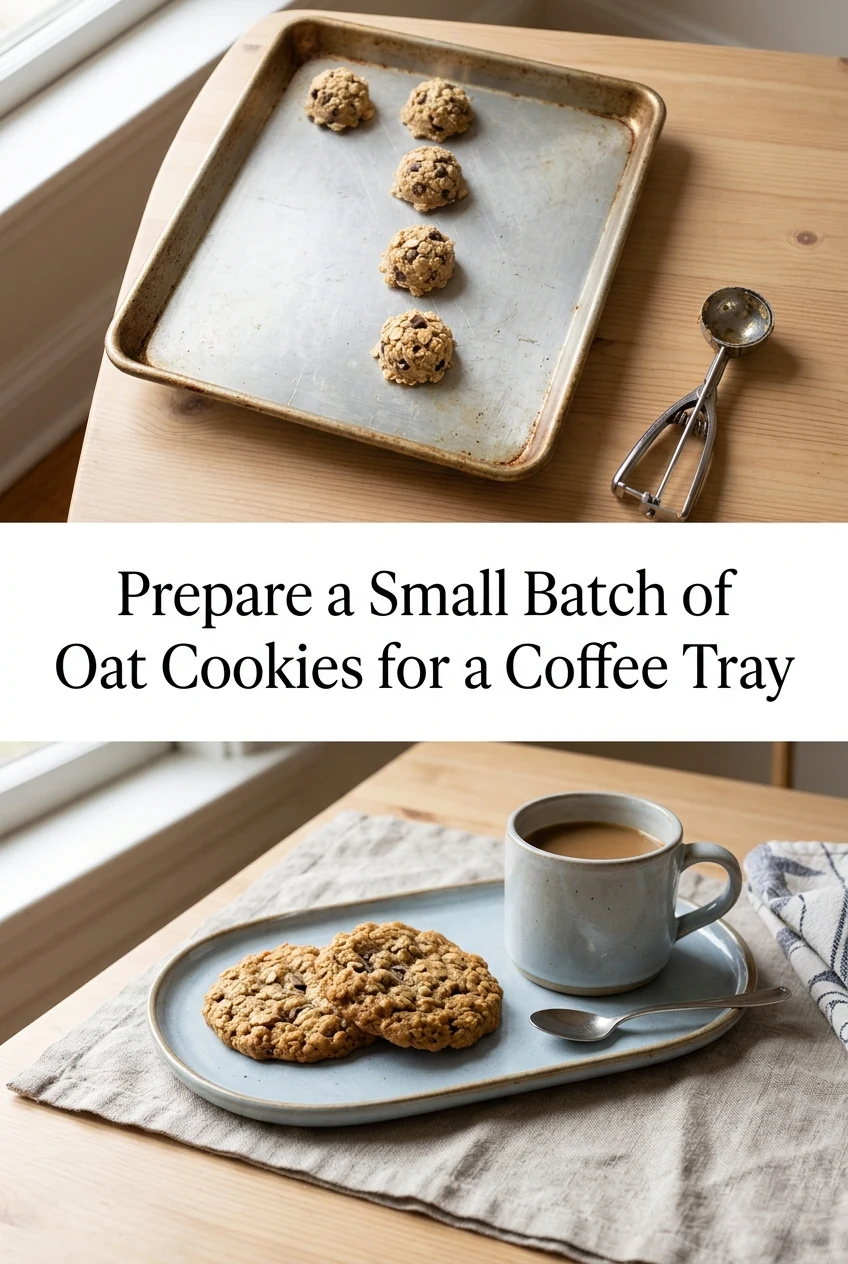
AI-generated editorial concept created for this article. The image is not a technical diagram or a tested result.
Scale the Dough to One Tray
Halving a standard recipe that yields twenty-four cookies gives you roughly twelve, which is still more than a single tray holds well. Dividing the original quantities by three is a more practical target for eight to ten cookies. Weigh ingredients rather than estimating by volume when working with small quantities, because a tablespoon of flour measured loosely can vary by several grams and that error matters more in a small batch than a large one.
Portion Each Cookie to a Consistent Weight
For coffee-plate cookies, a portioned weight of 25 to 30 grams per piece produces a cookie roughly 6 to 7 centimeters across after baking, which fits neatly beside a cup without overhanging the saucer. Use a small kitchen scale and a spoon or disher to pull equal portions. Uneven portions bake at different rates on the same sheet, so the lightest pieces overbake before the heaviest ones are done. Consistent weight solves this without adjusting oven time.
Space Portions on the Sheet
Oat cookies spread moderately during baking. Leaving at least 5 centimeters between raw portions on a standard 30 by 40 centimeter sheet allows spread without cookies merging. Eight portions fit comfortably in two rows of four at that spacing. Place the sheet on the middle rack so heat circulates evenly above and below. If your oven runs hotter at the back, rotate the sheet once at the halfway point of the bake time.
Adjust Bake Time for a Smaller Load
A single tray with eight cookies carries less thermal mass than a full batch, so the oven temperature recovers faster after the door closes. In practice this often means the cookies are done one to two minutes sooner than the original recipe states, though your specific oven will vary. Begin checking for a lightly golden edge and a center that looks just set rather than wet. The center firms further as the cookies cool on the sheet for five minutes.
Cool and Transfer for Serving
Leave cookies on the hot sheet for five minutes after removing from the oven; moving them immediately risks breaking the structure before it sets. Transfer to a wire rack for full cooling before placing on a serving tray. If cookies will sit on a coffee tray for more than two hours at room temperature, cover loosely with a clean cloth. For longer holds, store in an airtight container and bring to the tray as needed rather than leaving them exposed.
A little more
to know.
Can I refrigerate the portioned dough and bake it the next day?
Yes. Cover portioned dough pieces on the sheet with plastic wrap and refrigerate at 4 degrees Celsius or below. Bake directly from cold, but expect to add two to three minutes to the bake time and check edges carefully.
Why do my small-batch cookies spread more than the original recipe?
Butter temperature is the most common cause. Warmer butter spreads faster. For a small batch, measure butter cold and let it soften only to cool room temperature before mixing, rather than leaving it out for an extended period.
Original editorial guidance and recipe formulations, not independently kitchen-tested. Times are estimates and depend on equipment and product directions. Cooked bases need additional cooling and refrigeration before cold serving. Images are AI-generated illustrations; appearance and yield may vary. Check actual ingredient labels, allergens, and any certification you require. We do not certify products. Read our approach.
Save to Pinterest ↗ANOTHER IDEA FOR THE COUNTER