Prepare a Dish for Used Tea Bags Without Pulling Their Strings Across Cups
A small, stable waste dish placed deliberately beside your brewing area solves one of the tidiest problems in a home café setup: the used tea bag that drips across the counter or, worse, drags its wet string through a neighbouring cup. This is a workflow and station-arrangement technique, not a recipe with a tested kitchen result. The steps below describe one illustrative plan for organising your brewing corner so that every spent bag travels a short, contained path from cup to dish without crossing another serving.
Read the note ↓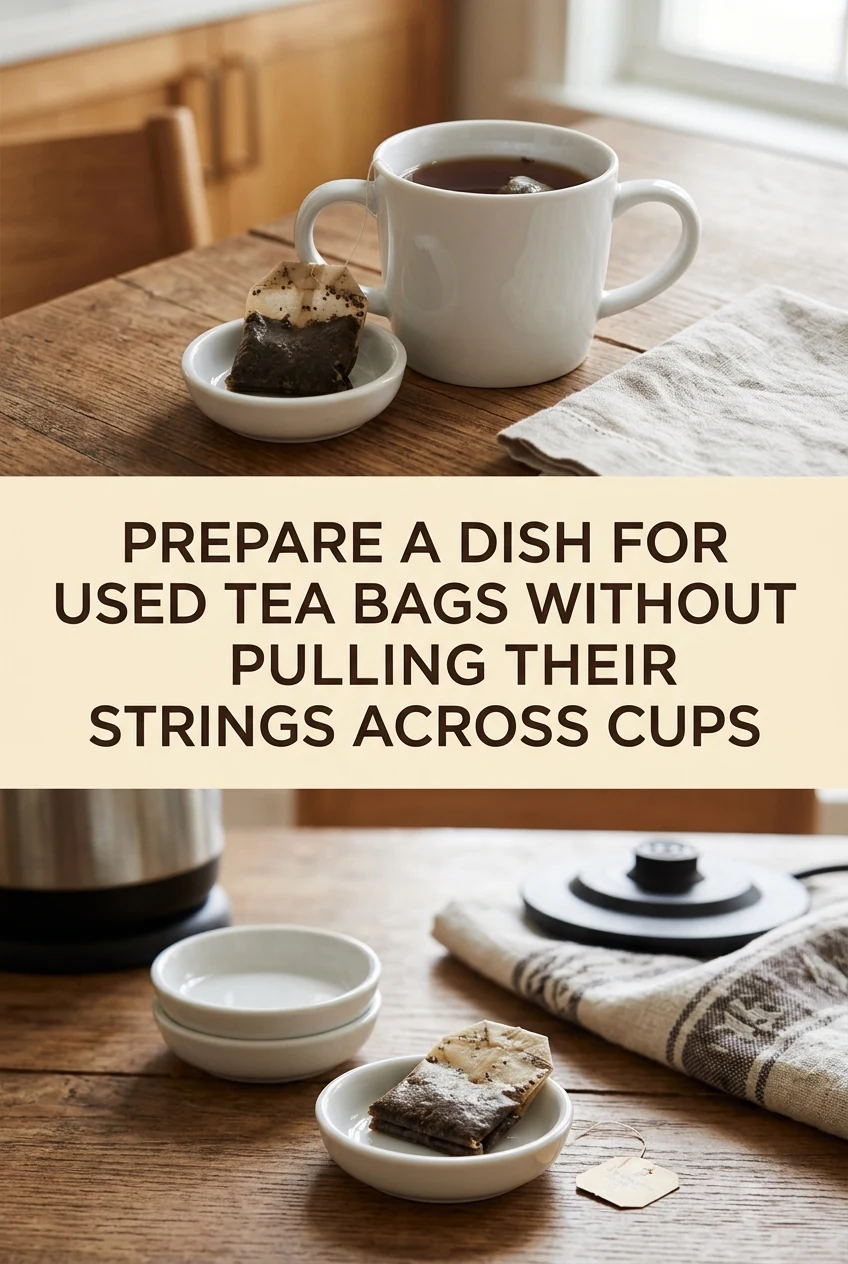
AI-generated editorial concept created for this article. The image is not a technical diagram or a tested result.
Choose a Suitable Waste Dish
Select a small ceramic or stainless-steel dish with a shallow lip — a saucer, a ramekin, or a dedicated tea-bag rest all work. The dish needs to sit flat without rocking, hold at least one bag without letting it slide off, and be easy to carry to the sink. Avoid dishes with a curved base on a smooth counter, as they shift when a wet bag lands on them. A diameter of roughly 8 to 10 centimetres gives enough surface for a standard tea bag to rest without the string hanging over the edge and touching the counter. Place a small square of paper towel inside the dish if you want to absorb drips and make rinsing quicker afterward.
Position the Dish Before You Pour
Station placement matters more than the dish itself. Set the waste dish to the non-dominant side of your brewing tray, at least 5 centimetres clear of any filled cup. In a worked example: if you are brewing two cups of green tea side by side on a 30-centimetre tray, place both cups toward the back edge at the left and centre, leaving the front half of the tray clear, and set the waste dish at the far right on a stable folded cloth. When you lift the bag from the left cup, draw it forward into this open corridor before moving it rightward to the dish. This ensures the bag and trailing string travel over empty surface rather than passing above the centre cup. Arrange the dish before you pour hot water so the station is fixed and you are not adjusting things while holding a dripping bag.
Lift and Transfer the Bag in One Direct Move
When the steeping time recommended on your tea maker's packaging is complete, lift the bag by pinching the string close to the bag tag, not by the tag itself. Keep the bag level and move it in a single arc directly to the waste dish. Do not loop the string around the bag to squeeze it; many tea makers advise against squeezing because it can affect clarity and taste, and wrapping a hot wet string around your fingers is uncomfortable. Simply let the bag drain briefly over the cup, then transfer it. The short, direct arc is the core of this technique: bag leaves cup, travels over clear counter, lands in dish. The string follows the same path and never crosses another cup.
Serving Multiple Cups Without Cross-Contamination
When serving three or more cups arranged in a row, route each bag through the clear open space in front of the cups rather than across the line of rims. In an illustrative setup with cups A, B, and C lined up left to right and the waste dish positioned to the right of cup C, clear the bags using this dedicated front corridor. Lift the bag from cup A, bring it forward into the open space in the foreground, and carry it rightward along that clear line into the dish. Repeat the forward-and-across motion for cup B, then transfer cup C directly into the adjacent dish. Routing along the clear foreground prevents any wet bag or trailing string from passing over neighbouring cups, keeping each serving completely isolated from drips.
Clearing the Dish and Resetting the Station
Once all bags are in the dish, carry the dish to the sink promptly. Used bags left sitting at room temperature should be discarded soon after brewing; do not store used bags for later reuse or leave them in a warm dish for extended periods. Discard the paper towel liner if you used one, rinse the dish, and return it to its position for the next round. If you are preparing a tea-based drink that includes perishable additions — such as a milk or cream component — refrigerate any unused portion promptly following standard food-safety practice rather than leaving it at counter temperature. Reset the station before guests arrive so the waste dish is already in place and the workflow runs without improvisation.
A little more
to know.
Can I use the same waste dish for both tea bags and matcha tools?
It is cleaner to keep them separate. Matcha whisks and scoops carry fine powder that can transfer to a wet tea bag and then colour the next cup unexpectedly. A dedicated small dish for tea bags and a separate rinse bowl for matcha tools keeps each station tidy and prevents flavour or colour transfer between the two.
What if my tray is too small to place the waste dish outside the cup area?
Move the waste dish off the tray entirely and onto the counter beside it. A tray is a carrying and presentation surface, not a boundary you must stay within. Placing the dish directly on the counter next to the tray gives you the clearance you need and keeps the arc of travel short. A folded cloth or small cork mat under the dish stops it sliding on smooth counter surfaces.
Original editorial guidance and recipe formulations, not independently kitchen-tested. Times are estimates and depend on equipment and product directions. Cooked bases need additional cooling and refrigeration before cold serving. Images are AI-generated illustrations; appearance and yield may vary. Check actual ingredient labels, allergens, and any certification you require. We do not certify products. Read our approach.
Save to Pinterest ↗ANOTHER IDEA FOR THE COUNTER