Pour a Fruit Puree Base Into a Glass Before Adding Ice Rather Than After
Fruit purees are denser than water and sink when poured over ice, but the ice cubes block their path and trap pockets of unmixed puree between them. Reversing the order solves this immediately. Pouring the puree into an empty glass first gives it a flat, unobstructed base. Ice added afterward settles on top evenly, and any liquid added next flows down through the gaps cleanly. The result is a drink that layers predictably and stirs with far less effort.
Read the note ↓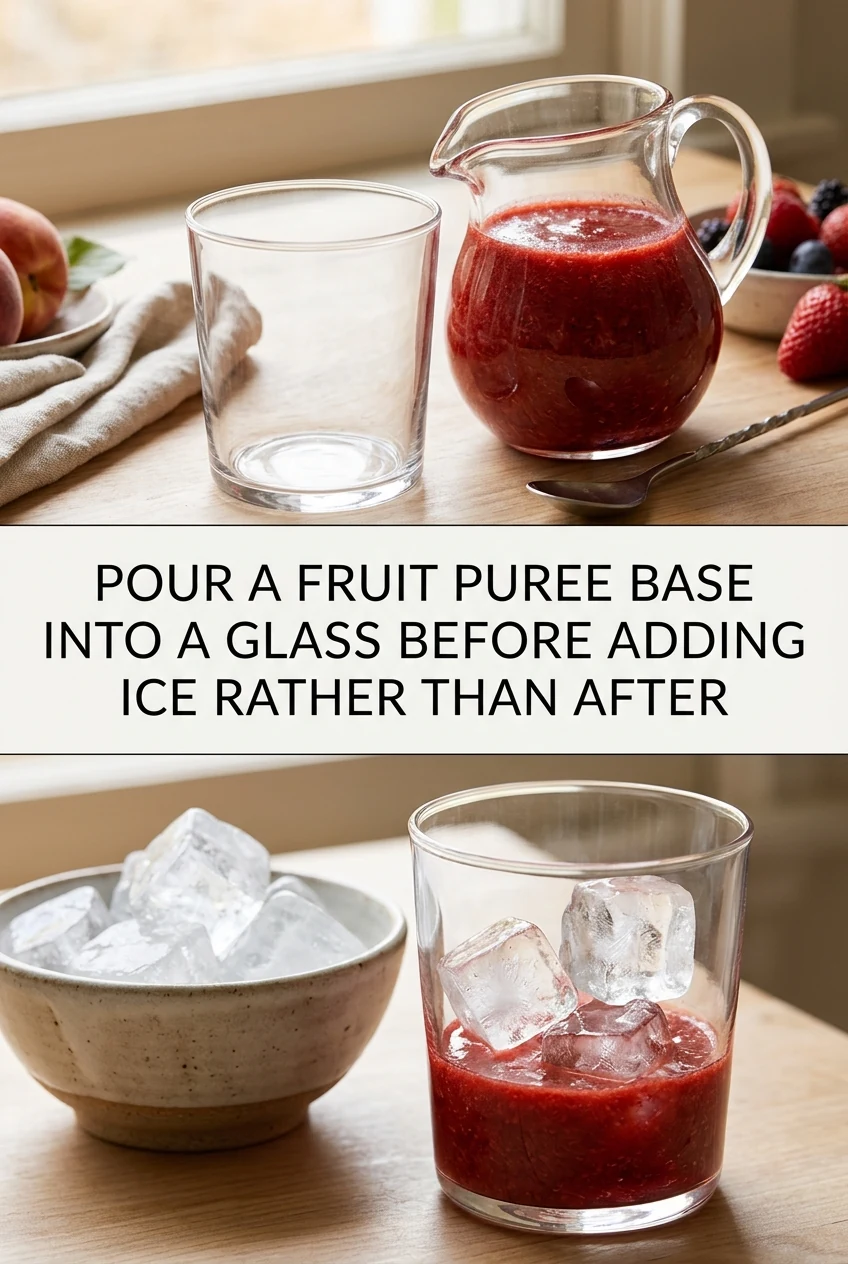
AI-generated editorial concept created for this article. The image is not a technical diagram or a tested result.
Why Puree Gets Trapped Above Ice
Ice cubes create an irregular lattice inside a glass. A thick puree poured onto that lattice sits in the gaps rather than flowing to the bottom. Stirring then drags ice upward instead of moving puree downward, and the drink stays streaky. The puree's density works in your favor only when it has a clear path to the bottom, which an empty glass provides. This is the single mechanical reason the order of assembly matters.
How to Measure and Pour the Puree First
Measure your puree into the empty glass before anything else. A common starting point for a single serving is 60 to 80 milliliters of puree in a 400-milliliter glass, though your recipe may differ. Pour slowly along the inside wall rather than dropping it straight down, which reduces splashing and keeps the base even. Once the puree sits flat at the bottom, you have a stable foundation for the next step.
Adding Ice Without Disturbing the Base
Lower ice into the glass rather than dropping it from height. Dropping a full scoop from above punches through the puree layer and sends it up the sides. Instead, tilt the glass slightly and slide four to six standard cubes down the inner wall. They will stack on top of the puree without displacing it. Crushed ice is lighter and settles more gently, making it a practical choice when you want to preserve a clean visual separation.
Pouring the Liquid Component Over Ice
Once ice is in place, add your liquid, whether milk, coconut water, or plain water, by pouring it over the back of a spoon held just above the ice surface. This slows the pour and spreads it across the cubes rather than forcing a single stream through them. The liquid chills as it passes the ice and meets the puree at the bottom. At this point a single stir with a long spoon is usually enough to combine everything.
When Layering Is the Goal Instead
If you want a visually distinct layer rather than a blended drink, skip the final stir entirely. The density difference between a mango or strawberry puree and a thinner liquid is enough to keep them separated for several minutes in a still glass. For an illustrative example, 70 milliliters of mango puree under 200 milliliters of lightly sweetened coconut water will hold a visible boundary for roughly two to three minutes before gradual mixing begins. Serve immediately for the clearest effect.
A little more
to know.
Does the puree temperature affect how well it stays at the bottom?
Yes. A room-temperature puree is slightly less viscous than a refrigerated one and will begin mixing with added liquid faster. Using a chilled puree straight from the refrigerator gives you more time to complete the assembly before the layers start to blend.
Can I use a blended whole-fruit puree the same way as a commercial one?
You can, but consistency varies. A home-blended puree with visible fiber is thicker and holds its position longer. Strain it through a fine mesh sieve first to remove large solids that could clog a straw or create an uneven base layer.
Original editorial guidance and recipe formulations, not independently kitchen-tested. Times are estimates and depend on equipment and product directions. Cooked bases need additional cooling and refrigeration before cold serving. Images are AI-generated illustrations; appearance and yield may vary. Check actual ingredient labels, allergens, and any certification you require. We do not certify products. Read our approach.
Save to Pinterest ↗ANOTHER IDEA FOR THE COUNTER