Measure Shelf Height Before Buying a Tall Ingredient Container
A tall ingredient container looks tidy on a home-cafe shelf until you get it home and discover the lid hits the cabinet above. Avoiding that frustration takes one measuring step before you buy, not after. This note walks through a straightforward fit check so the container you choose actually slides in and out of its spot with the lid on.
Read the note ↓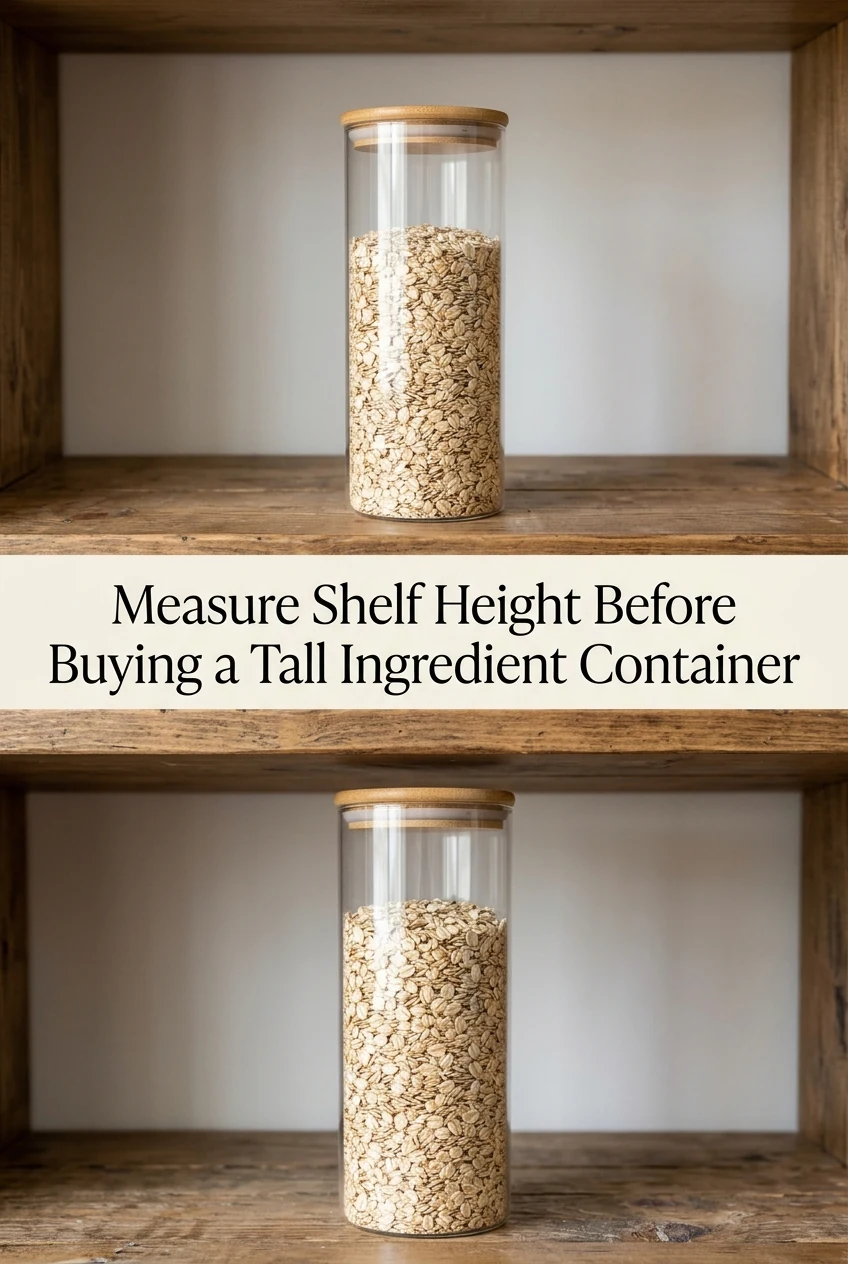
AI-generated editorial concept created for this article. The image is not a technical diagram or a tested result.
Why the Lid Changes Everything
Most product listings give the body height of a container, not the total height with the lid seated and locked. A flip-top, a screw cap with a raised grip, or a hinged clasp can add anywhere from a few millimetres to more than two centimetres on top of the stated figure. If your shelf clearance is tight, that extra height is the difference between a container that fits and one that has to sit on the counter instead. Always treat the closed-lid height as the number that matters for a fit check.
How to Measure Your Available Clearance
Stand in front of the shelf and measure from the shelf surface straight up to the underside of the cabinet or shelf above it. Use a rigid tape measure held vertically so it does not bow. Write that number down. Then subtract a small working margin, around one to two centimetres, so you can lift the container slightly when pulling it forward rather than dragging it flat. That adjusted figure is your usable clearance. For example, if the gap measures 28 cm and you subtract 1.5 cm for handling room, your usable clearance is 26.5 cm. Any container whose closed-lid height is at or below 26.5 cm is a candidate.
Checking a Container Before You Buy
In a shop, place the container on a flat surface, seat the lid fully as the maker intends, and measure from the base to the highest point of the closed lid. If you are ordering online, look for a listed overall height with lid or contact the seller to ask for it. If only the body height is listed, check whether the product page shows a cross-section diagram or a dimensions table that includes the lid. When no lid-on figure is available from the seller, it is safer to choose a different product whose full dimensions are confirmed rather than guess and risk a poor fit.
A Worked Example Using a Syrup Bottle and a Spice Jar
Suppose your home-cafe shelf gap measures 30 cm and your usable clearance after the handling margin is 28.5 cm. You are considering two containers: a tall glass syrup bottle whose product page lists a body height of 27 cm with a metal screw cap, and a shorter wide-mouth spice jar listed at 14 cm total including lid. For the syrup bottle, the seller confirms the cap adds 2 cm, giving a closed-lid height of 29 cm. That exceeds your 28.5 cm usable clearance, so this bottle does not fit without removing the handling margin entirely, which makes daily use awkward. The spice jar at 14 cm fits easily. This is an illustrative plan showing how the arithmetic works, not a tested result with those specific products. The principle is the same regardless of which containers you are evaluating.
Organising Ingredients Once the Containers Fit
Once you have confirmed fit, label each container clearly with the ingredient name and, where relevant, the date you filled it. For dry goods such as ground coffee, whole spices, or sugar, follow the storage guidance on the original packaging rather than assuming a new container extends or changes any timeframe. For anything perishable, such as a homemade simple syrup or a dairy-based mix, refrigerate it promptly and follow the same caution you would apply to any fresh preparation. Use only alcohol-free vanilla flavoring if vanilla is part of any mix you are storing, and confirm any gelatin used in recipes is labeled halal. The container fit check is separate from food-safety practice; both matter independently.
A little more
to know.
What if the container fits the shelf but the lid cannot open fully because the cabinet is in the way?
A container that fits in height when closed may still be awkward if the lid needs vertical clearance to open, such as a flip-top that swings upward. Check the lid action in the shop or ask the seller whether the lid opens to the side or straight up. If it opens upward, you need enough clearance above the closed-lid height for the lid to swing without catching on the shelf above. Measure that arc if you can, or choose a container with a lid that lifts off completely or rotates rather than one that hinges upward into a confined space.
Should I measure every shelf position or just the one I plan to use?
Measure the specific position where the container will actually live day to day. Shelf gaps vary between positions on the same unit because shelves are not always perfectly level and brackets can sit at slightly different heights on each side. If you plan to move the container between two spots, measure both and use the smaller usable clearance as your limit. That way the container works in either location without having to re-check each time.
Original editorial guidance and recipe formulations, not independently kitchen-tested. Times are estimates and depend on equipment and product directions. Cooked bases need additional cooling and refrigeration before cold serving. Images are AI-generated illustrations; appearance and yield may vary. Check actual ingredient labels, allergens, and any certification you require. We do not certify products. Read our approach.
Save to Pinterest ↗ANOTHER IDEA FOR THE COUNTER