Match a Syrup Bottle Opening Size to the Jigger or Spoon Used for Pouring
A syrup bottle that drips, glug-pours, or requires a funnel every time you measure a dose slows down a home café workflow and leads to inconsistent quantities in finished drinks. The fix is not a new measuring tool but a deliberate check of whether the bottle opening and the measuring vessel are physically compatible before you fill the bottle. This guide explains how to assess that fit, what opening styles work with common measuring tools, and how to adjust when the match is poor.
Read the note ↓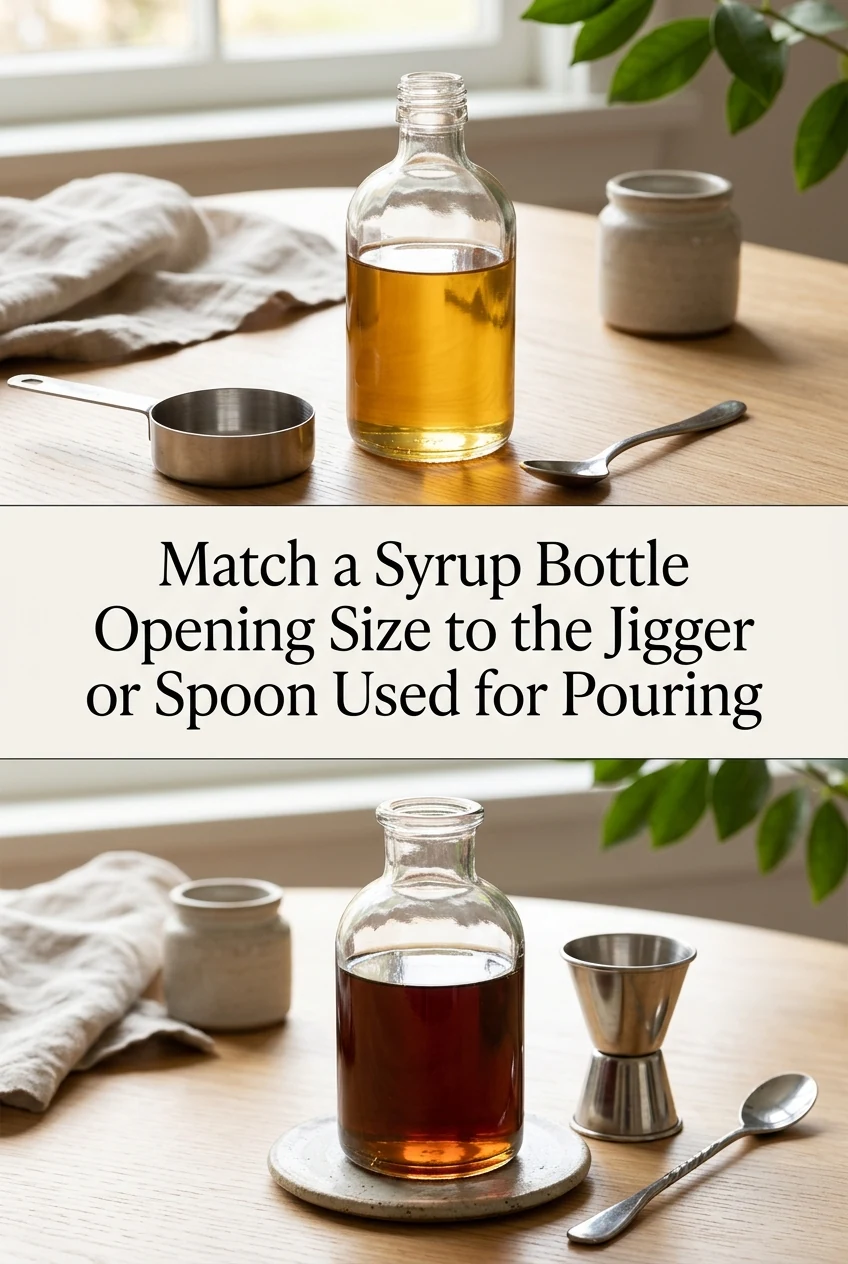
AI-generated editorial concept created for this article. The image is not a technical diagram or a tested result.
Identify the Two Opening Styles You Will Encounter
Most small syrup bottles fall into two categories: a wide mouth with an opening of roughly 38 millimetres or more, and a narrow neck with an opening closer to 18 to 28 millimetres. Wide-mouth bottles pour in a broad stream that is easy to aim into a jigger or tablespoon measure but can overshoot a small spoon quickly. Narrow-neck bottles give more controlled flow but may drip along the outside of the neck if the syrup is thick. Knowing which type you have shapes the rest of the matching decision.
Check How the Bottle Neck Aligns Over the Jigger
Hold the empty bottle over the jigger you plan to use and tip it as if pouring. The stream should fall cleanly into the jigger opening without requiring you to tilt the bottle at an awkward angle or hold it very close to avoid splashing. As an illustrative example, a narrow-neck bottle with an 18-millimetre opening held 5 to 8 centimetres above a standard double jigger typically produces a stream narrow enough to aim accurately. This is a physical check, not a guaranteed outcome for every bottle and jigger combination.
Test the Pour Rate With Water Before Filling With Syrup
Fill the candidate bottle with plain water and practise the pour into your measuring tool over a sink. Count how quickly the liquid reaches the target line on the jigger or fills the spoon. A bottle that empties the target volume in under two seconds with a narrow stream is easier to stop accurately than one that floods the measure in half a second. This water test costs nothing and reveals pour-rate problems before you commit the bottle to a finished syrup batch.
Add a Pour Spout Insert When Flow Is Hard to Control
A bottle pour spout insert, which features a tapered dispensing tube and a ribbed flexible collar, narrows the opening to provide a steady, directional stream. These push-in inserts are made to fit standard narrow bottle necks—typically with an internal diameter of roughly 18 to 22 millimetres—rather than wide-mouth openings. Press the collar firmly into the bottle neck until it seats flush without wobbling. After inserting, repeat the water test to confirm the restricted flow rate pairs well with your jigger or measuring spoon. Remove and clean the spout thoroughly between syrup batches to prevent flavour carryover.
Decide When a Funnel Is Still the Right Answer
When you choose a narrow-neck bottle for clean pouring into a jigger or spoon, refilling that bottle from a saucepan or storage container will usually require a funnel. That is an acceptable compromise: keep a dedicated small funnel with your prep equipment for refilling rather than at the active beverage station. The goal of matching the bottle opening to your measuring tool is to eliminate drips, funnels, and awkward handling during drink assembly, whereas refilling the bottle is a separate, less frequent preparation step.
A little more
to know.
Does syrup viscosity change how well a matched bottle and jigger combination performs?
Yes. A thicker syrup flows more slowly than a thin one through the same opening, so a bottle that pours well with a light syrup may require a longer tilt or pour time with a denser batch. Retest the pour rate whenever you change syrup recipes.
Can I use a squeeze bottle instead of a standard syrup bottle for better control?
A squeeze bottle gives direct control over flow rate and works well for tablespoon-level doses. The trade-off is that squeeze bottles are harder to clean thoroughly between syrup varieties and may retain flavours if not washed promptly after each batch.
Original editorial guidance and recipe formulations, not independently kitchen-tested. Times are estimates and depend on equipment and product directions. Cooked bases need additional cooling and refrigeration before cold serving. Images are AI-generated illustrations; appearance and yield may vary. Check actual ingredient labels, allergens, and any certification you require. We do not certify products. Read our approach.
Save to Pinterest ↗ANOTHER IDEA FOR THE COUNTER