Make a Small Batch of Plain Coconut Macaroons
Coconut macaroons are small, chewy mounds built from whipped egg whites and desiccated coconut, baked until the outside turns lightly golden while the centre stays moist. This article walks through a straightforward small-batch plan yielding roughly twelve pieces, sized for a quiet afternoon at home rather than a large gathering. These baked biscuits are entirely distinct from coconut-flavoured drinks or blended café beverages. The method described here is an illustrative home-café approach, not a laboratory-tested result, so treat the timings and quantities as a reliable starting point that you may need to adjust slightly for your own oven.
Read the note ↓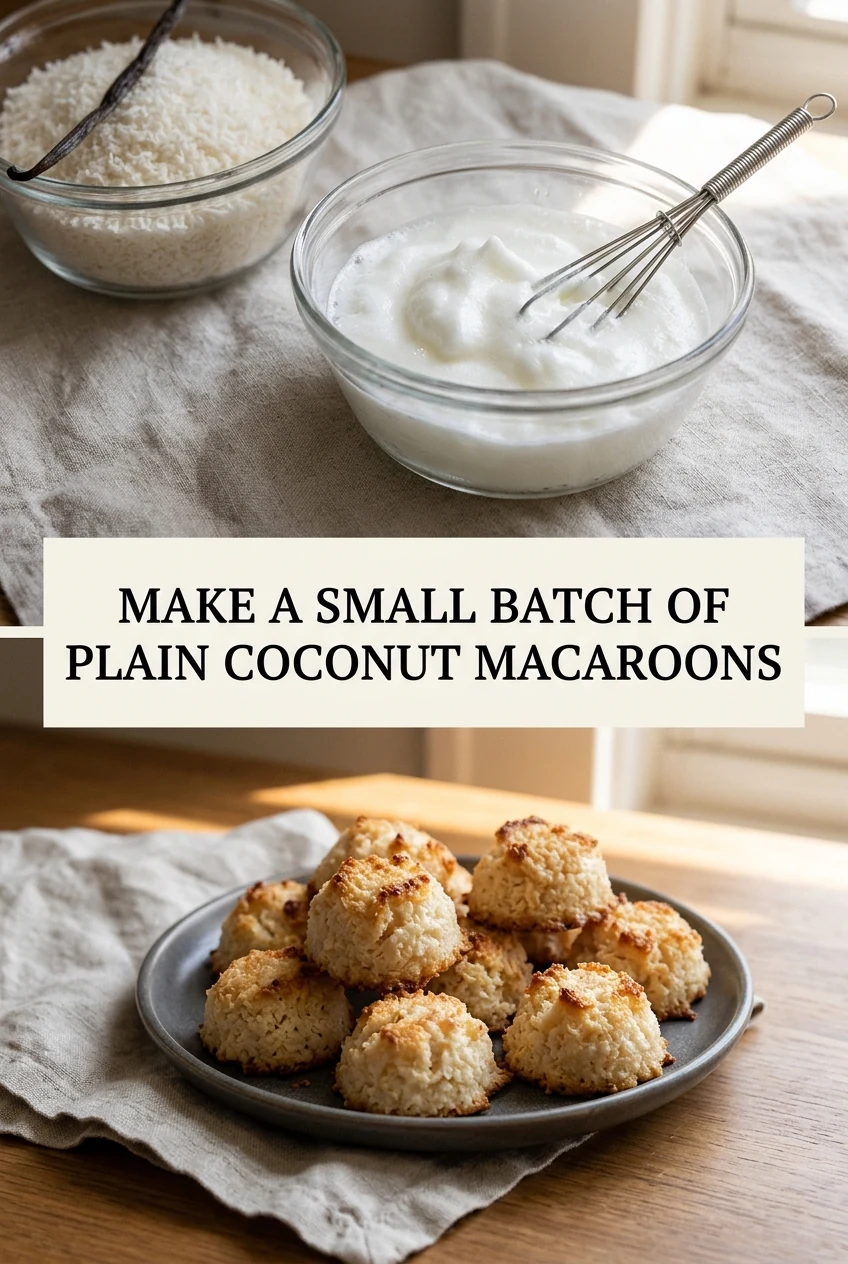
AI-generated editorial concept created for this article. The image is not a technical diagram or a tested result.
Ingredients for Twelve Macaroons
Gather the following before you begin: 2 large egg whites, 80 g caster sugar, a small pinch of fine salt, half a teaspoon of alcohol-free vanilla flavouring (check the label to confirm it contains no ethanol), and 160 g of desiccated coconut. That is the complete list. The egg whites provide structure and lift; the sugar sweetens and helps bind; the salt sharpens flavour; the alcohol-free vanilla adds a mild background note; and the desiccated coconut supplies both body and the characteristic chew. Use halal-certified desiccated coconut if certification matters to your household. No gelatin is required in this recipe. Weigh ingredients before you start mixing so nothing is rushed once the egg whites are beaten.
Preparing the Egg-White Coconut Mixture
Set your oven to the temperature recommended in your oven's own manual for baking small biscuits — a moderate heat is typical, often somewhere around 160 to 170 degrees Celsius for a fan-assisted oven, but follow your appliance's guidance rather than assuming a universal setting. Line a flat baking tray with non-stick baking paper. In a clean, dry bowl, whisk the two egg whites with the pinch of salt until they form soft peaks — the mixture should hold a gentle curve when you lift the whisk but not be stiff or dry. Gradually add the caster sugar one tablespoon at a time, whisking briefly between additions, until the mixture is glossy and slightly thicker. Stir in the half teaspoon of alcohol-free vanilla flavouring. Finally, fold in the 160 g of desiccated coconut using a large spoon or spatula, turning the mixture gently until every strand is coated and no dry coconut remains at the bottom of the bowl.
Portioning and Shaping
Use a tablespoon or a small ice-cream scoop to portion the mixture. Each level tablespoon of mixture produces one macaroon, and the quantities above should give you approximately twelve portions. Place each mound onto the lined tray, leaving roughly four centimetres between them so they have space without spreading into one another. Lightly press each mound into a compact dome with damp fingertips — this helps them hold their shape during baking rather than collapsing flat. Twelve mounds arranged in three rows of four fit neatly on a standard 30-by-40-centimetre tray. If your tray is smaller, bake in two rounds rather than crowding the pan.
Baking and Cooling
Slide the tray into the preheated oven and bake until the macaroons are golden at the tips and edges while remaining pale and slightly soft at the base. In a typical fan-assisted oven this takes somewhere between 18 and 22 minutes, but check your own oven's behaviour from around the 16-minute mark, as ovens vary. The macaroons are ready when the coconut strands on top have taken on a warm golden colour and the bases feel set when you gently lift one with a palette knife. Remove the tray and leave the macaroons on it for five minutes — they firm up as they cool and are fragile when very hot. Transfer them to a wire rack and allow them to reach room temperature fully before storing or serving.
Storing Perishable Baked Goods Promptly
Because these macaroons contain egg whites, they are a perishable item. Once fully cooled, place them in an airtight container and refrigerate promptly. Do not leave them at room temperature for extended periods, particularly in warm weather. Consume them within a timeframe you are comfortable with given your refrigerator's performance — no specific shelf life is guaranteed here. If you plan to serve them as part of a home-café spread alongside coffee or tea, bring only the number you need out of the refrigerator shortly before serving rather than leaving the whole batch out. These macaroons pair naturally with a plain black coffee or a milky tea and sit well on a small plate beside a square of dark chocolate.
A little more
to know.
Can I use sweetened desiccated coconut instead of unsweetened?
You can, but the macaroons will taste noticeably sweeter because sugar is already present in sweetened coconut alongside the sugar in the meringue. If you use sweetened coconut, consider reducing the caster sugar by about one to two tablespoons to balance the overall sweetness, rather than sampling raw egg mixture before baking. The baked texture should remain similar either way.
Why are these called macaroons rather than macarons?
Coconut macaroons and French macarons are two different biscuits that share a distant common origin but are made very differently. Coconut macaroons are rustic, chewy mounds built primarily from desiccated coconut and egg whites, as described in this article. French macarons are smooth, sandwiched meringue shells made with almond flour and require a more technical process. The two names are often confused, but they refer to distinct products.
Original editorial guidance and recipe formulations, not independently kitchen-tested. Times are estimates and depend on equipment and product directions. Cooked bases need additional cooling and refrigeration before cold serving. Images are AI-generated illustrations; appearance and yield may vary. Check actual ingredient labels, allergens, and any certification you require. We do not certify products. Read our approach.
Save to Pinterest ↗ANOTHER IDEA FOR THE COUNTER