Keep a Dedicated Spoon Rest Beside the Stovetop During a Warm Drink Session
During a session of making several warm drinks in sequence, a stirring spoon moves between pots, cups, and syrups repeatedly. Setting it down on the counter each time leaves sticky rings, transfers flavours between drinks, and creates a surface hygiene problem that compounds across the session. A small dedicated dish placed beside the pot before you begin costs almost no setup time and solves all three problems without requiring any change to how you stir.
Read the note ↓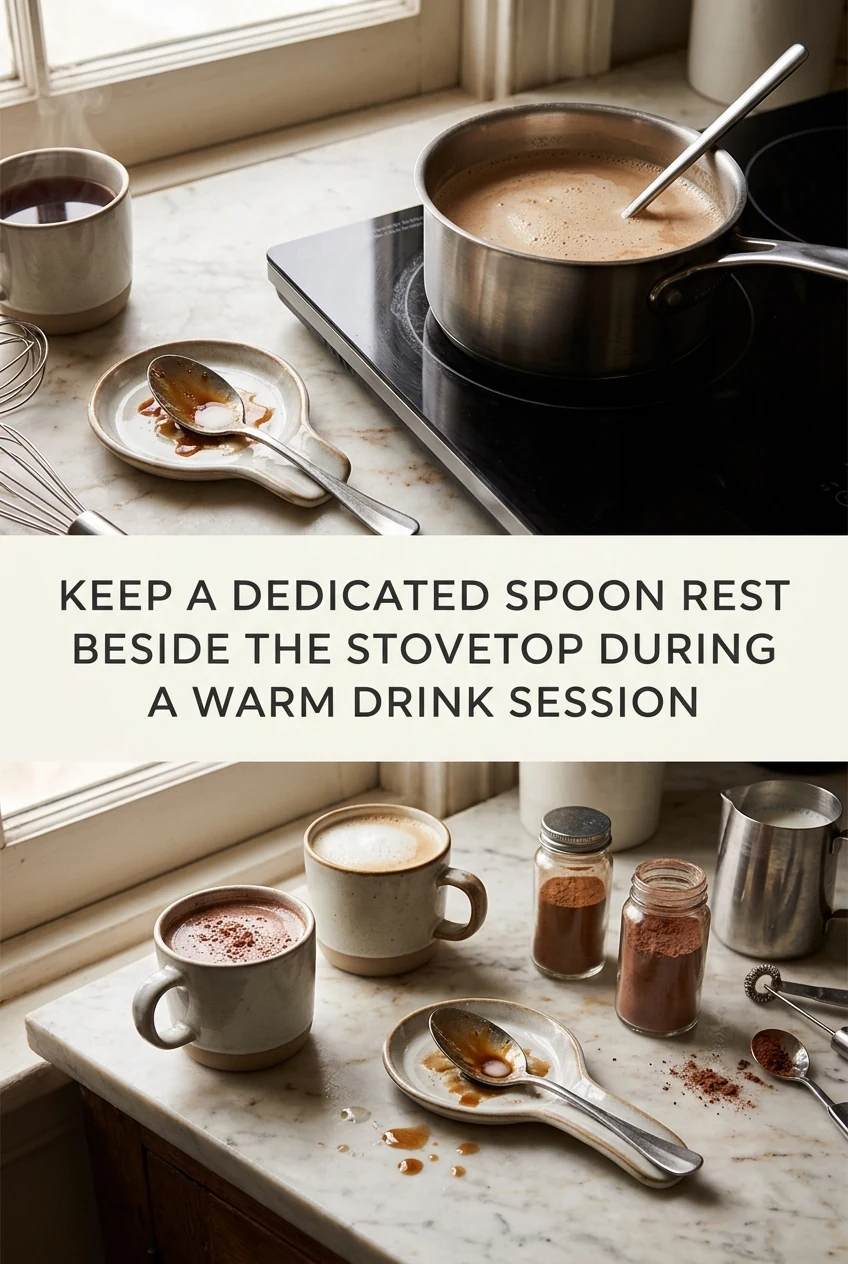
AI-generated editorial concept created for this article. The image is not a technical diagram or a tested result.
Why the counter surface is a poor default resting place
A spoon rested on a counter carries warm liquid that spreads into a thin film, cools, and becomes tacky within a minute or two. When the spoon is picked up again, it lifts some of that residue and carries it into the next drink. In a session involving cocoa, a flavoured syrup, and plain milk, this transfer is enough to introduce off-notes into a drink that should taste clean. The counter surface also accumulates heat marks from a warm spoon placed repeatedly in the same spot.
Choosing the right dish for a spoon rest
A small ceramic or stainless steel dish with a rim of at least 1 centimetre is sufficient to catch drips without them running onto the counter. A dish roughly 10 centimetres in diameter accommodates most standard stirring spoons without the handle overhanging so far that the dish tips. Avoid dishes with a porous or unglazed surface, which absorbs flavoured liquids and is harder to rinse clean between uses during a session.
Positioning the dish to make the habit automatic
Place the spoon rest dish to the right of the pot if you are right-handed, or to the left if left-handed, within easy reach without crossing over the heat source. Positioning it before you turn on the stovetop makes it part of the setup rather than an afterthought. If the dish is placed too far away, the natural tendency is to set the spoon on the nearest flat surface, which defeats the purpose entirely. Proximity is what makes the habit stick across a full session.
Managing the dish when switching between flavoured drinks
When moving from one drink to another with a distinctly different flavour, rinse the spoon under warm running water and wipe it on a clean cloth before returning it to the rest dish. The dish itself should be rinsed if it has collected a visible pool of liquid from the previous drink. This two-step reset takes under 30 seconds and prevents the spoon rest from becoming a source of cross-contamination rather than a solution to it.
Cleaning the spoon rest at the end of a session
At the end of the session, wash the spoon rest dish with warm water and dish soap in the same way you would any small piece of kitchenware. Do not leave it sitting with pooled liquid in it between sessions, as dried syrup residue is harder to remove and can harbour bacteria if left at room temperature. A dish that is cleaned promptly after each session remains ready to use immediately at the start of the next one without any additional preparation.
A little more
to know.
Is a spoon rest necessary if I am only making one drink?
For a single drink the risk of cross-contamination is lower, but a sticky counter residue still results from setting the spoon down even once. Using a dish takes no extra effort and keeps the stovetop area cleaner, which is useful regardless of how many drinks are being prepared.
Can I use a folded piece of paper towel as a spoon rest instead of a dish?
Paper towel absorbs liquid quickly but saturates and becomes ineffective after one or two uses. It also does not prevent the spoon from rolling or sliding. A rigid dish is more stable, reusable, and easier to rinse clean mid-session without interrupting the drink-making workflow.
Original editorial guidance and recipe formulations, not independently kitchen-tested. Times are estimates and depend on equipment and product directions. Cooked bases need additional cooling and refrigeration before cold serving. Images are AI-generated illustrations; appearance and yield may vary. Check actual ingredient labels, allergens, and any certification you require. We do not certify products. Read our approach.
Save to Pinterest ↗ANOTHER IDEA FOR THE COUNTER