Fold Cocoa Powder Into Oat Cookie Dough Without Leaving Dry Streaks
Cocoa powder added directly to wet cookie dough tends to clump and streak because its fine particles resist dispersing once surrounded by moisture. The result is an uneven batch where some cookies bake darker than others and dry pockets appear when you break one open. Pre-mixing the cocoa with the other dry ingredients before any wet ingredients are added is the practical fix, and it requires no extra equipment beyond the bowl you were already planning to use.
Read the note ↓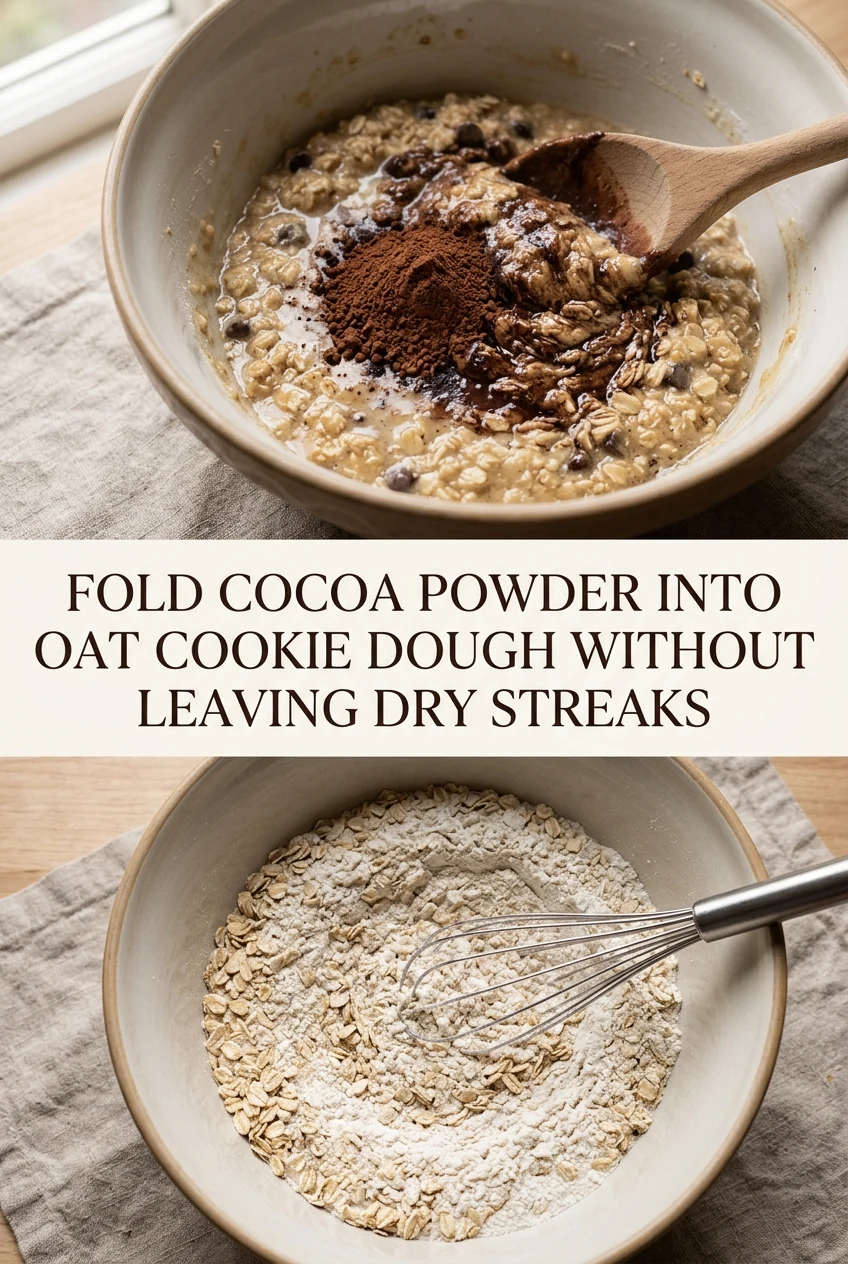
AI-generated editorial concept created for this article. The image is not a technical diagram or a tested result.
Why Cocoa Streaks in Wet Dough
Cocoa powder contains natural fats and very fine starches that resist quick dispersion when exposed directly to liquid. When dry cocoa meets wet ingredients, the exterior of each cluster hydrates immediately into a sticky barrier, trapping dry powder inside and creating persistent lumps. If you try to mix cocoa into dough that is already wet, breaking up these sealed pockets requires aggressive stirring, which can overwork the dough and still leave visible, unblended streaks in the baked cookies.
Sift Cocoa With the Dry Ingredients First
Measure the cocoa powder and sift it together with the flour, salt, and any raising agent into a bowl, then stir in the rolled oats before the wet ingredients are prepared. Sifting breaks up any compacted cocoa lumps and disperses the fine particles evenly through the flour. For a small batch of 12 cookies using 180 grams of rolled oats and 60 grams of plain flour, 25 grams of cocoa powder sifted in at this stage distributes thoroughly without streaking. These quantities are illustrative; follow your specific recipe proportions.
Combine Wet Ingredients Separately Before Mixing
Melt the fat and mix it with the sugar, egg, and any other wet components in a separate bowl before adding the dry mixture. Keeping the two groups apart until the moment of combining means the cocoa is already evenly distributed through the dry blend when it meets the wet ingredients. The fat then coats the cocoa particles uniformly rather than encountering them as isolated clumps, which is what causes the streaking problem in the first place.
Fold Rather Than Stir When Combining
Add the dry mixture to the wet bowl in two additions, folding with a spatula rather than stirring vigorously. Folding moves the mixture over itself, which incorporates the dry blend without overworking the dough. Overmixing oat cookie dough toughens the texture. Stop folding as soon as no dry streaks are visible. If you see a faint cocoa streak after the first addition, add the second portion of dry ingredients and fold again; the additional dry material helps absorb and distribute the remaining streak.
Check the Dough Before Portioning
Before scooping the dough onto the baking tray, press a small piece between your fingers and look at the cross-section. An even, uniformly dark colour throughout confirms the cocoa is well distributed. A lighter patch or pale streak means one more gentle fold is needed. Portioning streaky dough onto the tray locks the uneven distribution in place, and baking will not correct it. Once the dough looks consistent, portion and bake according to your recipe instructions.
A little more
to know.
Does the type of cocoa powder, natural or Dutch-process, affect how it mixes into the dry ingredients?
Both types benefit equally from pre-mixing with the dry ingredients. While Dutch-process cocoa is alkalized and wets slightly faster in liquids than natural cocoa, both varieties contain residual cocoa butter that causes them to form compacted lumps during storage. Sifting either type with the flour ensures even dispersion before the wet ingredients are introduced.
What if I have already added the cocoa to wet dough and can see streaks?
Gently smear the visible cocoa pockets against the side of the bowl using the flat edge of a silicone spatula to disperse the lumps without overworking the dough. Avoid vigorous stirring, which overdevelops gluten and toughens oat cookies. While this mechanical smearing helps blend stubborn streaks, it is less reliable than sifting the cocoa into the dry ingredients from the start.
Original editorial guidance and recipe formulations, not independently kitchen-tested. Times are estimates and depend on equipment and product directions. Cooked bases need additional cooling and refrigeration before cold serving. Images are AI-generated illustrations; appearance and yield may vary. Check actual ingredient labels, allergens, and any certification you require. We do not certify products. Read our approach.
Save to Pinterest ↗ANOTHER IDEA FOR THE COUNTER