Fold Chopped Toasted Almonds Into Shortbread Dough Without Breaking the Texture
Shortbread relies on minimal gluten development for its characteristic crumbly, tender bite. Adding chopped toasted almonds after the dough comes together risks overworking the mixture if you continue using a mixer or press too firmly by hand. Folding the nuts in gently by hand at the right moment keeps the dough short while distributing the almonds evenly. Understanding when and how to fold, rather than mix, is the practical skill that separates a tender result from a tough one.
Read the note ↓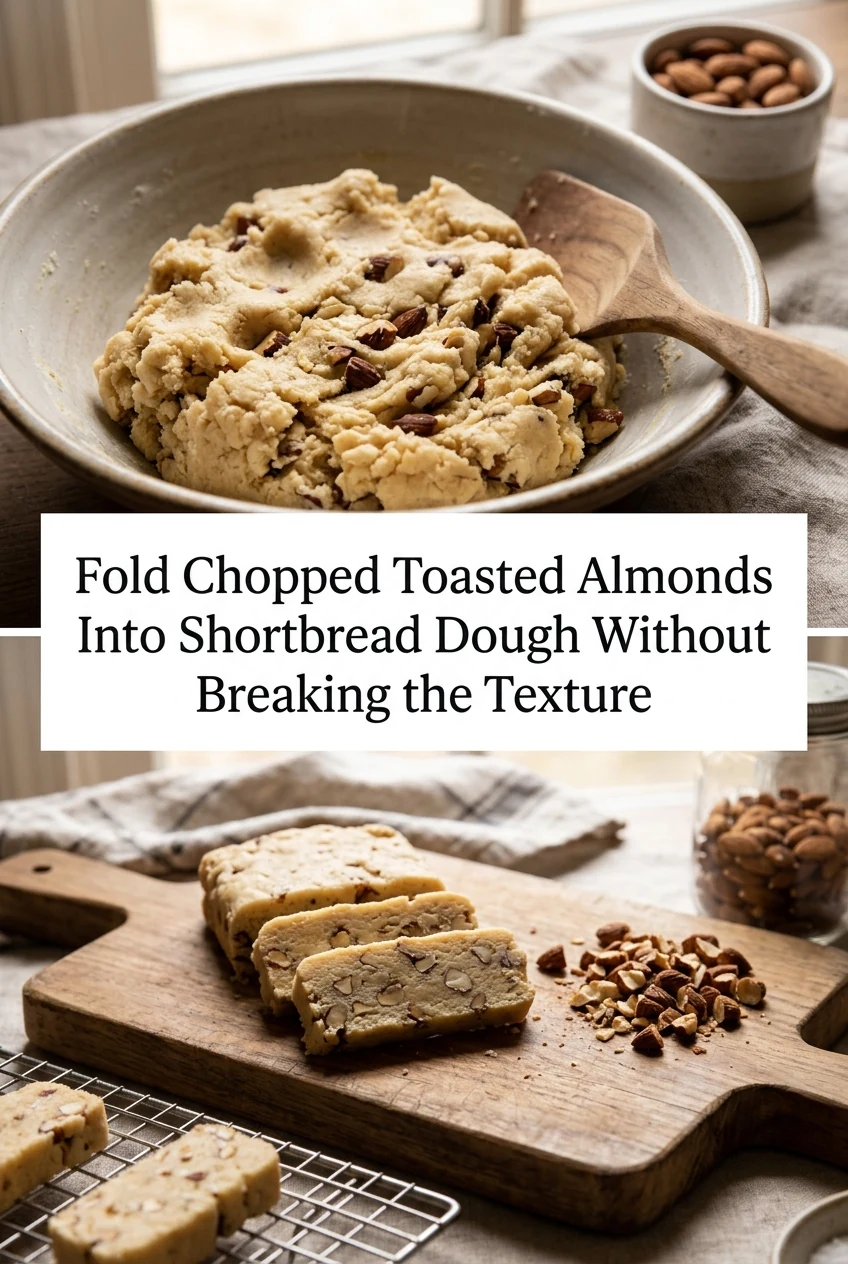
AI-generated editorial concept created for this article. The image is not a technical diagram or a tested result.
Toast and Chop the Almonds First
Spread whole blanched almonds in a single layer on a dry baking tray and toast in an oven preheated to 170 degrees Celsius for eight to ten minutes, until lightly golden and fragrant. Cool them completely before chopping. Warm nuts release oil that can make the dough greasy and affect how the butter binds. Chop to roughly 5 mm pieces using a sharp knife rather than a food processor, which produces uneven dust and larger fragments in the same batch.
Make the Dough to the Just-Combined Stage
Cream 125 grams of cold butter with 55 grams of icing sugar until just combined, not pale and fluffy. Add 185 grams of plain flour and work the mixture until it barely comes together into a shaggy dough. Stop at this point, before the dough is smooth. Overworking before the nuts are added means the dough is already too developed when you fold them in, leaving no margin. The dough should look rough and hold together when pressed but not be sticky.
Fold Rather Than Stir or Press
Turn the dough onto a lightly floured surface and scatter 60 grams of the cooled chopped almonds over the top. Use a bench scraper or your fingertips to fold the dough over itself three to four times, rotating a quarter turn between each fold. This distributes the nuts without compressing the dough repeatedly in one direction. Stop as soon as the almonds appear evenly spread through the dough. Continuing beyond this point develops gluten and toughens the baked shortbread.
Shape Without Overhandling
Press the dough gently into a flat disc or roll it to about 8 mm thickness using light, even pressure. If the dough cracks at the edges, press the cracks together with your fingertips rather than re-rolling the whole piece. Cut shapes and transfer them to a lined baking tray. Refrigerate the cut pieces for 20 minutes before baking. Chilling firms the butter again, which helps the shortbread hold its shape and reduces spreading during baking.
Bake and Assess the Result
Bake at 160 degrees Celsius for 16 to 20 minutes until the edges are just turning pale gold. The center may look underdone but will firm as it cools. A shortbread that is tough after cooling was most likely overworked during the folding stage rather than overbaked. As a practical check, a well-folded batch should break cleanly with a snap rather than bending. If bending occurs, the dough had too much gluten development before baking.
A little more
to know.
Can I add the almonds at the start when creaming the butter?
Adding nuts at the creaming stage causes them to break down further and distributes almond oil throughout the fat, which changes the dough's texture and reduces the distinct crunch of visible nut pieces in the finished biscuit.
Does the nut size affect how the dough holds together during cutting?
Yes. Pieces larger than about 8 mm create weak points in the dough that cause cracking when you cut shapes. Keeping pieces around 5 mm allows the dough to hold together cleanly while still providing noticeable texture in the baked result.
Original editorial guidance and recipe formulations, not independently kitchen-tested. Times are estimates and depend on equipment and product directions. Cooked bases need additional cooling and refrigeration before cold serving. Images are AI-generated illustrations; appearance and yield may vary. Check actual ingredient labels, allergens, and any certification you require. We do not certify products. Read our approach.
Save to Pinterest ↗ANOTHER IDEA FOR THE COUNTER