Distinguish Baking Paper from Waxed Wrapping Paper
Baking paper and waxed wrapping paper look similar on a roll, and both feel slightly smooth to the touch, but they are made for entirely different tasks. Placing the wrong sheet inside a hot oven can cause smoke, melting wax, or a ruined bake. This guide walks through how to read product packaging, identify each material by its stated properties, and line a tin correctly once you know which sheet you are holding.
Read the note ↓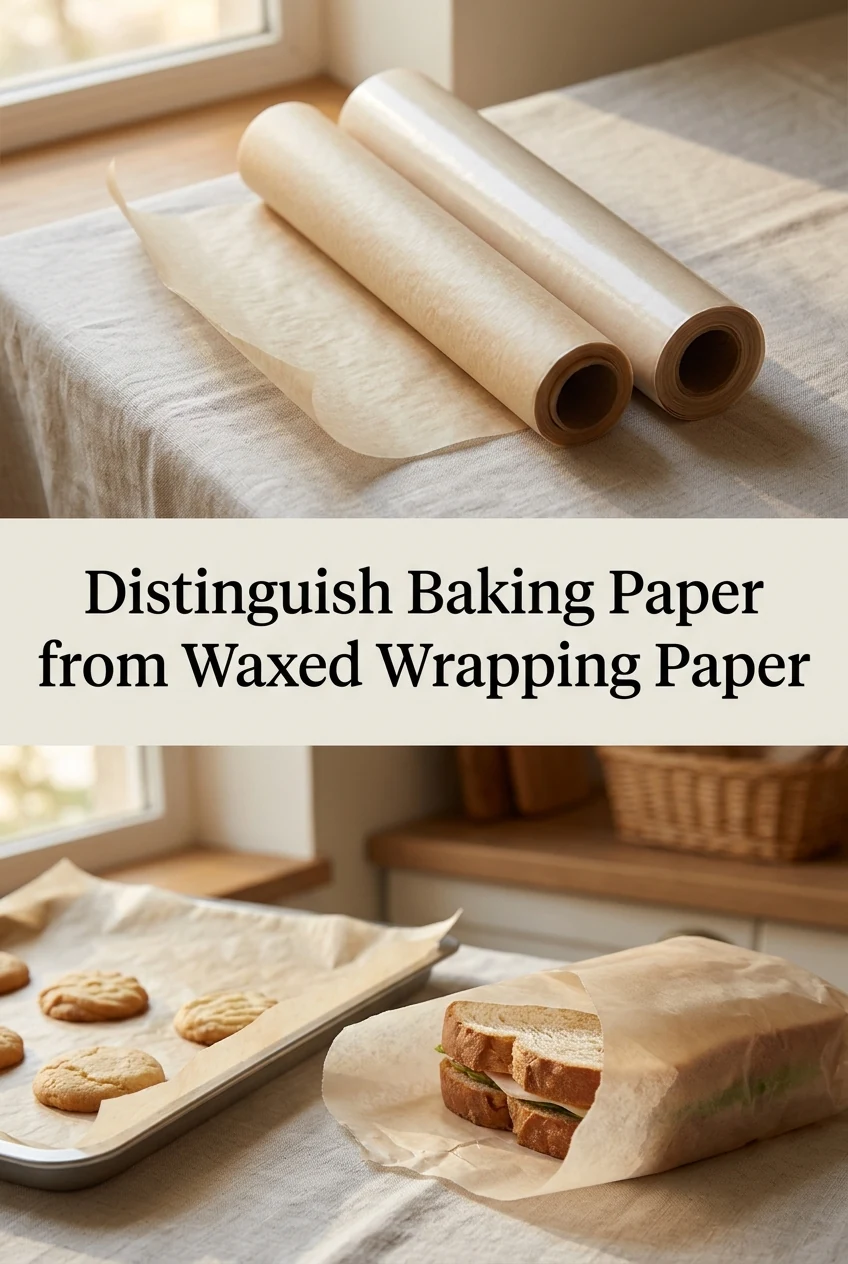
AI-generated editorial concept created for this article. The image is not a technical diagram or a tested result.
Read the Label Before You Unroll Anything
The single most reliable way to tell the two papers apart is to read what the manufacturer has printed on the box or the core of the roll. Baking paper, also called parchment paper, will state an oven-safe temperature range, commonly somewhere between 200 °C and 230 °C, and the packaging will use words such as 'non-stick baking liner' or 'oven-safe.' Waxed wrapping paper will state that it is intended for cold wrapping, food storage, or sandwich wrapping, and it will carry no oven temperature rating at all. If a box does not mention oven use, treat the product as unsuitable for baking. Do not infer heat tolerance from how a sheet looks or feels.
Physical Differences Worth Noting
Once you know what you are looking for, a few physical clues can support what the label already told you. Baking paper has a dry, slightly translucent surface that comes from a silicone coating applied during manufacture. Waxed paper has a faint sheen and feels slightly tacky or waxy when you press a fingernail lightly across it, because it is coated with a thin layer of paraffin or food-grade wax. Waxed paper also tears with a softer, almost crinkly sound, while baking paper tends to be a little stiffer and tears more cleanly. These clues are helpful for sorting unlabelled offcuts, but they are not a substitute for reading the original packaging before first use.
Appropriate Uses for Each Sheet
Baking paper is designed to line cake tins, baking trays, and loaf pans for oven use up to the temperature stated on its packaging. It resists grease and prevents baked goods from sticking without adding flavour. Waxed paper is well suited to wrapping sandwiches, lining a cold tray of sweets, separating layers of biscuits in a storage container, or placing under a cooling rack to catch drips at room temperature. It is also useful for rolling out dough on a cold surface because the wax reduces sticking without any oven step involved. Using waxed paper in a hot oven is not a safe substitute; the wax coating is not heat-stable and will begin to melt and smoke at oven temperatures.
A Worked Example: Lining a 20 cm Round Tin
This is an illustrative plan, not a kitchen-tested result. Suppose you are preparing a simple sponge and need to line a 20 cm round tin. First, locate the roll and read its label to confirm it states oven-safe use and carries a temperature rating that covers your intended baking temperature. Once confirmed as baking paper, place the tin base-down on the sheet and trace around it with a pencil, then cut just inside the line so the circle sits flat without riding up the sides. For the side strip, cut a length equal to the inner circumference of the tin, which for a 20 cm tin is approximately 63 cm (diameter multiplied by 3.14), and cut the strip to a height that matches the depth of the tin. Lightly brush the tin with a neutral oil, press the base circle in, then fit the side strip against the wall. The oil helps the paper stay in place before batter is added. If your recipe calls for alcohol-free vanilla flavoring, confirm the bottle is explicitly labelled as alcohol-free before adding it to your batter.
Storage and Handling After Baking
Once baking is complete, allow the item to cool on a rack before removing the baking paper. Peel the paper away gently to avoid breaking a delicate crust. Discard used baking paper after a single oven session; reusing a sheet that has absorbed grease and heat is not recommended. Any baked good containing dairy, eggs, or fresh fruit should be covered and refrigerated promptly once it has cooled to room temperature. Do not leave perishable bakes at room temperature for extended periods. Store unused rolls of baking paper and waxed paper in a dry cupboard away from heat sources, and keep each roll in its original labelled box so there is no confusion the next time you reach for a sheet.
A little more
to know.
Can I use waxed paper to line a tin if I grease it heavily first?
No. The issue is not sticking but heat tolerance. Waxed paper carries no oven-safe rating, and the wax coating is not designed to withstand oven temperatures. Adding grease does not change the properties of the coating. Use only paper that the manufacturer has explicitly rated for oven use at your intended temperature.
My baking paper roll has no box. How do I confirm it is oven-safe?
Check the core of the roll for any printed text, and look for any sticker or band still attached to the roll. If no temperature rating or oven-safe statement appears anywhere on the product, treat it as unconfirmed and do not use it in the oven. Purchase a new roll in its original packaging so you can read the manufacturer's stated heat limits before lining any tin.
Original editorial guidance and recipe formulations, not independently kitchen-tested. Times are estimates and depend on equipment and product directions. Cooked bases need additional cooling and refrigeration before cold serving. Images are AI-generated illustrations; appearance and yield may vary. Check actual ingredient labels, allergens, and any certification you require. We do not certify products. Read our approach.
Save to Pinterest ↗ANOTHER IDEA FOR THE COUNTER